

Many adults in New Hampshire with joint pain avoid surgery because they fear long recovery times and extended downtime. The good news is that minimally invasive surgery involves smaller incisions preserving muscle and soft tissue, offering faster healing and improved mobility compared to traditional open procedures. This guide explains what minimally invasive orthopedic surgery is, how it works, who benefits most, and what to expect during recovery so you can make an informed decision about your joint health.
Table of Contents
- What Is Minimally Invasive Orthopedic Surgery And How Does It Work?
- Advantages Of Minimally Invasive Surgery For Joint Pain Patients In New Hampshire
- Is Minimally Invasive Surgery Right For Your Joint Condition? Candidate Criteria Explained
- What To Expect During And After Minimally Invasive Joint Surgery: Recovery Insights
- Explore Advanced Minimally Invasive orthopedic Options In New Hampshire
- Frequently Asked Questions About Minimally Invasive Joint Surgery
Key takeaways
| Point | Details |
|---|---|
| Smaller incisions speed healing | Minimally invasive surgery uses tiny cuts that reduce tissue damage and accelerate recovery timelines. |
| Less pain and lower infection risk | Patients experience reduced postoperative discomfort and fewer complications than traditional open surgery. |
| Faster return to activities | Most people resume daily routines, work, and hobbies weeks sooner than with conventional procedures. |
| Suitable for common joint conditions | Effective for meniscus tears, cartilage damage, arthritis, and sports injuries in knee, shoulder, and hip. |
| Requires proper evaluation | Consultation with a New Hampshire orthopedic specialist determines candidacy based on your specific condition. |
What is minimally invasive orthopedic surgery and how does it work?
Minimally invasive orthopedic surgery refers to advanced techniques that repair joint damage through incisions typically measuring less than one centimeter. Surgeons insert a tiny camera called an arthroscope along with specialized instruments to visualize and treat the problem area without cutting through large sections of muscle or soft tissue. This approach contrasts sharply with traditional open surgery, which requires larger incisions and more extensive tissue disruption.
The arthroscope transmits high-definition images to a monitor, allowing the surgeon to navigate inside the joint with precision. For knee procedures, the surgeon may repair torn meniscus tissue, remove damaged cartilage, or reconstruct ligaments using this method. Shoulder surgeries address rotator cuff tears, labral damage, and impingement issues through similar small portals. Hip arthroscopy treats labral tears and removes bone spurs causing pain.
Because surrounding muscles and tissues remain largely intact, your body experiences significantly less trauma. Joint procedure examples demonstrate how preserving healthy tissue translates to reduced blood loss during surgery and lower infection risk afterward. Smaller wounds also mean minimal scarring, which many patients appreciate for both cosmetic and functional reasons.
The technology behind these procedures has evolved dramatically over the past decade. Modern arthroscopes provide crystal-clear visualization, while specialized instruments allow surgeons to perform complex repairs through openings smaller than a dime. Surgeons can suture torn ligaments, smooth rough cartilage surfaces, and remove inflamed tissue with remarkable accuracy.
Pro Tip: Ask your surgeon about the specific minimally invasive methods they use and their recovery expectations for your particular joint condition to set realistic goals and prepare appropriately.
Key advantages of minimally invasive techniques include:
- Preservation of healthy muscle and connective tissue surrounding the joint
- Reduced postoperative pain requiring less medication
- Lower risk of infection due to smaller surgical wounds
- Minimal scarring that heals faster and remains less visible
- Shorter hospital stays, often same-day discharge
Advantages of minimally invasive surgery for joint pain patients in New Hampshire
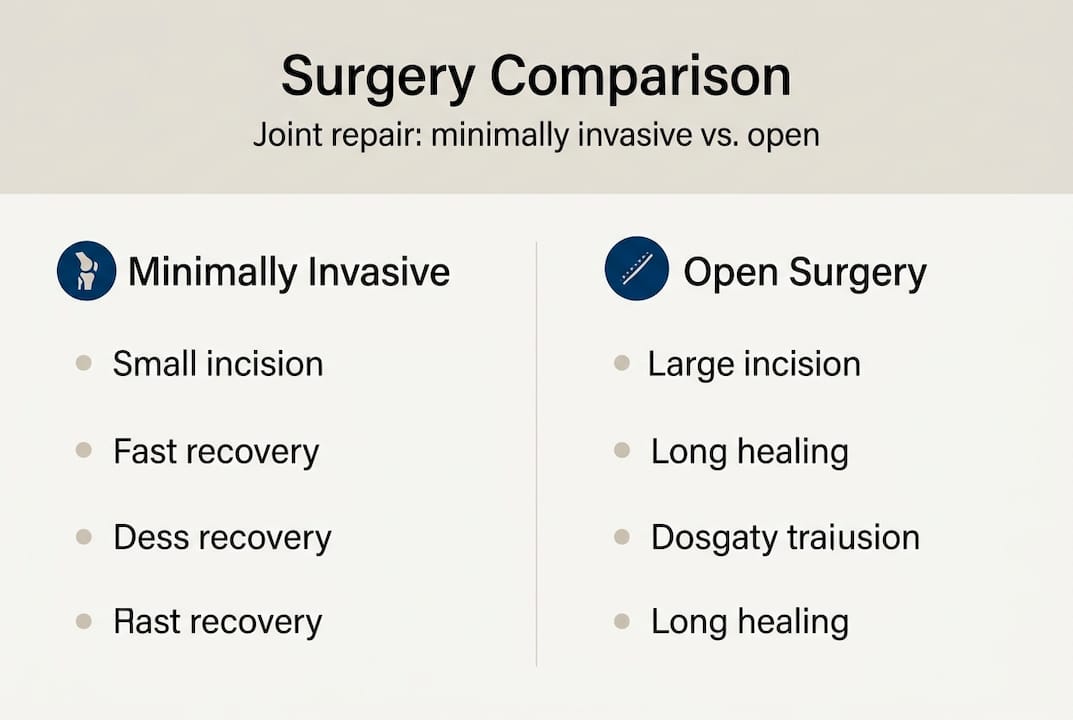
The benefits of minimally invasive surgery extend far beyond smaller scars. Patients benefit from faster recovery and less postoperative pain with minimally invasive techniques, which directly impacts your ability to return to work, hobbies, and daily activities. Understanding these advantages helps you appreciate why this approach has become the preferred option for many joint conditions.

| Factor | Minimally Invasive Surgery | Traditional Open Surgery |
|---|---|---|
| Incision size | Under 1 cm | 10-15 cm or larger |
| Hospital stay | Same day or overnight | 2-4 days typical |
| Recovery to daily activities | 2-4 weeks | 6-12 weeks |
| Postoperative pain level | Mild to moderate | Moderate to severe |
| Infection risk | Under 1% | 2-5% |
| Visible scarring | Minimal | Significant |
The reduced trauma to your body means less inflammation and swelling after surgery. You’ll likely need fewer pain medications and experience less stiffness during the healing process. Many patients report being able to move the affected joint more comfortably within days rather than weeks.
Shorter hospital stays translate to lower healthcare costs and reduced exposure to hospital-acquired infections. Most minimally invasive procedures allow you to go home the same day, recovering in the comfort of your own environment. This convenience matters significantly for adults juggling work responsibilities and family obligations.
For New Hampshire residents dealing with joint pain from osteoarthritis or sports injuries, the faster return to normal activities makes a substantial difference in quality of life. If you enjoy hiking, skiing, or other outdoor activities common in the region, minimally invasive surgery gets you back on the trails or slopes much sooner. The knee surgery recovery guide outlines specific timelines for various activity levels.
Key lifestyle benefits include:
- Quicker return to work, often within 1-2 weeks for desk jobs
- Earlier resumption of exercise and recreational activities
- Less disruption to family routines and caregiving needs
- Reduced need for extended time off or disability leave
- Lower overall medical expenses due to shorter recovery
The psychological impact shouldn’t be overlooked either. Knowing you’ll recover faster reduces anxiety about surgery and encourages people to address joint problems earlier rather than suffering through worsening pain. Early intervention often leads to better long-term outcomes and may prevent more extensive damage requiring complex procedures later. Comprehensive knee services incorporate both surgical and non-surgical options tailored to your specific needs.
Is minimally invasive surgery right for your joint condition? Candidate criteria explained
Not every joint problem requires or benefits from minimally invasive surgery. Proper evaluation is key to determining whether you’re a good candidate for this approach. Understanding the criteria helps you have more productive conversations with your orthopedic surgeon about treatment options.
Ideal candidates typically meet several criteria:
- Age and overall health status that support surgical healing, though minimally invasive techniques expand eligibility for older adults
- Specific joint conditions amenable to arthroscopic treatment, such as meniscus tears, ligament injuries, or cartilage damage
- Failure of conservative treatments like physical therapy, injections, or medications to provide adequate relief
- Absence of severe arthritis or extensive joint deterioration that would require joint replacement
- Realistic expectations about outcomes and commitment to post-surgical rehabilitation
- No significant medical conditions that increase surgical risks beyond acceptable levels
Common joint conditions successfully treated with minimally invasive surgery include meniscus tears in the knee, rotator cuff tears in the shoulder, labral tears in the hip, and loose bodies or bone spurs in various joints. Early-stage osteoarthritis may also benefit from arthroscopic debridement to remove damaged tissue and smooth rough surfaces causing pain.
Your surgeon will conduct a thorough evaluation including physical examination, review of your medical history, and diagnostic imaging such as X-rays or MRI scans. These tests reveal the extent of joint damage and help determine whether minimally invasive techniques can adequately address your specific problem. Some conditions require open surgery for complete repair, particularly when extensive reconstruction is necessary.
Age alone doesn’t disqualify you from minimally invasive surgery. Many older adults in their 60s, 70s, and beyond undergo successful arthroscopic procedures with excellent outcomes. The key factors are overall health, bone quality, and the nature of the joint problem rather than chronological age.
Previous surgeries on the same joint may complicate but don’t necessarily prevent minimally invasive approaches. Scar tissue and altered anatomy require experienced surgical skill to navigate safely. Choosing an orthopedic surgeon with extensive arthroscopic experience becomes especially important in these situations.
Pro Tip: Prepare questions about your specific condition and the surgeon’s experience with minimally invasive methods before your consultation to make the most of your appointment time and gather information for an informed decision.
Some joint problems remain better suited to traditional open surgery or joint replacement. Severe arthritis with bone-on-bone contact, large rotator cuff tears involving multiple tendons, or complex fractures may require more extensive surgical access. Your surgeon will explain why a particular approach is recommended for your situation and discuss all available options.
What to expect during and after minimally invasive joint surgery: recovery insights
Understanding the surgical experience and recovery process helps you prepare mentally and physically for minimally invasive joint surgery. Recovery involves less pain and quicker return to mobility supported by physical therapy, but knowing the timeline and milestones sets realistic expectations.
The surgical day typically unfolds as follows:
- Arrival at the surgical center 1-2 hours before your procedure for pre-operative preparation
- Meeting with the anesthesiologist to discuss sedation options, usually regional nerve blocks plus light sedation
- The actual surgery lasting 30-90 minutes depending on complexity
- Recovery room monitoring for 1-2 hours as anesthesia wears off
- Discharge home the same day with pain management instructions and mobility aids if needed
Immediate post-operative care focuses on managing swelling and discomfort. You’ll use ice, elevation, and prescribed medications to control pain during the first few days. Most patients describe the discomfort as manageable and significantly less than they anticipated. Nerve blocks provide excellent pain relief for the first 12-24 hours.
The first week involves rest and gentle movement to prevent stiffness. You’ll likely use crutches or a sling depending on which joint was treated. Follow all weight-bearing and movement restrictions carefully to protect the surgical repair. Many people return to light desk work within a week, though physical jobs require longer recovery.
| Recovery Milestone | Minimally Invasive Surgery | Traditional Open Surgery |
|---|---|---|
| Walking without aids | 1-2 weeks | 4-6 weeks |
| Return to desk work | 1-2 weeks | 4-6 weeks |
| Driving (if knee/hip) | 2-4 weeks | 6-8 weeks |
| Light exercise | 4-6 weeks | 10-12 weeks |
| Full activity/sports | 3-4 months | 6-9 months |
Physical therapy begins within the first week or two after surgery. Your therapist designs a progressive program to restore range of motion, rebuild strength, and improve joint stability. Consistent participation in therapy dramatically improves outcomes and reduces the risk of re-injury. Physical therapy expectations vary based on the specific procedure and your individual goals.
Swelling and bruising gradually diminish over 2-4 weeks. The small incisions heal quickly, with sutures typically removed after 7-10 days or dissolving on their own. You can usually shower within a few days, though soaking the incisions should be avoided until fully healed.
Most patients achieve significant improvement in pain and function within 6-12 weeks. Full recovery, including return to demanding sports or physical work, takes 3-6 months as tissues fully heal and strength returns to pre-injury levels or better. Patience during this phase prevents setbacks and ensures optimal long-term results.
At-home care contributes significantly to recovery success. Follow your surgeon’s instructions regarding activity restrictions, wound care, and medication schedules. Attend all follow-up appointments so your surgeon can monitor healing and address any concerns promptly. The knee surgery recovery guide provides detailed information for post-operative care specific to knee procedures.
Explore advanced minimally invasive orthopedic options in New Hampshire
If joint pain is limiting your activities or quality of life, exploring minimally invasive surgery options with an experienced orthopedic specialist makes sense. Nowak Orthopedic Associates in Hampton offers comprehensive evaluation and personalized treatment plans tailored to your specific condition and lifestyle goals. Dr. Nowak specializes in arthroscopic techniques for shoulder, knee, hip, elbow, and hand conditions, combining surgical expertise with complementary therapies for optimal outcomes.
The practice provides a full spectrum of care, from conservative treatments like physical therapy and injections to advanced surgical interventions when needed. The sports injury treatment workflow demonstrates how individualized assessment guides treatment decisions. For patients seeking non-surgical options, orthobiologic injections may provide relief and potentially delay or avoid surgery.
Scheduling a consultation allows you to discuss your symptoms, review diagnostic findings, and understand all available treatment options. Early evaluation often leads to better outcomes by addressing problems before they progress to more severe stages requiring complex intervention. Explore the full range of orthopedic services to learn how comprehensive care addresses your joint health needs.
Pro Tip: Early evaluation leads to better outcomes because addressing joint problems promptly prevents further damage and may allow less invasive treatment options.
Frequently asked questions about minimally invasive joint surgery
What makes minimally invasive surgery safer than traditional methods?
Minimally invasive surgery reduces infection risk because smaller incisions expose less internal tissue to potential contaminants. The preserved muscle and soft tissue also maintain better blood supply, promoting faster healing and reducing complications. Less surgical trauma means lower risk of blood clots and shorter anesthesia exposure.
How long does the minimally invasive surgery procedure usually take?
Most arthroscopic procedures take 30-90 minutes depending on the joint and complexity of the repair. Simple diagnostic arthroscopy may take as little as 20 minutes, while complex reconstructions like ACL repair can extend to 2 hours. Your surgeon will provide a specific time estimate based on your procedure.
Can older adults in New Hampshire undergo minimally invasive joint surgery?
Yes, age alone doesn’t disqualify candidates for minimally invasive surgery. Many patients in their 60s, 70s, and 80s successfully undergo arthroscopic procedures with excellent outcomes. The deciding factors are overall health status, bone quality, and the specific joint condition rather than chronological age.
What types of physical therapy support recovery after surgery?
Physical therapy begins with gentle range-of-motion exercises to prevent stiffness, then progresses to strengthening exercises as healing allows. Therapists use manual techniques, therapeutic exercises, and modalities like ultrasound or electrical stimulation to reduce pain and restore function. Your program is customized based on your procedure and goals.
How do I choose the right surgeon for minimally invasive orthopedic procedures?
Select a board-certified orthopedic surgeon with extensive experience performing arthroscopic procedures on your specific joint. Ask about their complication rates, patient outcomes, and how many similar procedures they perform annually. Choosing an orthopedic surgeon involves evaluating credentials, experience, communication style, and patient reviews to find the best fit for your needs.