

Most athletes assume that rest is the cornerstone of recovery after a sports injury. In reality, modern rehabilitation is a structured, active process built on evidence-based phases, targeted exercises, and criteria-driven progression. Simply waiting it out can actually slow your return to sport and increase reinjury risk. This guide walks you through the phases of rehab, what they look like for common injuries like hamstring strains and ACL tears, and the advanced strategies that are changing outcomes for athletes across New Hampshire and beyond.
Table of Contents
- Phased approach to sports injury rehabilitation
- Rehabilitation for common sports injuries
- Advanced rehabilitation strategies and their impact
- Setting realistic expectations in sports injury recovery
- What most athletes miss about sports injury rehabilitation
- Explore personalized rehabilitation and sports injury solutions
- Frequently asked questions
Key Takeaways
| Point | Details |
|---|---|
| Phased rehab matters | Effective recovery follows sequential phases from acute management to functional training. |
| Criteria-based progression | Advancing rehab based on functional milestones is safer than relying on time alone. |
| Modern strategies outperform rest | Eccentric exercises and active rehab techniques speed recovery and reduce reinjury risk. |
| Expectations must be realistic | Recovery timelines vary; most injuries are mild/moderate but severe cases like ACL rupture take months. |
Phased approach to sports injury rehabilitation
Rehabilitation is not a single event. It is a sequence of carefully structured phases, each building on the last. Understanding this framework helps you set expectations and stay committed when progress feels slow.
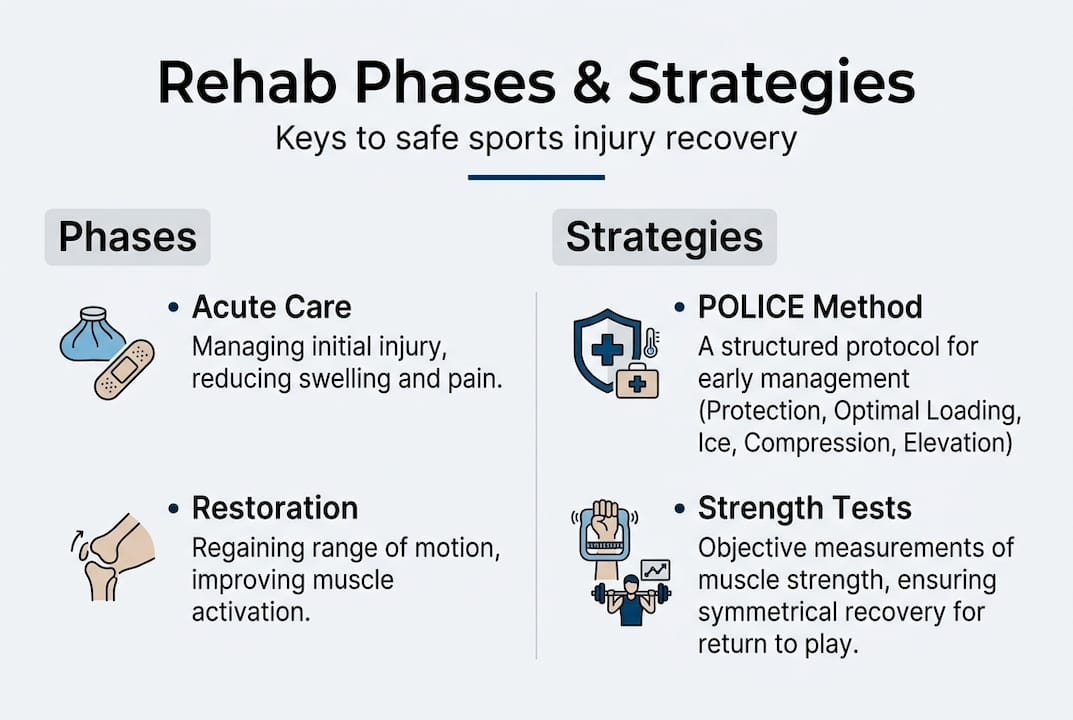
Sports injury rehabilitation typically begins with acute management using the RICE protocol (Rest, Ice, Compression, Elevation), then transitions through active therapy phases as healing progresses. The four main phases are:
| Phase | Timeframe | Primary Goal |
|---|---|---|
| Acute | Days 1-5 | Control swelling and pain |
| Subacute | Days 5-21 | Restore range of motion |
| Remodeling | Weeks 3-12 | Rebuild strength and tissue |
| Functional | Weeks 6 onward | Sport-specific movement |
What can you expect during each phase? Here is a quick breakdown:
- Acute phase: Ice, rest, and gentle compression. Pain and swelling are the focus.
- Subacute phase: Light movement, gentle stretching, and low-load exercise begin.
- Remodeling phase: Progressive resistance training, balance work, and neuromuscular control.
- Functional phase: Sport-specific drills, agility work, and return-to-play testing.
For a broader view of how this process is managed, the rehab workflow for athletes at Nowak Orthopedic Associates outlines the clinical steps from diagnosis to return to sport. You can also explore specific injury types and treatments to understand how phase length varies by injury severity.
The Medscape rehab treatment guide reinforces that early, guided movement within the first few days is critical for tissue healing and long-term function.
Pro Tip: One of the most common mistakes athletes make is staying in the acute phase too long. Delaying movement beyond five days, when clinically appropriate, can lead to muscle atrophy and stiffness that adds weeks to your recovery.
Rehabilitation for common sports injuries
With a clear view of rehab phases, let’s see what these look like for the most common sports injuries.
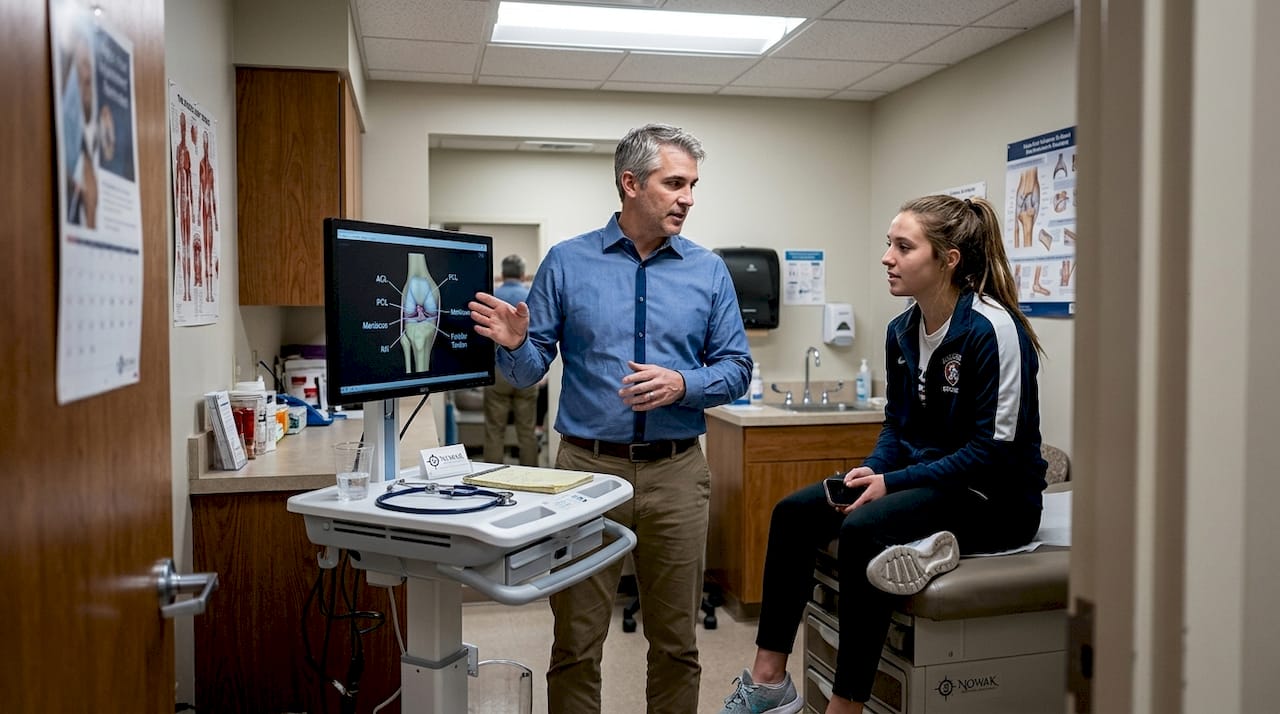
Not all injuries follow the same path. A Grade I hamstring strain and an ACL rupture require very different approaches, even though both involve the same general phases.
| Injury | Mild (Grade I) Timeline | Severe (Grade III) Timeline | Key Exercise |
|---|---|---|---|
| Hamstring strain | 1-3 weeks | 3-6 months | Nordic curl |
| ACL reconstruction | N/A | 10-15 months | Single-leg squat |
Hamstring strain rehab follows phased progression, while ACL rehab is criteria-based and averages 10-15 months. For ACL reconstruction specifically, criteria-based progression is now the standard, with a median return-to-sport time of 12 months.
Here is a numbered progression for hamstring rehab:
- Acute rest and ice for the first 48-72 hours.
- Gentle range-of-motion stretching starting around day 3.
- Isometric strengthening exercises in week 2.
- Progressive loading with eccentric training benefits such as Nordic curls in weeks 3-6.
- Sport-specific running drills once strength benchmarks are met.
For ACL recovery, reviewing physical therapy phases can help you understand what each visit should accomplish. Our [knee surgery recovery guide](https://www.nowakorthopedics.com/2026/03/07/how-to-recover-from knee surgery-2026-new-hampshire-guide/) also covers post-surgical expectations in detail. If hamstring tightness is a recurring issue, stretch therapy for hamstrings can be an effective adjunct to your program.
Pro Tip: Return-to-play decisions should never be based on time alone. Criteria-based clearance, including strength symmetry, movement quality, and psychological readiness, significantly reduces reinjury risk compared to calendar-based protocols.
Advanced rehabilitation strategies and their impact
Now that we have reviewed protocols for common injuries, here is how advanced strategies and new science are shaping rehab outcomes.
Traditional rest-based recovery is giving way to smarter, more targeted approaches. The shift from RICE to POLICE (Protection, Optimal Loading, Ice, Compression, Elevation) and even MEAT (Movement, Exercise, Analgesics, Treatment) reflects a growing understanding that early optimal loading is now preferred over prolonged rest.
Eccentric training is one of the most significant advances in modern rehab, reducing hamstring and ACL reinjury risk by 50-70%. This type of training, where the muscle lengthens under load, builds stronger, more resilient tissue than traditional concentric-only programs.
Other advanced modalities gaining traction include:
- Blood flow restriction (BFR) training: Builds muscle with lower loads, ideal in early rehab.
- Platelet-rich plasma (PRP) injections: Stimulate tissue repair at the injury site.
- Extracorporeal shockwave therapy (ESWT): Reduces chronic tendon pain and promotes healing.
- Nutritional support: Protein timing and anti-inflammatory foods accelerate tissue remodeling.
“Recovery is not passive. The body responds to the right kind of stress, applied at the right time, with the right intensity.”
Mental readiness also plays a larger role than most athletes expect. Fear of reinjury, low confidence, and anxiety about performance are known to delay return-to-sport decisions. A truly effective rehab program addresses these factors alongside physical benchmarks. Explore the full range of sports medicine services available to athletes in New Hampshire.
Pro Tip: Ask your provider directly: “What criteria do I need to meet before advancing to the next phase?” If the answer is only a date on the calendar, push for functional benchmarks instead.
Setting realistic expectations in sports injury recovery
Armed with advanced science, athletes should know what real-world recovery looks like, not just best-case scenarios.
Data from elite sport gives us a useful reference point. Most sports injuries in elite women’s football are mild or moderate, with absence of 28 days or fewer. Severe injuries account for only 8% of cases, though ACL rupture carries a median absence of 292 days.
| Injury Severity | Typical Absence | Key Recovery Factor |
|---|---|---|
| Mild (Grade I) | 1-7 days | Pain-free movement |
| Moderate (Grade II) | 8-28 days | Strength restoration |
| Severe (Grade III) | 28+ days | Criteria-based clearance |
Factors that speed recovery include early loading, strong psychological resilience, consistent sleep, and nutritional support. Factors that slow it include delayed treatment, poor movement patterns, and psychological fear of reinjury.
Benchmarks for a safe return to sport typically include:
- Limb symmetry index above 90% for strength and power.
- Full pain-free range of motion.
- Successful completion of sport-specific agility tests.
- Psychological readiness confirmed through validated questionnaires.
“ACL rupture median absence is 292 days, underscoring why criteria-based rehab matters more than optimistic timelines.”
For athletes in New Hampshire, following a structured local injury treatment workflow ensures you are progressing through the right benchmarks at the right time. Research on high-speed sports rehab continues to refine how we sequence these milestones.
What most athletes miss about sports injury rehabilitation
Here is our candid take: too many athletes treat rehab as something that happens to them rather than something they actively drive. They show up, follow instructions, and wait for clearance. That passive mindset is one of the biggest obstacles to a full, lasting recovery.
Criteria-based progression is safer and more effective, and multidisciplinary support including psychological readiness is essential but often overlooked. Yet most athletes never ask about their functional benchmarks or mental readiness scores.
Return-to-play is about function, not just time. Knowing your strength symmetry numbers, your movement quality scores, and your own confidence level gives you real agency in the process. Work with your multidisciplinary sports medicine team to track these markers, not just the date on a calendar.
Pro Tip: Bring a list of questions to every rehab appointment. Ask what benchmark you need to hit before your next phase. Active participation in your own recovery consistently produces better outcomes.
Explore personalized rehabilitation and sports injury solutions
For those in New Hampshire seeking hands-on support, Nowak Orthopedic Associates offers a structured path from injury to full function. You can review a detailed sports injury treatment workflow tailored to athletes in our region. If you are looking for non-surgical options, our orthobiologic injections including PRP can support tissue healing and reduce recovery time. Connect with our sports medicine team to build a personalized plan that matches your injury, your goals, and your timeline.
Frequently asked questions
How soon should movement begin after a sports injury?
Movement typically begins within one to five days following the acute RICE or PRICE phase, transitioning to guided low-impact activity as pain and swelling allow.
What is the difference between time-based and criteria-based rehab?
Criteria-based rehab uses functional benchmarks such as strength levels and psychological readiness to guide progression, while time-based rehab relies only on elapsed days, which is less reliable and carries higher reinjury risk.
How long is recovery for a severe sports injury like ACL rupture?
ACL rupture recovery typically takes 10-15 months, with a median return-to-sport of around 12 months, depending on meeting specific functional criteria at each phase.
Are advanced rehab strategies like eccentric training better?
Yes. Research shows that eccentric training reduces hamstring reinjury risk by up to 70% and improves functional outcomes significantly compared to traditional rest-only or passive protocols.