

TL;DR:
- Complete clinical information and documented conservative treatments are essential before referral.
- Verify insurance requirements and obtain prior authorizations early to prevent claim denials.
- Clear communication and shared decision-making improve patient engagement and care outcomes.
When an incomplete referral lands on a specialist’s desk, the patient waiting for knee or shoulder care pays the real price. Missing imaging, undocumented conservative treatment attempts, or the wrong insurance authorization can push a patient’s appointment back by weeks. For primary care physicians and specialists across New Hampshire, a well-structured referral process is not a formality. It is a direct extension of patient care, and getting it right the first time protects both your patient and your practice.
Table of Contents
- Prepare a complete clinical picture before referral
- Verify conservative management before referring
- Follow specialist referral requirements in New Hampshire
- Collaborate with patients and specialists for best outcomes
- Our perspective: Rethinking referrals as a collaborative process
- Learn more or refer with Nowak Orthopedics
- Frequently asked questions
Key Takeaways
| Point | Details |
|---|---|
| Comprehensive documentation | Full patient history, pain, function, and treatment attempts ensure fast, effective referrals. |
| Prior conservative care | Always document failed non-surgical efforts like PT and NSAIDs before referring non-urgent cases. |
| Know insurance rules | Refer according to NH-specific insurance requirements and distinguish elective from urgent scenarios. |
| Collaborative process | Involve patients and communicate fully with orthopedic specialists for optimal outcomes. |
Prepare a complete clinical picture before referral
A strong orthopedic referral begins long before you pick up the phone or submit a form. The orthopedic specialist needs a clear, complete picture of your patient’s condition to triage appropriately and plan an efficient first visit. Without that foundation, the process stalls.
Before initiating a referral, gather the following:
- Pain characteristics: Location, onset, duration, and aggravating or relieving factors
- Functional limitations: What activities the patient can no longer perform and how this affects daily life or work
- Prior treatments: Medications tried, physical therapy attended, and any injections received
- Relevant imaging: X-rays, MRI, or ultrasound results with dates and radiology reports
- Medical history: Comorbidities, current medications, allergies, and prior surgeries
- Patient goals: Whether the patient is open to surgery, their activity demands, and their recovery expectations
Comprehensive patient information before referral, including pain assessment, functional limitations, prior conservative treatments, medical history, imaging, and patient expectations, gives the receiving specialist everything needed to move forward without delays.
A common mistake is ordering an MRI before the referral simply to appear thorough. Unless there is a specific clinical indication, unnecessary imaging adds cost and rarely changes the specialist’s initial evaluation plan. Send what you have and let the orthopedic team guide further workup.
Pro Tip: Ask the patient directly: “Would you consider surgery if it was recommended?” Documenting this answer shapes the entire referral narrative and helps the specialist prioritize their consultation approach.
| Referral element | Complete referral | Incomplete referral |
|---|---|---|
| Pain description | Detailed, with timeline | Vague or absent |
| Functional impact | Specific limitations noted | Not documented |
| Conservative care | Treatments listed with outcomes | Missing or unclear |
| Imaging | Reports attached | Ordered but not sent |
| Patient goals | Clearly stated | Not addressed |
Exploring pre-referral treatments with your patient before submitting the referral also strengthens the documentation trail and supports the specialist’s planning.
Verify conservative management before referring
Once a complete clinical picture is established, focus on demonstrating that appropriate conservative measures were attempted. Most payers and orthopedic specialists expect a documented trial of conservative care before elective surgical consultation, particularly for musculoskeletal conditions like osteoarthritis (OA) or tendinopathy.
A stepped-care approach works best. Follow this sequence and document each step:
- Activity modification: Reduce or adjust activities that aggravate the condition
- NSAIDs or analgesics: Documented trial with duration and patient response
- Physical therapy: Minimum 4 to 6 weeks with attendance records and progress notes
- Weight management: Relevant for knee and hip OA; document BMI and any counseling provided
- Corticosteroid or other injections: If appropriate, note the type, date, and patient response
- Failure documentation: Record why each step did not provide adequate relief
A stepped-care approach means trying core treatments first and documenting failures and functional limitations, not just pain complaints, before referral.
This distinction matters. Payers and specialists want to see that the patient’s function is meaningfully impaired, not just that they report discomfort. Phrases like “patient unable to climb stairs” or “cannot return to work as a carpenter” carry more weight than “patient reports knee pain.”
Avoid ordering advanced imaging such as MRI without a clear indication at this stage. Plain X-rays are usually sufficient for initial OA or injury evaluation. Reviewing physical therapy documentation standards can help you understand what orthopedic specialists expect to see in the records you send.
Pro Tip: If a patient declines physical therapy for financial or logistical reasons, document that conversation. Refusal is still a clinical data point and protects you if a payer questions the referral.
Follow specialist referral requirements in New Hampshire
Proper preparation leads to the crucial question: what do payers, local health networks, and specialists expect for New Hampshire referrals in 2026?
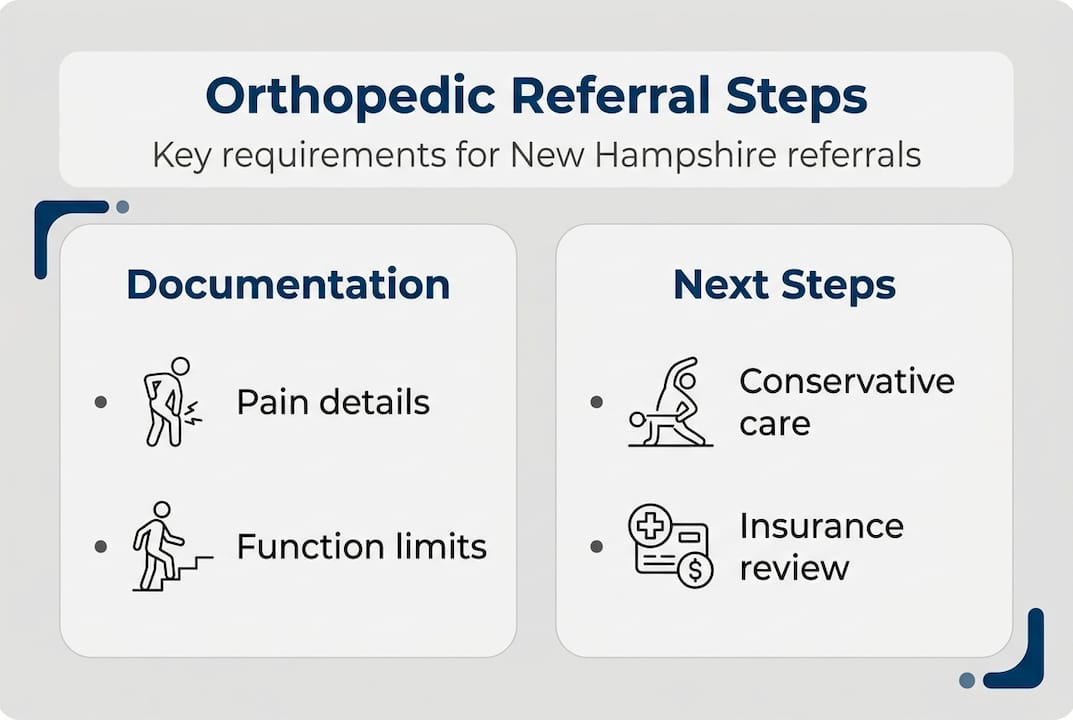
Insurance requirements vary by plan type. For Medicare Advantage HMO plans in New Hampshire, a PCP referral is required before specialist visits, with certain exceptions for urgent care. Failing to obtain this authorization in advance can result in denied claims for both the patient and the specialist.
Key steps for referral submission in New Hampshire:
- Check the patient’s plan type: HMO plans require prior referral; PPO plans typically do not
- Obtain prior authorization early: Submit documentation before the appointment, not after
- Use the correct referral codes: Confirm CPT and ICD-10 codes with your billing team
- Confirm network participation: Verify the orthopedic specialist is in-network for the patient’s plan
- Document the submission: Keep a record of referral approval numbers and submission dates
Reviewing insurance referral requirements specific to New Hampshire can help you avoid common authorization errors.
| Scenario | Pathway | Action needed |
|---|---|---|
| Elective joint pain consult | Standard referral | Prior auth, full documentation |
| Acute sports injury | Expedited referral | Notify specialist directly, same-day if possible |
| Suspected infection (septic joint) | Urgent/emergent | Direct ED or specialist contact, no delay |
| Acute fracture | Urgent referral | Call specialist, send imaging immediately |
For urgent situations such as suspected septic arthritis, acute fractures, or severe ligament injuries, do not wait for insurance paperwork. Contact the orthopedic office directly by phone and send records simultaneously.
Collaborate with patients and specialists for best outcomes
Having ensured compliance and logistics, focus now shifts to working with patients and specialists for the smoothest handoff. A referral is only as effective as the communication surrounding it.

Shared decision-making is essential before the referral is submitted. Patients who understand why they are being referred, what to expect at the specialist visit, and what treatment options may be discussed are far more likely to follow through and engage meaningfully with their care.
Best practices for effective collaboration:
- Set clear expectations: Tell patients the specialist will review all options, including non-surgical ones
- Send complete records electronically: Use secure messaging or patient portals to transfer notes, imaging, and labs before the appointment
- Communicate directly with the specialist: A brief phone call or clinical summary note for complex cases reduces back-and-forth
- Follow up after the consult: Ask the patient what was discussed and whether a treatment plan was initiated
- Stay engaged: Orthopedic care often involves ongoing management; your role does not end at the referral
Shared decision-making on surgery risks and benefits is a priority when referring to local orthopedic centers, and direct communication by phone or online scheduling helps streamline the process.
For patients with sports injuries, understanding the sports injury referral process in New Hampshire helps you set accurate timelines and recovery expectations with athletes and active patients.
Pro Tip: After the specialist visit, request a copy of the consultation note. This keeps your records current and ensures any recommended follow-up lands back in your care plan.
Our perspective: Rethinking referrals as a collaborative process
At Nowak Orthopedic Associates, we see firsthand how the quality of a referral shapes the entire care experience. A well-documented referral does not just speed up scheduling. It tells us what the patient has already been through, what they are hoping for, and where we can add the most value.
Research consistently shows that delayed orthopedic care leads to worse functional outcomes, particularly for conditions like rotator cuff tears and ACL injuries. The difference between a two-week and a six-week wait often comes down to documentation completeness. Reviewing joint procedure outcomes reinforces why early, well-supported referrals matter so much. We encourage you to view every referral as a clinical handoff, not an administrative checkbox.
Learn more or refer with Nowak Orthopedics
Ready to streamline your orthopedic referrals or need assistance for a specific case? Nowak Orthopedic Associates in Hampton, NH supports referring providers with clinical resources, efficient scheduling, and direct communication for complex cases. Whether your patient needs evaluation for a sports injury, joint pain, or a condition that may respond to non-surgical care, we are here to help. Explore our sports medicine care, review our step-by-step relief guide, or learn about our regenerative clinic for patients who want to avoid surgery.
Frequently asked questions
What documentation is most critical for an orthopedic referral?
Comprehensive patient information including pain details, functional limitations, failed conservative treatments, past imaging, and patient goals gives the specialist everything needed to move forward without delays.
Are prior physical therapy or medications always required before referral?
Most cases require documented conservative management attempts unless urgent intervention is needed for acute injuries, fractures, or suspected infections.
What are urgent orthopedic referral situations?
Acute fractures, severe ligament injuries, or suspected septic arthritis require immediate referral. Do not delay for urgent ortho care situations to clear insurance paperwork first.
How do insurance requirements affect orthopedic referrals in New Hampshire?
Medicare Advantage HMO and similar plans in New Hampshire require a PCP referral before specialist visits unless the situation is urgent; always verify the patient’s specific plan rules before submitting.