

TL;DR:
- Fellowship-trained elbow surgeons have specialized knowledge leading to more accurate diagnosis and better outcomes.
- Most elbow conditions can be initially treated non-surgically, with surgery reserved for persistent cases.
- Minimally invasive techniques offer faster recovery, less pain, and fewer complications for suitable candidates.
Most people assume any orthopedic doctor can handle an elbow problem just as well as a specialist. That assumption can cost you months of unnecessary pain. Elbow orthopedic surgeons bring focused training in joint-specific anatomy, biomechanics, and procedures that general orthopedists simply do not practice every day. Whether you are a weekend tennis player in Hampton dealing with persistent lateral pain or an athlete recovering from a ligament tear, the right specialist makes a measurable difference in how fast and how fully you recover.
Table of Contents
- What defines an elbow orthopedic surgeon?
- Common elbow conditions treated by specialists
- Current treatment approaches: non-surgical to surgical options
- Elbow care for athletes: sports injuries and advanced interventions
- Minimally invasive elbow surgery: what to know in 2026
- Our perspective: the specialist gap is real, and it matters
- Ready to get the right care for your elbow?
- Frequently asked questions
Key Takeaways
| Point | Details |
|---|---|
| Expertise matters | Elbow orthopedic surgeons bring advanced training tailored to complex injuries and conditions. |
| Treatment is stepwise | Non-surgical methods come first, with surgery reserved for when they’re truly needed. |
| Minimally invasive is rising | Modern surgery often means less pain and faster recoveries, especially for eligible patients. |
| Athlete focus | Specialists help athletes return to play with personalized procedures and rehab plans. |
| Local access | New Hampshire residents can find expert elbow care without traveling far. |
What defines an elbow orthopedic surgeon?
Elbow orthopedic surgeons are fellowship-trained physicians, meaning they completed additional specialty training beyond a standard orthopedic residency. That extra step is not a formality. It means they spend focused time mastering the anatomy and surgical techniques specific to the elbow, a joint that is far more complex than most people realize.
The elbow is a hinge joint formed by three bones: the humerus (upper arm), radius, and ulna (forearm). According to elbow biomechanics research, elbow orthopedic surgeons specialize in diagnosing and treating conditions using advanced knowledge of this joint, including ligaments like the ulnar collateral and the muscles and tendons that control stability and motion. When any of these structures fails, the consequences ripple into your grip strength, throwing mechanics, and daily function.
What separates a specialist from a generalist comes down to depth of experience:
- Mastery of elbow-specific nerve anatomy (ulnar, radial, and median nerves all cross the elbow)
- Proficiency in both arthroscopic and open elbow procedures
- Ability to manage complex or failed prior surgeries
- Understanding of how elbow mechanics affect the shoulder and wrist
“The elbow is often undertreated because patients and even some physicians underestimate its complexity. A fellowship-trained specialist sees patterns that a generalist may miss entirely.”
If you are exploring advanced joint care or wondering how to evaluate your options, understanding this distinction is the first step. You can also review guidance on choosing an orthopedic surgeon in New Hampshire before your first appointment.
Common elbow conditions treated by specialists
With the basics covered, you will want to know what specific elbow problems a surgeon can address and when you should seek their help. Not every elbow ache requires a specialist, but certain conditions do not resolve without one.
Elbow injuries treated by specialists include tennis elbow, golfer’s elbow, fractures, dislocations, arthritis, tendon tears, ulnar nerve entrapment, cubital tunnel syndrome, and joint instability. Each of these has a distinct cause, population at risk, and treatment pathway.
Here is a quick look at who tends to develop these conditions:
- Tennis elbow (lateral epicondylitis): Affects painters, carpenters, and racquet sport players
- Golfer’s elbow (medial epicondylitis): Common in golfers, baseball pitchers, and manual laborers
- Cubital tunnel syndrome: Affects people who bend their elbow repeatedly or sleep with arms flexed
- UCL tears: Seen most often in overhead throwing athletes
- Elbow arthritis: Affects older adults and those with prior fractures or dislocations
| Condition | Key symptom | When to see a specialist |
|---|---|---|
| Tennis elbow | Outer elbow pain with gripping | After 6 weeks of no improvement |
| Golfer’s elbow | Inner elbow pain, weak grip | Persistent pain with activity |
| Cubital tunnel syndrome | Numbness in ring and pinky fingers | Any nerve symptoms |
| UCL tear | Instability during throwing | Immediately for athletes |
| Elbow fracture or dislocation | Acute pain, swelling, deformity | Emergency evaluation |
You can review the full range of elbow treatments available to understand what care options apply to your specific diagnosis.
Current treatment approaches: non-surgical to surgical options
Identifying your condition is only the start. Knowing what treatment paths exist sets expectations and empowers you as a patient. The good news is that most elbow conditions are treated without surgery, at least initially.
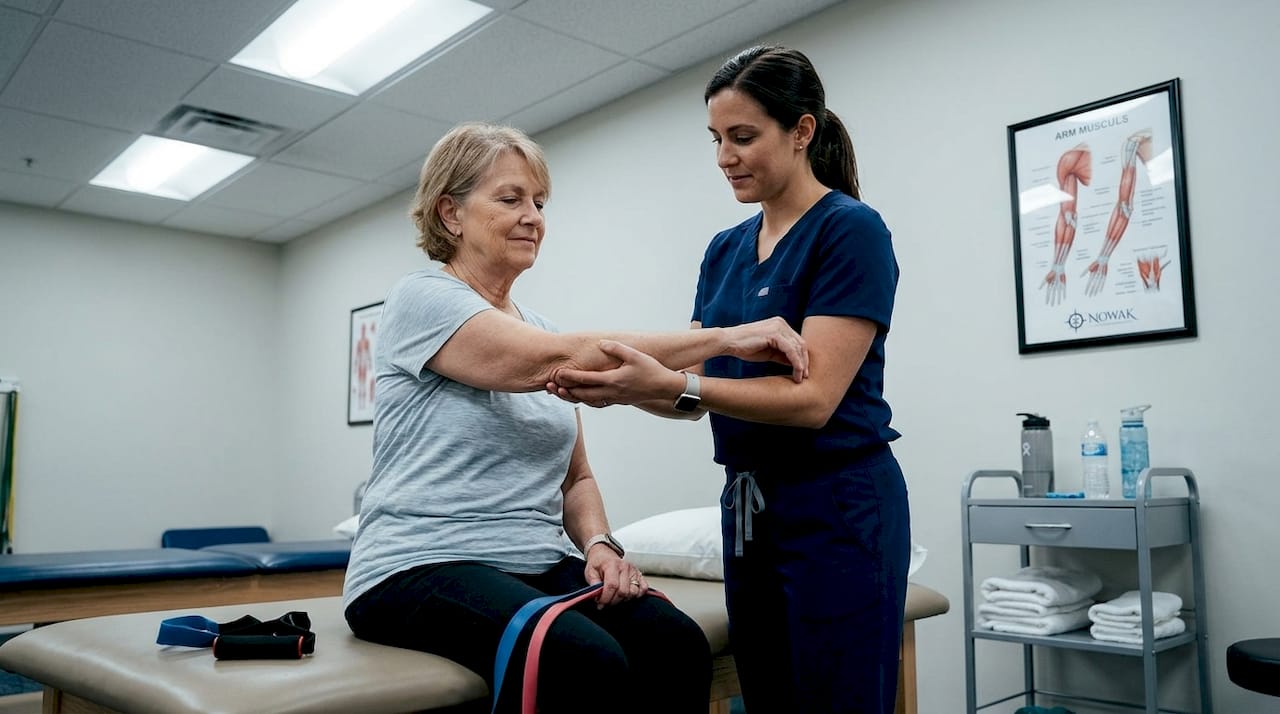
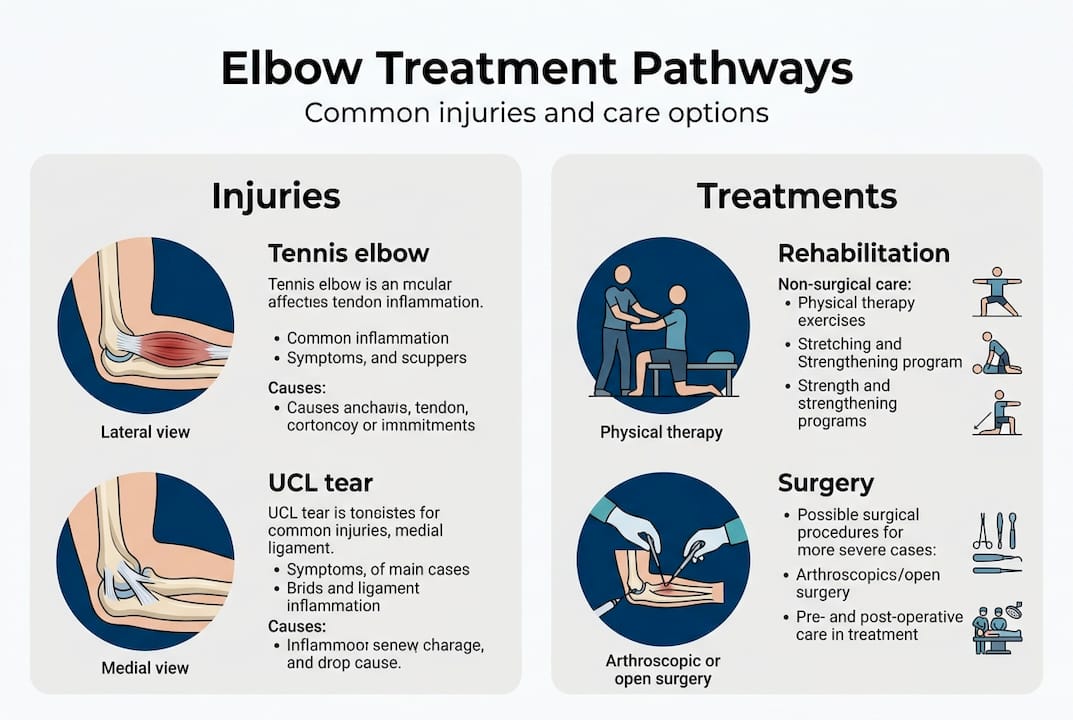
Modern elbow care follows a clear progression. Treatment techniques used by specialists include non-operative approaches first, such as rest, physical therapy, and injections, followed by surgical options like arthroscopic debridement, ligament reconstruction, fracture repair, nerve decompression, and in severe cases, total elbow arthroplasty or radial head replacement. Minimally invasive WALANT (wide awake local anesthesia no tourniquet) techniques are increasingly common.
A typical patient care pathway looks like this:
- Initial evaluation: Imaging, physical exam, and diagnosis
- Conservative care: Rest, activity modification, and physical therapy
- Injections: Corticosteroid or PRP injections to reduce inflammation
- Reassessment: If symptoms persist beyond 3 to 6 months, surgical options are discussed
- Minimally invasive surgery: Elbow arthroscopy or WALANT procedures when appropriate
- Open surgery: Reserved for complex fractures, ligament reconstruction, or joint replacement
- Rehabilitation: Structured physical therapy to restore strength and motion
Pro Tip: Many patients push for surgery too soon. Giving non-surgical care a genuine 3 to 6 month trial, with consistent physical therapy, resolves the majority of overuse injuries. Rushing to the operating room before exhausting non-surgical options often leads to longer overall recovery times.
Elbow care for athletes: sports injuries and advanced interventions
Athletes and high-demand individuals often need more targeted expertise. Here is how specialists approach elbows in sports settings.
Elbow care for athletes involves specialized management of UCL reconstruction (commonly called Tommy John surgery), tendon repairs, arthroscopy for impingement, and a strong focus on return-to-sport timelines. Sports medicine orthopedic surgeons who specialize in the elbow understand the mechanical demands of throwing, swinging, and racquet sports in ways that generalists do not.
| Procedure | Target athlete | Typical return to sport |
|---|---|---|
| UCL reconstruction (Tommy John) | Baseball pitchers, quarterbacks | 12 to 18 months |
| Elbow arthroscopy (debridement) | Overhead athletes, gymnasts | 3 to 6 months |
| Lateral epicondylectomy | Tennis players, golfers | 3 to 4 months |
| Triceps tendon repair | Weightlifters, linemen | 4 to 6 months |
| Cubital tunnel release | Throwing athletes | 2 to 4 months |
Long-term joint health is part of the conversation too. A good elbow specialist does not just fix the immediate injury. They address the mechanics that caused it, so you are not back in the office a year later with the same problem.
Pro Tip: If you are an athlete with a complex elbow injury, ask specifically whether your surgeon is fellowship-trained in sports medicine or upper extremity surgery. General orthopedists may be excellent, but high-demand cases benefit from a specialist who manages these injuries regularly. You can also explore sports injury rehab and NH sports injury options to plan your recovery path.
Minimally invasive elbow surgery: what to know in 2026
With sports and everyday injuries covered, many patients ask: can these problems be fixed less invasively? The answer is yes, and the options have expanded significantly.
Elbow arthroscopy uses small incisions and a tiny camera to visualize and treat the joint from the inside. WALANT is a technique that uses only local anesthesia, allowing patients to remain awake and avoid general anesthesia risks entirely. Minimally invasive techniques are associated with lower complication rates compared to open surgery in certain conditions, particularly elbow stiffness and loose body removal.
Benefits of minimally invasive elbow surgery include:
- Less post-operative pain and swelling
- Shorter hospital stay, often same-day discharge
- Faster return to daily activities
- Reduced risk of infection and scarring
- Better visualization of joint structures during the procedure
Not every patient qualifies. Severe fractures, complete ligament tears, or advanced arthritis may still require open techniques. But for conditions like loose bodies, early contracture, synovitis (joint lining inflammation), and mild impingement, minimally invasive joint surgery is often the preferred first surgical option.
Our perspective: the specialist gap is real, and it matters
We see patients regularly who spent months bouncing between providers before getting an accurate diagnosis and a plan that actually worked. The specialist gap in elbow care is not a marketing concept. It is a clinical reality. General orthopedic doctors are skilled and valuable, but elbow injuries, especially nerve-related conditions and sports injuries, have nuances that require focused expertise.
What we have found is that patients who see an elbow-focused surgeon earlier tend to avoid unnecessary procedures and recover faster. The instinct to start with whoever is available is understandable, but for persistent or complex elbow pain, it often adds time and frustration to the process. Seeking subspecialty care early is not overreacting. It is smart patient advocacy.
Ready to get the right care for your elbow?
At Nowak Orthopedic Associates in Hampton, NH, Dr. Roger B. Nowak provides board-certified orthopedic care with a focus on minimally invasive techniques for elbow conditions including cubital tunnel release, lateral and medial epicondylectomy, and triceps tendon repair. Beyond surgery, our Regenerative Medicine Clinic offers PRP injections, SoftWave therapy, and guided stretch therapy for patients who want to explore non-surgical healing. If you are dealing with elbow pain that is not improving, visit nowakorthopedics.com to schedule an evaluation and get a personalized treatment plan built around your goals.
Frequently asked questions
What makes an elbow orthopedic surgeon different from a general orthopedic doctor?
Elbow orthopedic surgeons have fellowship-level training in elbow-specific anatomy and complex procedures that go beyond what general orthopedists practice routinely. This depth of focus leads to more accurate diagnoses and better outcomes for difficult cases.
How do I know if I need surgery for my elbow pain?
Surgery is typically considered after non-operative treatments like physical therapy and injections have been tried for several months without adequate relief. An elbow specialist will evaluate your diagnosis, activity level, and imaging before recommending any procedure.
What are the benefits of minimally invasive elbow surgery?
Minimally invasive techniques are linked to lower complication rates compared to open surgery in select conditions, along with less pain, faster recovery, and same-day discharge for many patients.
Can athletes return to their sport after elbow surgery?
Yes. With specialized surgical care and a structured rehabilitation program, most athletes return to full sport participation, though timelines vary by procedure and sport demands.
Are there local elbow specialists in New Hampshire?
Yes, New Hampshire has fellowship-trained elbow orthopedic surgeons serving the region. Local specialists handle both routine and advanced elbow cases, so you do not need to travel out of state for high-quality care.