

TL;DR:
- Minimally invasive elbow surgery involves small incisions using cameras and specialized tools.
- Benefits include lower pain, faster recovery, and fewer complications compared to open surgery.
- Suitable candidates are those with mild to moderate conditions, while severe deformities may need open procedures.
Many adults assume that elbow surgery means a long scar, weeks in a sling, and months away from normal life. That assumption is outdated. Minimally invasive elbow procedures have reshaped what patients can realistically expect, from shorter hospital stays to faster returns to work and recreation. This guide walks you through what these procedures actually involve, who qualifies, how they compare to traditional open surgery, and what recovery genuinely looks like, so you can have an informed conversation with your surgeon.
Table of Contents
- What is minimally invasive elbow surgery?
- How minimally invasive elbow surgery is performed
- Benefits and risks: Comparing minimally invasive and open elbow surgery
- Who is a good candidate? Selection and safety considerations
- What to expect after surgery: Recovery and outcomes
- Our perspective: What most articles don’t tell you about minimally invasive elbow surgery
- Ready to explore minimally invasive elbow care?
- Frequently asked questions
Key Takeaways
| Point | Details |
|---|---|
| Less invasive options | Modern elbow surgery means smaller incisions and faster recovery for many conditions. |
| Better outcomes, fewer risks | Minimally invasive approaches often result in less pain, lower complication rates, and quicker return to function. |
| Expertise matters | Surgeon skill and careful patient selection are key for optimal, safe results. |
| Not for every case | Some severe elbow issues still require traditional open surgery for the best outcomes. |
What is minimally invasive elbow surgery?
Minimally invasive elbow surgery refers to procedures performed through small incisions, typically less than one centimeter, that limit disruption to surrounding muscles, tendons, and skin. Rather than opening the entire joint, surgeons work through narrow entry points called portals, using specialized cameras and instruments to see and treat the problem inside.
There are two primary approaches:
- Elbow arthroscopy: A tiny camera called an arthroscope is inserted into the joint, projecting a magnified image of the interior onto a monitor. Additional portals allow instruments to remove loose bone fragments, release scar tissue, or address inflammation.
- Mini-open techniques: For conditions like elbow contracture, surgeons may use mini-open incisions of 3 to 5 cm, balancing reduced tissue trauma with the visibility needed for more complex releases.
Common conditions treated this way include loose bodies (bone or cartilage fragments floating in the joint), elbow contractures (stiffness from scar tissue), mild arthritis, tennis elbow, and post-injury inflammation.
One important caveat: the elbow is one of the most anatomically demanding joints to work inside. Nearby neurovascular structures require specialized surgeon expertise to navigate safely. This is not a procedure where surgeon experience is optional. Learning more about minimally invasive joint surgery can help you understand what separates a skilled specialist from a generalist.
How minimally invasive elbow surgery is performed
Next, let’s look at exactly how these advanced procedures are carried out, step by step.
- Anesthesia: Most procedures use regional or local anesthesia, meaning you are comfortable but often awake. General anesthesia is used in select cases.
- Positioning: You are positioned carefully to give the surgeon optimal access to the joint while protecting surrounding nerves.
- Portal creation: Small entry points are made at precise locations around the elbow. Placement matters enormously because the ulnar and radial nerves run very close to standard portal sites.
- Camera insertion: The arthroscope is guided into the joint. The surgeon views a real-time, magnified image of the cartilage, synovium, and bone on a monitor.
- Treatment: Additional instruments enter through secondary portals to remove loose bodies, release contractures, smooth damaged cartilage, or address other findings.
- Closure: Portals are closed with a single suture or small bandage. Most patients go home the same day.
The outpatient nature of this procedure is one of its clearest advantages. You are not admitted to a hospital ward; you recover at home, often starting gentle movement within 24 hours.
Pro Tip: Ask your surgeon specifically how many elbow arthroscopies they perform per year. Volume matters more in the elbow than in almost any other joint because of how close the nerves are to standard working portals.
For a deeper look at what this procedure involves, the elbow arthroscopy guide and our full list of elbow surgery treatments are good starting points.
Benefits and risks: Comparing minimally invasive and open elbow surgery
Having seen the surgical process, it’s natural to wonder how minimally invasive techniques truly compare to traditional open surgery.
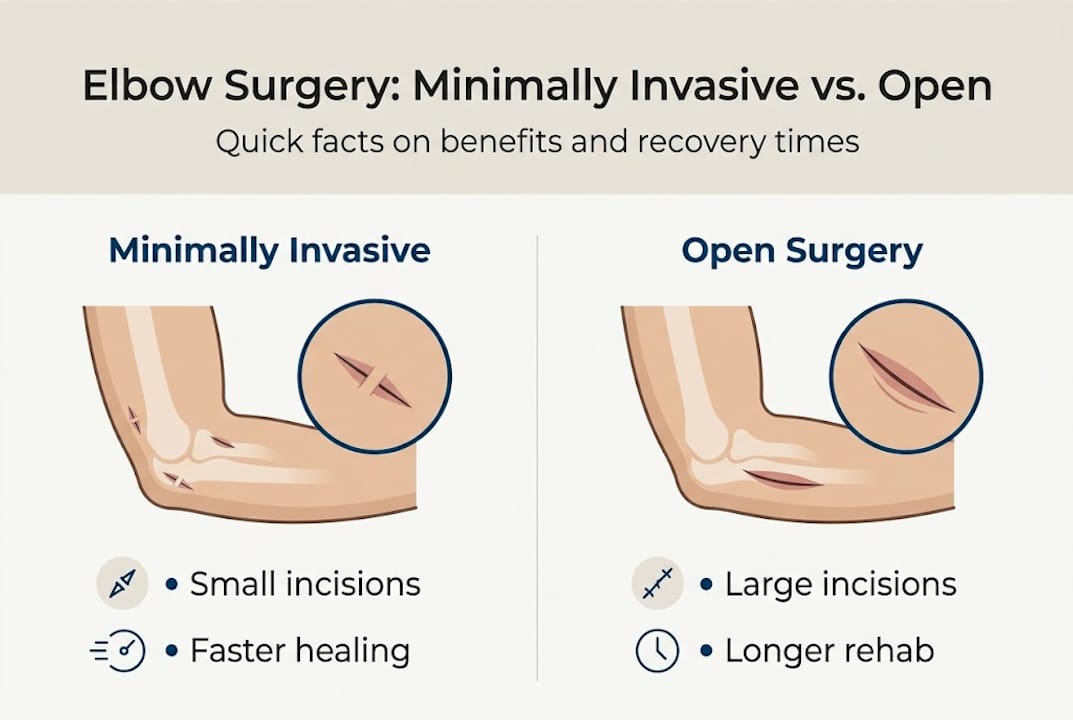
| Factor | Minimally invasive | Open surgery |
|---|---|---|
| Incision size | Less than 1 cm portals | Several centimeters |
| Pain level | Lower | Higher |
| Recovery speed | Faster | Slower |
| Complication rate | 1.5 to 5% | 23 to 38% |
| Best for | Contractures, loose bodies, mild arthritis | Severe deformity, complex reconstruction |
The numbers tell a compelling story. ROM gains of 40 to 51 degrees and Mayo Elbow Performance scores improving roughly 30 points are consistently reported after minimally invasive procedures, with complication rates dramatically lower than open approaches.
That said, the picture is not entirely one-sided:
- For tennis elbow specifically, arthroscopic and open approaches show similar functional outcomes, though arthroscopy tends to cause less postoperative discomfort.
- For severe or complex elbow stiffness, open surgery may still offer better visualization and control.
- Arthroscopy typically takes longer in the operating room, which affects cost and anesthesia exposure.
The arthroscopy vs open comparison is worth reviewing in detail, and our overview of elbow surgery outcomes covers what realistic functional gains look like across procedures.
Who is a good candidate? Selection and safety considerations
Before deciding on surgery, it’s crucial to know if minimally invasive techniques truly fit your condition and safety needs.
Minimally invasive elbow surgery tends to work best for:
- Elbow contractures causing stiffness after fracture or prolonged immobilization
- Loose bodies creating locking, clicking, or sharp pain
- Mild to moderate arthritis with preserved joint space
- Lateral or medial epicondylitis (tennis or golfer’s elbow) that has not responded to conservative care
- Post-injury scarring limiting range of motion
It is generally not the right choice when:
- Severe joint deformity is present
- Heterotopic ossification (abnormal bone growth) is extensive
- Major ligament reconstruction is required
- Prior elbow surgeries have significantly altered the anatomy
“Arthroscopy offers superior visualization but demands skill; open or mini-open approaches may be safer when visualization is poor or prior surgery has changed the anatomy.” Mini-Open Technique for Elbow Release
Nerve injury is the most discussed risk in elbow arthroscopy. Ulnar and radial nerve injury rates range from 0.46 to 13.6% depending on technique and surgeon experience, which is why patient selection and provider expertise are inseparable from safety.
Pro Tip: If you have had a previous elbow surgery, be upfront with your surgeon. Scar tissue from prior procedures can shift nerve positions, making standard portal placement riskier.
Connecting with a qualified elbow surgery specialist is the clearest first step toward understanding your individual candidacy.
What to expect after surgery: Recovery and outcomes
Once you know if you’re a candidate, it’s time to set real expectations about what life is like after this type of elbow surgery.
The first 24 to 48 hours:
- You go home the same day in most cases.
- The arm is wrapped and slightly elevated to control swelling.
- Pain is typically mild and managed with oral medication.
- Gentle finger and wrist movement is often encouraged right away.
The first two to four weeks:
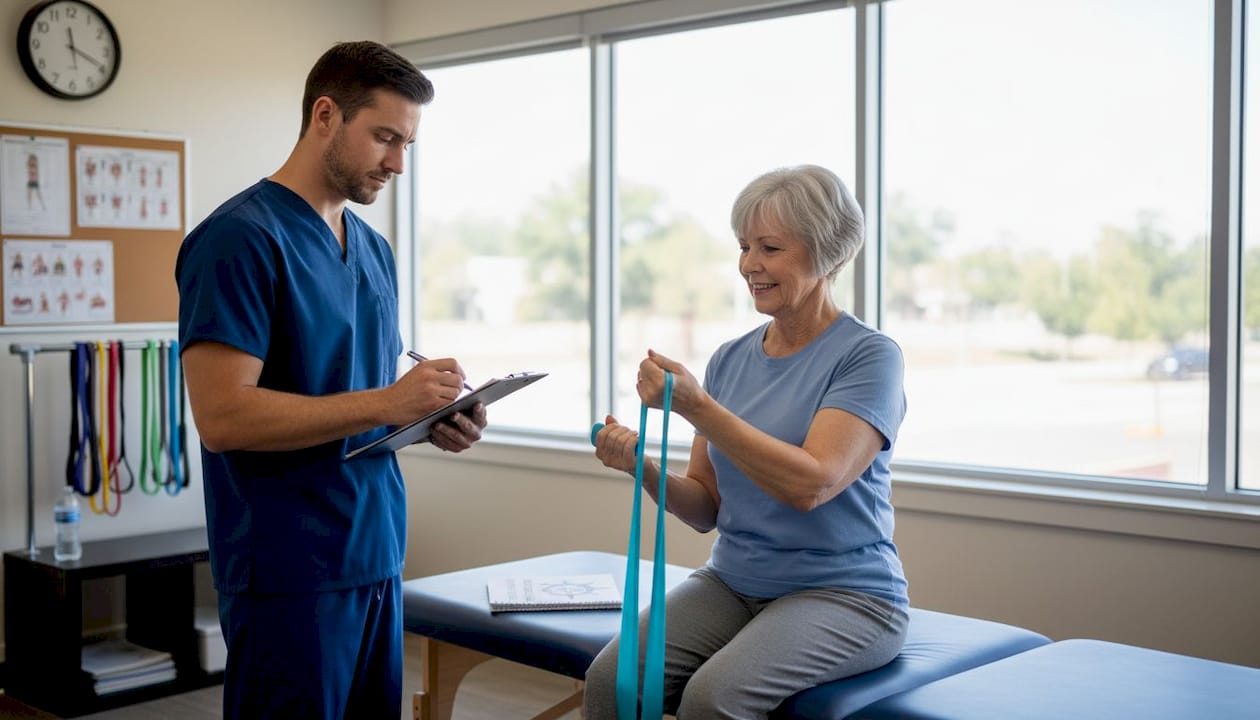
- A physical therapist guides you through range of motion exercises.
- Swelling decreases steadily; most patients notice meaningful improvement within two weeks.
- Light daily tasks like eating and writing usually return within the first week.
Longer-term benchmarks:
- A final range of motion arc exceeding 100 degrees is a common outcome after contracture release.
- Return to desk work often happens within two to four weeks.
- Return to physical labor or sport may take two to three months.
- Infection and reoperation rates remain low compared to open procedures.
Key factors that influence your recovery include your age, the severity of the original condition, how consistently you engage with rehabilitation, and whether any complications arise. Reviewing a detailed elbow surgeon recovery guide and exploring joint pain recovery options can help you plan realistically.
Our perspective: What most articles don’t tell you about minimally invasive elbow surgery
After understanding the evidence and options, let’s step back for some straight talk based on firsthand experience.
Minimally invasive does not mean effortless. We see patients who expect to skip rehabilitation because the incisions were small, and that mindset consistently leads to slower recoveries. The surgery removes the obstacle; your effort in physical therapy determines how much function you actually regain.
We also want to be honest: not every patient is a candidate, and overselling arthroscopy as universally superior does a disservice to people who genuinely need open surgery. The best outcome comes from matching the right technique to the right person, not from chasing the least invasive option regardless of fit. Reading about elbow arthroscopy realities gives you a more grounded picture of what to expect.
Ready to explore minimally invasive elbow care?
If you think minimally invasive elbow care could help you, here’s where to start your next steps.
At Nowak Orthopedic Associates in Hampton, NH, Dr. Roger B. Nowak evaluates each patient individually to determine whether arthroscopy, mini-open techniques, or non-surgical options like PRP or SoftWave therapy are the best path forward. You can learn more about minimally invasive elbow treatment, find guidance on choosing among orthopedic surgeons in New Hampshire, or review our advanced joint procedures to see the full range of options available to you.
Frequently asked questions
Is minimally invasive elbow surgery painful?
Most patients experience less pain than with open surgery; discomfort is typically mild and managed with oral medication for a few days after the procedure.
How long does recovery take after minimally invasive elbow surgery?
Basic function often returns within two to four weeks, with full activity possible in two to three months depending on the procedure performed and the patient’s commitment to rehabilitation.
What are the main risks of minimally invasive elbow surgery?
Nerve injury is the most notable risk given elbow anatomy, with ulnar and radial nerve rates ranging from 0.46 to 13.6%; infection and reoperation are less common than with open surgery.
Can all elbow problems be fixed with minimally invasive surgery?
No. Severe deformities or complex trauma may require traditional open surgery, as open approaches remain better for complex stiffness and major reconstructions where full joint visibility is essential.