

TL;DR:
- Partial knee replacement targets only damaged knee compartments, preserving natural tissue and reducing recovery time.
- Suitable candidates have arthritis confined to one area, intact ligaments, and good bone quality.
- PKR offers comparable long-term success to total knee replacement with fewer risks and quicker recovery.
If you’re dealing with persistent knee pain in New Hampshire, you may assume total knee replacement is the only real solution. That assumption is worth questioning. For many patients with osteoarthritis limited to one area of the knee, partial knee replacement can deliver similar pain relief and functional improvement, often with a faster recovery and fewer complications. Understanding your options clearly can change the course of your care and help you get back to the activities you love sooner than you might expect.
Table of Contents
- What is partial knee replacement?
- Who is a candidate for partial knee replacement?
- Benefits, outcomes, and risks: What does the evidence say?
- Partial knee replacement in practice: The New Hampshire perspective
- What the data and our experience really say about partial knee replacement
- Considering knee replacement? See New Hampshire’s leading orthopedic experts
- Frequently asked questions
Key Takeaways
| Point | Details |
|---|---|
| PKR conserves healthy tissue | Partial knee replacement only replaces the damaged area, preserving more of your natural bone and ligaments. |
| Ideal for select patients | Best results occur when osteoarthritis is limited to one compartment of the knee and ligaments are intact. |
| Recovery is typically quicker | Most patients experience less pain and a faster return to activity compared to total knee replacement. |
| Long-term success rates are high | Survivorship at 10 years is generally 90% or higher for most partial knee replacements. |
| Surgeon experience matters | Outcomes depend heavily on choosing an expert orthopedic surgeon for assessment and surgery. |
What is partial knee replacement?
Partial knee replacement, also called unicompartmental knee arthroplasty (UKA) or PKR, is a surgical procedure that replaces only the damaged section of the knee rather than the entire joint. Think of it this way: if only one corner of your knee is worn down by osteoarthritis, replacing the whole joint may be more than what’s actually needed.
The knee has three compartments: the medial (inner), lateral (outer), and patellofemoral (front). PKR targets whichever single compartment has deteriorated, leaving healthy bone, cartilage, and ligaments completely intact. This is the core distinction from total knee replacement (TKR), which resurfaces all three compartments.
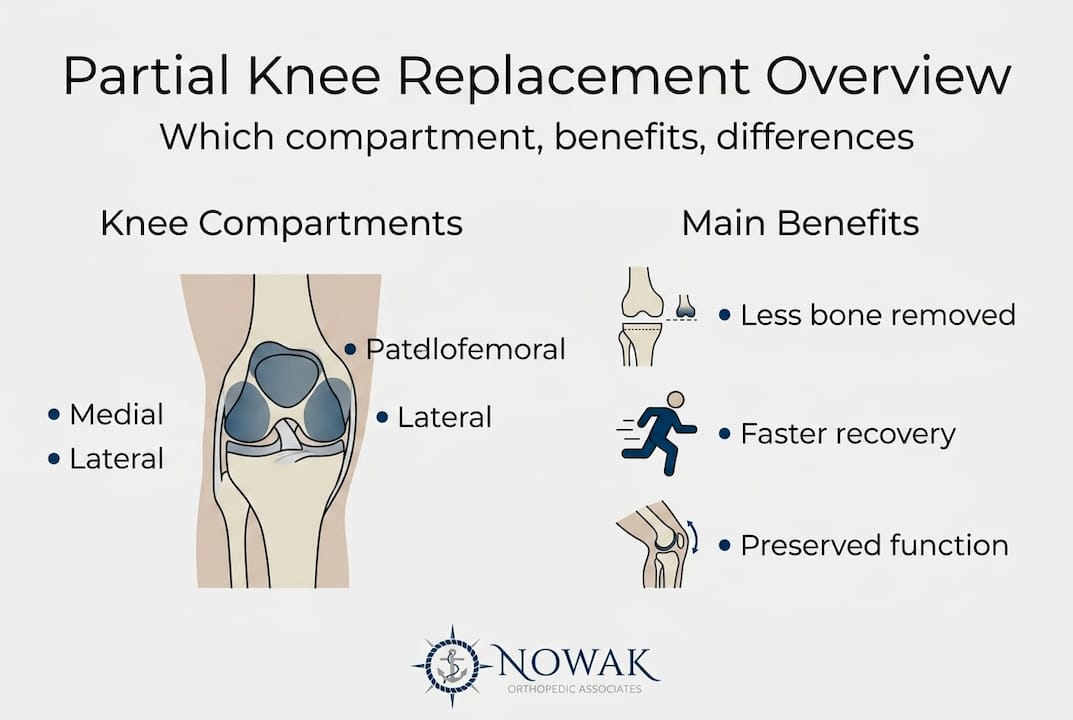
For context, here’s how the two procedures compare across the most important factors:
| Factor | Partial knee replacement | Total knee replacement |
|---|---|---|
| Bone removed | Minimal | Significant |
| Recovery time | Shorter (weeks) | Longer (months) |
| Hospital stay | Often 1 day | 2-3 days |
| Complication risk | Lower | Higher |
| Revision risk | Slightly higher | Slightly lower |
Research confirms that PKR can offer similar pain and function improvement as total knee replacement for select patients, with fewer complications and lower costs. This is meaningful data for anyone weighing their knee replacement options in New Hampshire.
Patients who have undergone PKR often report that their knee feels more natural after surgery, since more of the original joint is preserved. If you want a broader look at joint procedure examples and how they compare, that resource is a helpful starting point.
Not every knee pain patient needs a total replacement. For the right candidate, partial knee replacement is a precise, effective, and less disruptive solution.
Who is a candidate for partial knee replacement?
Not everyone with knee pain qualifies for PKR. Getting the patient selection right is arguably the most important step in the entire process. Here’s what surgeons typically look for when evaluating candidacy:
- Arthritis confined to one compartment. If osteoarthritis has spread to two or more areas of the knee, PKR is not appropriate.
- Intact ligaments. Specifically, the anterior cruciate ligament (ACL) must be functional. Ligament instability rules out partial replacement.
- Good bone quality. Sufficient bone density is required to support the implant securely.
- Absence of inflammatory arthritis. Conditions like rheumatoid arthritis cause joint-wide inflammation, making PKR unsuitable.
- Manageable deformity. Significant angular deformity of the knee generally disqualifies a patient.
Ideal candidates are often active adults who want to preserve as much natural knee function as possible, and who may wish to delay or avoid total knee replacement altogether. Osteoarthritis and knee pain confined to a single compartment is the most common reason patients pursue PKR.
Contraindications are equally important to understand. Edge cases and contraindications include multi-compartment arthritis, ligament deficiency, rheumatoid arthritis, or significant deformity. A thorough imaging evaluation and physical exam are essential before any decision is made. You can learn more about available NH knee care services to get a sense of what a full evaluation involves.
Pro Tip: If you’ve been told you need a total knee replacement but your arthritis seems limited to one area, it’s worth asking your surgeon specifically whether PKR has been considered and why or why not.
Benefits, outcomes, and risks: What does the evidence say?
Let’s talk numbers, because the data on PKR is encouraging. According to a 2025 Lancet study, long-term survivorship00250-4/fulltext) is approximately 90 to 93% for medial or lateral PKR at 10 years, and around 82% for patellofemoral PKR. That means the large majority of patients are still using their original partial replacement a decade after surgery.
Key benefits of PKR over TKR include:
- Shorter hospital stay, often just one day for partial replacement
- Faster return to daily activities, typically measured in weeks rather than months
- Less blood loss and reduced risk of infection or clotting complications
- More natural knee feel, since healthy tissue is preserved
- Lower overall cost, when all factors including recovery time are considered
For a broader view of procedures for joint pain relief and how PKR fits within that landscape, that resource covers recovery expectations in helpful detail.
That said, PKR does carry some specific risks. The most notable is the need for revision surgery if arthritis progresses to other compartments of the knee over time. This is why the revision rate for PKR is slightly higher than for TKR over very long time horizons. Harvard Health confirms that PKR outcomes are comparable to TKR for the right patients, but patient selection and surgical skill are critical variables. Exploring knee joint preservation strategies can also help patients understand how PKR fits into a longer-term joint health plan.
Partial knee replacement in practice: The New Hampshire perspective
Understanding the evidence provides a foundation; now let’s see how PKR is practiced and accessed in New Hampshire. The quality of your outcome is closely tied to the experience of your surgical team. PKR is technically more demanding than total knee replacement in certain respects, because precision in implant sizing and positioning is critical when only one compartment is being treated.
Here’s what to look for when choosing a surgeon and care team for PKR in New Hampshire:
- Surgeon volume. Surgeons who perform PKR regularly tend to have better outcomes and lower revision rates.
- Advanced imaging. Weight-bearing X-rays and MRI help confirm that arthritis is truly limited to one compartment.
- Individualized evaluation. A good surgeon will not push you toward surgery; they will walk you through all appropriate options first.
- Post-surgical support. Physical therapy and follow-up care are essential components of a full recovery.
PKR outcomes are highly surgeon-dependent and converting to TKR is possible if needed. Local access to experienced orthopedic care in New Hampshire makes a meaningful difference in how smoothly the process goes from consultation through recovery.
Pro Tip: Ask your surgeon how many partial knee replacements they perform each year and what their personal revision rate is. That single question can tell you a great deal about your expected outcome.
Reviewing a detailed knee surgery recovery guide and post-surgery knee care tips before your procedure will help you set realistic expectations and prepare your home and routine for a smoother recovery.
What the data and our experience really say about partial knee replacement
After working with patients across New Hampshire, we’ve found that the biggest barrier to a good outcome isn’t the surgery itself. It’s the assumption that one type of knee replacement is automatically better than another. That’s simply not how it works.
The best result comes from matching the right procedure to the right patient, and that requires careful evaluation, honest discussion, and high-quality imaging. Modern imaging and surgical techniques00250-4/fulltext) have improved outcomes meaningfully, but selection and experience remain the deciding factors. PKR is not a lesser version of TKR. For appropriate patients, it can be a smarter, more targeted intervention that preserves function, reduces risk, and leaves the door open for future treatment if needed. We encourage patients to view it as a flexible option, not a final answer, and to explore all available joint procedure outcomes before deciding.
Considering knee replacement? See New Hampshire’s leading orthopedic experts
If you’re living with knee pain in New Hampshire, you deserve a clear, individualized assessment, not a one-size-fits-all recommendation. At Nowak Orthopedics, Dr. Roger B. Nowak and our team specialize in unicompartmental knee arthroplasty and a full range of knee care solutions. We work with each patient to determine whether PKR, TKR, or a non-surgical approach is the right fit. Explore our NH orthopedic surgeons resource and review available joint pain relief procedures to take your first step toward lasting relief.
Frequently asked questions
How long does a partial knee replacement last?
Most partial knee replacements last 10 to 15 years, with about 90% survivorship00250-4/fulltext) at the 10-year mark for medial and lateral UKA. Longevity depends on patient activity level, weight, and whether arthritis spreads to other compartments.
Is recovery from partial knee replacement faster than total knee replacement?
Yes. Most patients recover more quickly from PKR, with fewer complications and faster recovery than TKR. Many people return to normal daily activities within a few weeks.

Can I have a total knee replacement later if I already had a partial?
Yes. PKR is designed to be convertible to TKR if arthritis spreads or if revision becomes necessary, making it a flexible rather than permanent commitment.
What are the main reasons someone can’t get a partial knee replacement?
Patients with extensive arthritis or ligament deficiency are not PKR candidates. Inflammatory conditions like rheumatoid arthritis and significant knee deformity also rule out partial replacement.