

TL;DR:
- Golfer’s elbow is a degenerative tendinopathy affecting inner elbow tendons, caused by overuse.
- Accurate diagnosis involves locating tenderness near the medial epicondyle and understanding specific movement triggers.
- Effective treatment emphasizes physical therapy, activity modification, and tendon remodeling exercises for full recovery.
Not every elbow injury you get from sports is tennis elbow. Many athletes and weekend golfers assume that pain near the elbow means the same thing, but golfer’s elbow is a distinct condition that affects different tendons and responds to different treatments. Getting the diagnosis wrong means following the wrong recovery plan, and that can keep you sidelined far longer than necessary. This guide walks you through what golfer’s elbow actually is, how it’s diagnosed, what treatments genuinely work, and how to build a recovery plan that gets you back to the activities you love.
Table of Contents
- What is golfer’s elbow and how does it occur?
- Diagnosis: How is golfer’s elbow identified?
- Treatment options: What actually works?
- Rehabilitation and returning to activity
- A fresh take: The overlooked truth about golfer’s elbow
- Expert help for lasting elbow relief
- Frequently asked questions
Key Takeaways
| Point | Details |
|---|---|
| Not just for golfers | Golfer’s elbow can affect anyone who overuses their wrist flexors, not just golfers. |
| Diagnosis is mostly clinical | A clear history and exam usually identify golfer’s elbow without need for advanced scans. |
| Physical therapy is best | Rehab focused on eccentric and isometric exercises offers the highest rate of long-term recovery. |
| Quick fixes aren’t always better | Injections may help short-term but physical therapy reduces recurrence and improves lasting strength. |
| Prevention is possible | Proper technique, warm-ups, and targeted strengthening lower your risk of recurrence. |
What is golfer’s elbow and how does it occur?
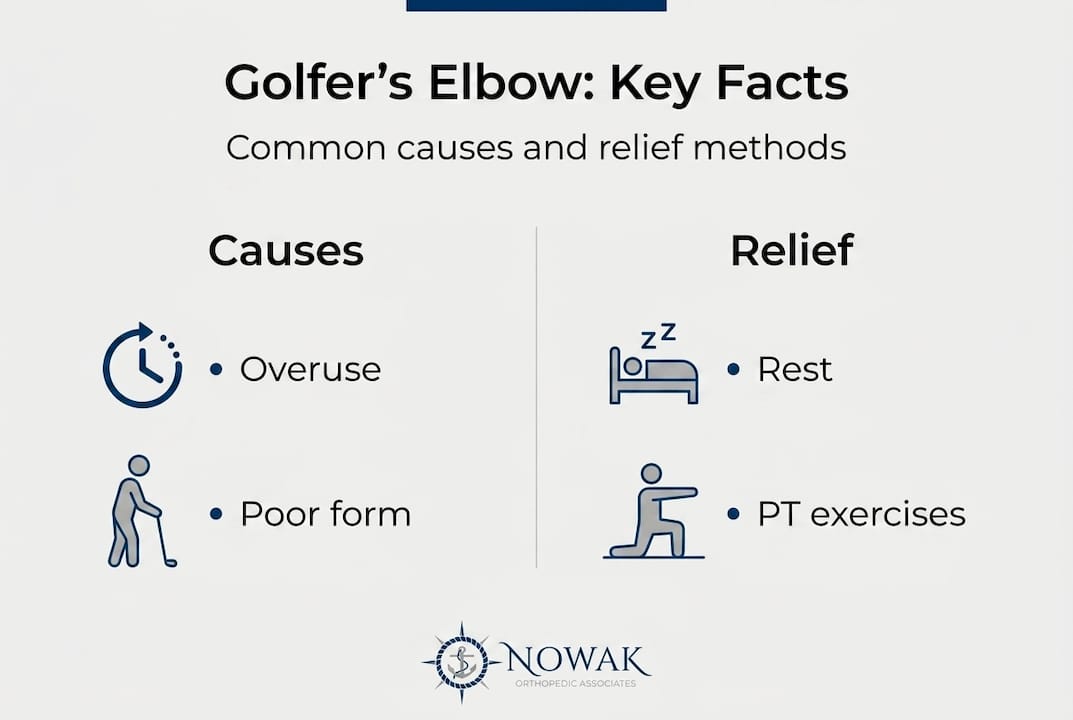
Golfer’s elbow, known clinically as medial epicondylitis, is a condition that affects the tendons and muscles on the inner side of the elbow. These are the same tendons that control wrist flexion and forearm pronation, meaning they’re heavily used any time you grip, swing, or twist your wrist. When those movements are repeated too often without adequate recovery, the tendons begin to break down.
Despite the name, you don’t have to play golf to develop this condition. It’s also common in baseball pitchers, rock climbers, construction workers, and anyone who performs repetitive gripping motions. The real culprit is overuse, not the sport itself.
Golfer’s elbow vs. tennis elbow: key differences
| Feature | Golfer’s elbow | Tennis elbow |
|---|---|---|
| Location | Inner (medial) elbow | Outer (lateral) elbow |
| Tendons affected | Wrist flexors, pronators | Wrist extensors |
| Painful movements | Gripping, flexion, pronation | Extension, lifting |
| Common in | Golfers, pitchers, climbers | Tennis players, painters |
A critical distinction that many people miss is the underlying tissue process. This is not an inflammatory condition in the traditional sense. It is a degenerative tendinopathy, meaning the tendon tissue itself has broken down over time. This is why anti-inflammatory medications and ice can reduce discomfort in the short term but do not fix the underlying problem.
The medial vs. lateral distinction matters enormously for treatment. Golfer’s elbow involves the flexor-pronator muscle group, while tennis elbow involves the extensor group on the opposite side. Treating one like the other leads to wasted time and continued pain.
Common risk factors include:
- Repetitive wrist flexion or forearm rotation
- Poor swing mechanics in golf or throwing mechanics in baseball
- Using tools or equipment that are too heavy or improperly sized
- Inadequate warm-up before activity
- Sudden increases in training volume
If you’ve been dealing with persistent inner elbow pain, exploring your elbow pain relief options is a smart first step before assuming the cause.
With the basics covered, next is pinning down how to recognize and confirm golfer’s elbow.
Diagnosis: How is golfer’s elbow identified?
Recognizing golfer’s elbow starts with understanding where and when it hurts. The most telling sign is tenderness located approximately 5mm distal and anterior to the medial epicondyle, the bony bump on the inner side of your elbow. Pain typically increases when you flex your wrist against resistance or pronate your forearm, such as turning a screwdriver or gripping a golf club at impact.
Typical symptoms to watch for:
- Aching or burning pain along the inner forearm
- Tenderness directly at or just below the inner elbow
- Weakness in the wrist or hand when gripping
- Stiffness in the elbow, especially in the morning
- Pain that worsens with wrist flexion or forearm rotation
Diagnosis is primarily clinical, meaning a skilled clinician can identify it through your medical history and a focused physical exam. Imaging is not always necessary, but ultrasound or MRI can be useful when the diagnosis is unclear or when other conditions like a UCL (ulnar collateral ligament) tear or ulnar neuropathy need to be ruled out.
If you experience numbness, tingling, or weakness in your ring and little fingers alongside elbow pain, that’s a sign of possible ulnar nerve involvement, which changes the treatment approach significantly.
One complication that’s often overlooked is what happens when golfer’s elbow goes untreated for months. Chronic cases can develop fibrosis (scar tissue formation), calcification within the tendon, limited range of motion, and persistent pain that becomes much harder to treat. Throwing athletes are particularly prone to developing concurrent UCL issues, which require a completely different management plan.
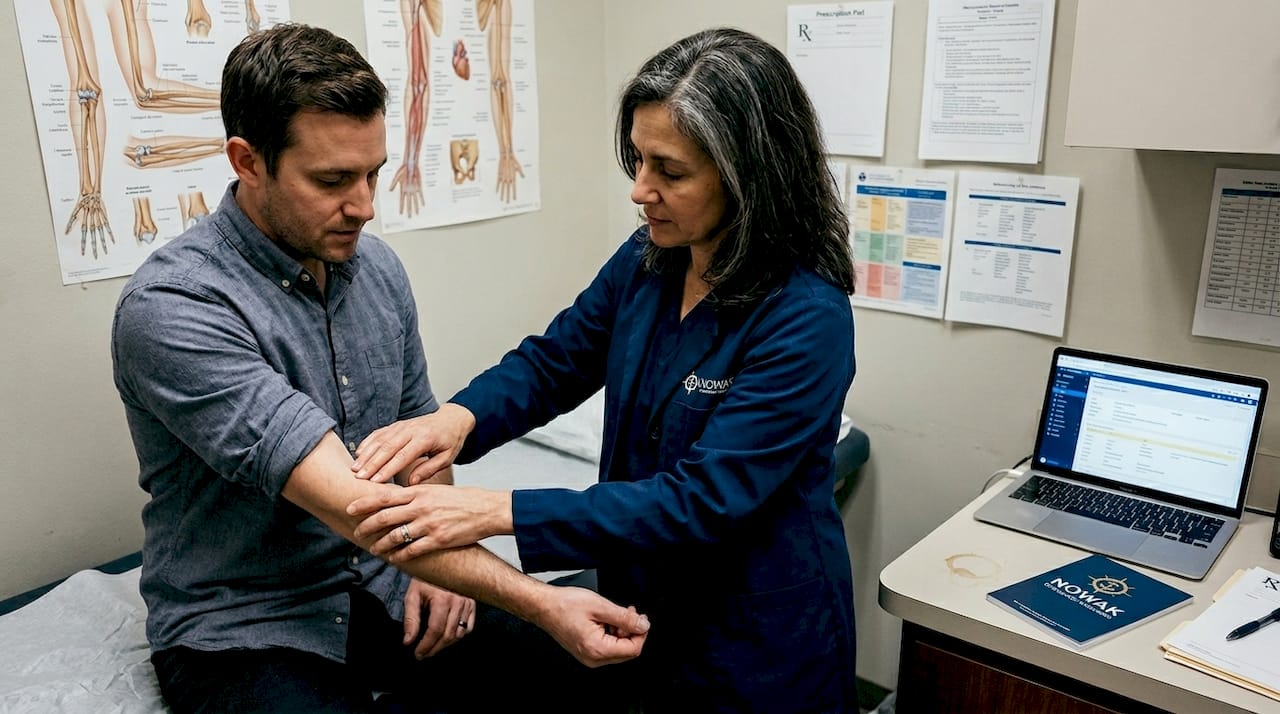
Pro Tip: If your inner elbow pain has lasted more than 4 to 6 weeks without improvement, it’s time to consider seeing an elbow orthopedic specialist rather than continuing to manage it on your own.
Once you know what golfer’s elbow looks like, it’s key to understand what truly works for treating it.
Treatment options: What actually works?
The good news is that golfer’s elbow responds well to conservative care in the vast majority of cases. Conservative treatment achieves success rates of 87 to 92 percent at one year, which means most people who follow a structured plan do recover fully without surgery.
Comparing treatment approaches
| Treatment | Short-term relief | Long-term outcome |
|---|---|---|
| Physical therapy | Moderate | Excellent |
| Corticosteroid injection | High | Poor to moderate |
| NSAIDs / ice | Moderate | No tissue repair |
| PRP injection | Moderate | Promising |
| Surgery | N/A | Reserved for failures |
Here’s how the main options stack up:
- Physical therapy with eccentric and isometric strengthening is the most effective long-term treatment. Eccentric exercises, where the muscle lengthens under load, stimulate tendon remodeling and rebuild tissue strength.
- Activity modification reduces the repetitive stress that caused the breakdown in the first place. This doesn’t mean complete rest; it means smarter loading.
- Corticosteroid injections provide quick short-term relief but carry risks of tendon weakening and higher recurrence rates when used as a standalone treatment. They work best as a bridge to physical therapy, not a replacement.
- NSAIDs and ice address pain and discomfort but do not repair degenerative tendon tissue. Relying on them alone delays real healing.
- PRP (platelet-rich plasma) injections are a regenerative option that introduces growth factors directly into the damaged tendon to support tissue repair.
Pro Tip: Ask your provider about injections for joint pain as part of a broader plan, not as a standalone fix. Pairing an injection with structured physical therapy tends to produce far better outcomes than either approach alone.
The most important takeaway is that elbow pain treatments need to address the degenerative nature of the condition. Chasing symptom relief without rebuilding tendon strength is one of the most common reasons people experience repeated flare-ups.
With treatment options laid out, what about the recovery process and real-life return to activity?
Rehabilitation and returning to activity
A structured rehab plan is what separates people who fully recover from those who deal with golfer’s elbow on and off for years. The rehabilitation protocol follows three clear phases, each building on the last.
The three phases of golfer’s elbow rehab:
- Phase 1: Pain control and range of motion. Focus on reducing pain, gentle stretching, and restoring full elbow and wrist movement. This phase typically lasts 2 to 4 weeks.
- Phase 2: Strengthening. Introduce eccentric and isometric exercises targeting the wrist flexors and forearm pronators. Eccentric strengthening is particularly important because it directly stimulates tendon tissue remodeling, which is the core of healing tendinosis.
- Phase 3: Functional and sport-specific training. Gradually reintroduce sport-specific movements, correct technique flaws, and rebuild confidence in the elbow under load.
Prevention tips to avoid recurrence:
- Correct your grip technique and swing mechanics with a coach
- Use properly fitted equipment (grip size, club weight)
- Always warm up before activity, including dynamic wrist and forearm movements
- Gradually increase training volume rather than making sudden jumps
- Strengthen the forearm and wrist regularly as part of your maintenance routine
Pro Tip: Don’t skip sports injury rehab phases even if you feel better early. Tendons heal more slowly than muscles, and returning too soon is the number one cause of re-injury.
If your progress stalls despite following a structured plan, ask your provider to assess for ulnar nerve involvement. Nerve irritation alongside tendinopathy requires a modified approach, and missing it is a common reason rehab doesn’t work as expected. A sports injury treatment workflow that accounts for nerve involvement can make a significant difference in outcomes.
Fully equipped with a recovery path, it helps to hear what most miss about golfer’s elbow from the expert perspective.
A fresh take: The overlooked truth about golfer’s elbow
Here’s something we see repeatedly in practice: people treat the pain, feel better for a few weeks, go back to their sport, and end up right back where they started. The cycle repeats for months, sometimes years.
The reason is straightforward. Pain relief and tissue healing are not the same thing. When you stop hurting, it doesn’t mean the tendon has rebuilt its strength or that your mechanics have changed. If you return to the same swing, the same grip, the same workload, you’re loading a tendon that hasn’t fully recovered.
What actually breaks the cycle is combining tendon remodeling through structured strengthening with real technique correction. Many athletes skip the technique piece entirely. They do the exercises, feel stronger, and assume that’s enough. But if the movement pattern that caused the breakdown in the first place hasn’t changed, the tendon will break down again.
We also see patients who focus entirely on inflammation management, relying on ice and NSAIDs for months, without ever addressing the degenerative tissue underneath. That approach treats the symptom while ignoring the cause. True recovery requires rebuilding the tendon, and that takes deliberate, progressive loading over time.
For those who have tried conservative care without success, elbow surgery options like medial epicondylectomy can provide lasting relief when the right candidate is identified.
Expert help for lasting elbow relief
If you’ve been managing inner elbow pain on your own without consistent improvement, a personalized treatment plan from an orthopedic specialist can make a real difference. At Nowak Orthopedic Associates, we evaluate each patient individually, considering the full picture of your activity level, symptoms, and goals. From orthopedic joint care to advanced regenerative therapies and surgical options when needed, our team is here to help you recover fully. Explore our dedicated elbow orthopedic care services to learn more about what’s available to you.
Frequently asked questions
How can I tell if my elbow pain is golfer’s elbow or tennis elbow?
Golfer’s elbow causes pain on the inner side of the elbow, while tennis elbow affects the outer side; each involves different wrist movements and tendons.
When should I see a doctor for golfer’s elbow?
See a doctor if pain persists despite rest, is accompanied by numbness or tingling, or limits your movement for weeks; imaging may be needed to rule out UCL tears or ulnar neuropathy.
How long does recovery from golfer’s elbow take?
Most people recover within 6 to 12 months with physical therapy and proper rehab; conservative PT success rates reach 87 to 92 percent at one year.
Is surgery necessary for golfer’s elbow?
Surgery is rarely needed since most cases improve with physical therapy and activity modification over time.
Can you prevent golfer’s elbow from coming back?
Yes, avoiding overuse, improving technique, and regular strengthening exercises help prevent recurrence; proper warm-up and equipment adjustments are also key prevention strategies.