

TL;DR:
- Arthroscopy is a minimally invasive joint surgery using small incisions and a camera for diagnosis and treatment.
- It is most effective for structural issues like meniscus tears, cartilage lesions, and shoulder labral repairs.
- Not suitable for advanced osteoarthritis or diffuse joint degeneration, with risks including nerve injury and infection.
If you’ve been told you need surgery for a painful shoulder, knee, or elbow, your first instinct might be to picture a long incision, a lengthy hospital stay, and months of recovery. That picture is outdated for many joint conditions. Arthroscopic surgery, a minimally invasive technique that uses a small camera and specialized instruments inserted through tiny openings, has fundamentally changed how orthopedic surgeons diagnose and treat joint problems. For adults in New Hampshire dealing with chronic joint pain, understanding what arthroscopy offers and where it has limits can make all the difference in choosing the right path forward.
Table of Contents
- What is arthroscopic surgery and how does it work?
- When and why does arthroscopic surgery matter?
- Limitations and risks: arthroscopy is not always the answer
- How to talk with your orthopedic specialist about arthroscopy
- Our perspective: why evidence and patient selection shape success
- Explore your joint pain solutions with Nowak Orthopedics
- Frequently asked questions
Key Takeaways
| Point | Details |
|---|---|
| Minimally invasive advantage | Arthroscopic surgery usually means less trauma and quicker recovery compared to open approaches. |
| Not for every case | Outcomes depend on the specific condition and patient factors—arthroscopy isn’t always superior. |
| Evidence-based decision | Durable pain relief and mobility gains are possible, but patient selection is key to success. |
| Know the risks | Even minimally invasive surgeries like arthroscopy have complications that should be discussed. |
| Communication matters | Ask your specialist about all options, risks, and expected outcomes for informed joint care decisions. |
What is arthroscopic surgery and how does it work?
Arthroscopy is a surgical technique in which a surgeon inserts a thin, flexible camera called an arthroscope into a joint through a small portal, typically less than a centimeter wide. A second or third portal allows the surgeon to pass miniature instruments into the joint space to repair, remove, or reconstruct damaged tissue. The entire procedure is guided by live video displayed on a monitor in the operating room.
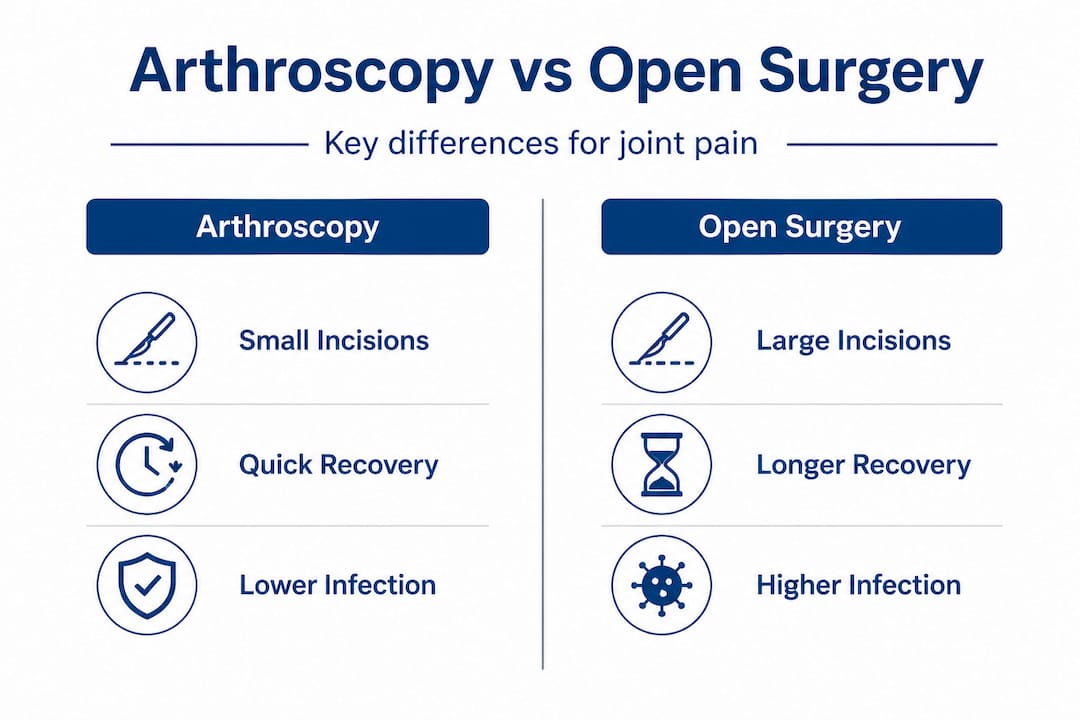
This approach is fundamentally different from open surgery, where a surgeon makes a long incision to gain direct access to the joint. Arthroscopy reduces soft-tissue trauma and supports both diagnosis and targeted therapy for joint pain and mechanical symptoms, making it a preferred first-line surgical option for many conditions.
Joints commonly treated with arthroscopy include:
- Knee: meniscus tears, cartilage lesions, ACL reconstruction, loose body removal
- Shoulder: rotator cuff repair, SLAP repair, Bankart repair, biceps tenodesis
- Elbow: removal of loose bodies, lateral or medial epicondyle procedures
- Ankle: cartilage repair, impingement treatment, ligament work
Because the incisions are so small, patients typically experience less post-operative pain, lower infection risk, and a faster return to daily activities compared to open procedures. You can review joint procedure examples to get a clearer sense of what different arthroscopic operations actually involve, or explore a focused shoulder arthroscopy overview if your pain is centered in that joint.

Pro Tip: Before your appointment, write down exactly when your pain started, what movements make it worse, and what you’ve already tried. That context helps your surgeon determine quickly whether arthroscopy, a non-surgical approach, or another procedure is the right fit for you.
When and why does arthroscopic surgery matter?
Understanding how arthroscopy works, you’ll want to know when it’s truly valuable and what the evidence shows for relief and recovery.
Arthroscopy delivers the most meaningful results in specific clinical scenarios. Loose bodies floating inside a joint, cartilage lesions that cause mechanical locking or catching, torn menisci in younger active patients, and unstable shoulder conditions like labral tears all respond well to arthroscopic intervention. These are structural problems where direct visualization and targeted repair produce reliable outcomes.
Research confirms that long-term outcomes can be durable for well-selected arthroscopic procedures, though results depend heavily on the specific condition and individual patient factors such as age, activity level, and the extent of existing joint damage.
82% of patients had no need for revision surgery at 10 years in a large series of arthroscopic cases, underscoring how durable results can be when the right patient receives the right procedure.
Arthroscopy vs. open surgery: a quick comparison
| Factor | Arthroscopic surgery | Open surgery |
|---|---|---|
| Incision size | Small portals (under 1 cm) | Large incision (several cm) |
| Soft-tissue trauma | Minimal | More significant |
| Hospital stay | Often same-day or overnight | Typically longer |
| Recovery time | Weeks in many cases | Months in many cases |
| Infection risk | Lower | Relatively higher |
| Outcome durability | High for correct indications | High for complex reconstructions |
Key steps in deciding whether arthroscopy is right for you
- Get a thorough physical exam and imaging (X-ray, MRI, or both) to identify the exact problem.
- Discuss your activity goals and pain level honestly with your surgeon.
- Review joint pain relief procedures to understand what options exist for your specific joint.
- Ask whether non-surgical treatments have been exhausted or are still worth trying.
- Confirm that your diagnosis is one where arthroscopy has a strong evidence base for success.
Comparing options across joints is also worthwhile. A review of shoulder vs knee arthroscopy shows how recovery timelines and functional goals differ meaningfully between those two joints, which matters when you’re planning around work or family responsibilities.
Limitations and risks: arthroscopy is not always the answer
While many benefit from arthroscopy, it’s critical to recognize its limitations and the importance of personalized treatment decisions.
Not every joint problem benefits from going inside the joint with a camera and instruments. Evidence and guidelines do not support arthroscopy for every degenerative joint pain scenario, and outcomes can be limited or even unfavorable depending on the pathology and indication. Conditions where arthroscopy tends to offer limited benefit include:
- Severe osteoarthritis (OA): When cartilage is broadly worn away, removing debris arthroscopically does not address the underlying joint degeneration and rarely provides lasting relief.
- Diffuse inflammatory arthritis: Systemic conditions like rheumatoid arthritis are better managed medically rather than surgically in most cases.
- Advanced bone-on-bone changes: Structural loss of this magnitude often requires partial or total joint replacement rather than arthroscopic work.
- Certain tendon ruptures: Complete tears with significant retraction may need open repair for adequate tissue mobilization and fixation.
It’s equally important to understand that complications and technical pitfalls exist and vary by joint and clinical context. Even a minimally invasive procedure carries real risks.
Common arthroscopic risks by category
| Risk category | Examples | Approximate incidence |
|---|---|---|
| Infection | Superficial or deep joint infection | Less than 1% |
| Nerve injury | Numbness, weakness near portal sites | 0.5 to 2% |
| Blood clots (DVT) | Deep vein thrombosis, especially in knee | 0.5 to 1.5% |
| Persistent symptoms | Pain or stiffness not resolved by surgery | Varies by diagnosis |
| Instrument breakage | Rare but possible with complex cases | Under 0.1% |
For patients considering elbow work, reviewing elbow arthroscopy details is especially useful since that joint carries a slightly higher nerve risk due to anatomy. And if non-surgical options haven’t been fully explored, non-surgical joint pain relief may still be the smarter starting point. Understanding surgical vs non-surgical criteria can help you frame that conversation with your provider.
Pro Tip: Be upfront with your surgeon about your BMI, smoking history, diabetes, or any blood-thinning medications. These factors directly affect complication risk and recovery, and they influence whether arthroscopy or an alternative approach is safer for you personally.
How to talk with your orthopedic specialist about arthroscopy
Knowing both the potential benefits and risks, here’s how you can approach your orthopedic specialist for a consultation tailored to your needs.
Careful patient selection and understanding of technical risks are essential for optimal results, which means you play an active role in that selection process. Coming prepared to your consultation makes a real difference.
Five questions to ask your orthopedic specialist
- Is my specific diagnosis one where arthroscopy has strong evidence for success, or are my symptoms likely coming from something arthroscopy can’t fix?
- What are the realistic outcomes for someone with my age, activity level, and degree of joint damage?
- What are the alternatives, including non-surgical options, and what happens if I wait?
- What does recovery actually look like for this procedure, and when can I return to my normal activities?
- What is your personal experience with this specific procedure, and what complication rate do you see in your practice?
These questions shift the conversation from “should I have surgery” to “is this the right surgery for me.” That distinction matters enormously. Exploring minimally invasive surgery options in New Hampshire and reviewing a guide to advanced joint care can also help you arrive at your appointment with a clearer framework for decision-making.
Pro Tip: Bring a written list of your symptoms, any imaging you’ve already had done, and your activity goals, whether that’s hiking, gardening, or simply walking without pain. Concrete goals help your surgeon tailor a plan that actually fits your life.
Our perspective: why evidence and patient selection shape success
With those practical questions in mind, let’s step back and share our broader experience and lessons from clinical practice.
We’ve seen arthroscopy produce genuinely life-changing results. A patient with a locked knee from a displaced meniscus tear who couldn’t walk comfortably can often return to hiking within weeks of a well-executed repair. A younger patient with a Bankart lesion causing repeated shoulder dislocations can regain stability and confidence after arthroscopic reconstruction. These outcomes are real and reproducible when the diagnosis is precise and the patient is well-selected.
But we’ve also learned, sometimes through difficult conversations, that arthroscopy is not universally superior and carries reported rates of persistent symptoms in cases where it wasn’t the right fit. A patient with advanced osteoarthritis who undergoes knee arthroscopy hoping for pain relief often finds little improvement, because the underlying problem, widespread cartilage loss, wasn’t addressed by the procedure.
The most important thing we can offer is honesty. When arthroscopy is the right answer, we’ll tell you clearly why. When it isn’t, we’ll explain what will actually help, whether that’s PRP injections, SoftWave therapy, a partial knee replacement, or a structured physical therapy program. The goal is always your joint pain relief and recovery, not the procedure itself.
Trust is built when patients feel heard and when their surgeon is transparent about both the promise and the limits of any treatment. That’s the standard we hold ourselves to.
Explore your joint pain solutions with Nowak Orthopedics
At Nowak Orthopedic Associates in Hampton, NH, Dr. Roger B. Nowak and our team provide thorough evaluations for adults dealing with joint pain, sports injuries, and degenerative conditions. Whether arthroscopy is the right answer or a non-surgical path makes more sense, we build individualized treatment plans around your goals and your specific diagnosis. Review our guide to advanced joint care to understand what a consultation involves, explore joint pain relief options available at our practice, or take the first step and schedule your first visit today. You deserve a clear plan and a provider who will give you straight answers.
Frequently asked questions
Is arthroscopic surgery suitable for all types of joint pain?
No, arthroscopy works best for specific structural problems and is not the right choice for every joint condition. Arthroscopy is not supported for every degenerative joint pain scenario, particularly in severe osteoarthritis where cartilage loss is widespread.
What are the main risks of arthroscopic surgery?
Risks include nerve injury, infection, blood clots, and persistent symptoms that vary depending on the joint and patient profile. Complications and technical pitfalls exist across all arthroscopic procedures, which is why surgeon experience and proper patient selection matter greatly.
How long does recovery from arthroscopic surgery typically take?
Recovery varies by procedure and individual health, but arthroscopy generally means a faster return to activity than open surgery, often measured in weeks rather than months. Arthroscopy reduces soft-tissue trauma and typically shortens the overall recovery timeline compared to traditional open approaches.
How do outcomes from arthroscopic surgery compare to open surgery?
Arthroscopy often delivers similar or better outcomes for specific conditions with less trauma and a shorter recovery, but open techniques remain superior in certain complex situations. Research shows that open repair had lower meniscal failure but higher rates of osteoarthritis progression and venous thromboembolism compared to arthroscopic repair, illustrating that neither approach is universally better.
Recommended
- Top orthopedic procedures for joint pain relief and recovery
- Non-surgical joint pain relief: Evidence-based options
- Shoulder arthroscopy: Benefits, risks, and what to expect
- Joint procedure examples: options and outcomes in 2026
- Why avoid surgery? 5 safer, holistic pain alternatives
- Understanding Hip Flexor Pain and How to Find Relief