

TL;DR:
- Joint pain typically results from injury, overuse, or disease, each with distinct signs and onset.
- Chronic conditions like osteoarthritis progressively damage joints and are influenced by age, weight, and injury history.
- Personalized prevention and treatment strategies, developed with specialists, yield better long-term outcomes.
Joint pain can feel puzzling, especially when it appears without a clear injury or obvious cause. One day you’re fine, and the next, your knee aches after a morning run, your shoulder stiffens during routine tasks, or your fingers swell without warning. The truth is, joint pain almost always has an identifiable source, whether it’s an acute injury, years of accumulated wear, or an underlying medical condition. Understanding these causes is the first step toward finding real, lasting relief.
Table of Contents
- How joint pain begins: Injury, overuse, or disease?
- The impact of arthritis and degenerative conditions
- Comparing acute injuries and overuse: Which matters more?
- Beyond the usual suspects: Rare and referred causes of joint pain
- What most guides miss: The importance of tailored prevention
- Explore expert joint care and treatment options
- Frequently asked questions
Key Takeaways
| Point | Details |
|---|---|
| Multiple root causes | Joint pain arises from injuries, overuse, or diseases like arthritis. |
| Degeneration is common | Arthritis, especially osteoarthritis, is a primary reason for joint discomfort in adults. |
| Overuse risks overlooked | Repetitive stress without rest commonly leads to joint pain but is often ignored. |
| Tailored care works best | Personalized prevention and treatment strategies lead to better, longer-lasting relief. |
How joint pain begins: Injury, overuse, or disease?
Let’s start by untangling the main reasons people of all ages experience joint pain. Most cases fall into three broad categories: acute injuries, overuse, and disease. In practice, these often overlap, making it important to look at the full picture.
Sports injuries cause joint pain via trauma or overuse in two distinct ways. The first is acute trauma, which includes sprains, fractures, and dislocations that happen suddenly during a fall, collision, or awkward landing. The second is overuse, where repetitive activity gradually breaks down tissue over weeks or months.
Overuse is particularly easy to overlook. Research confirms that overuse in sports and mechanical fatigue accumulate through repetitive submaximal loads, meaning loads that aren’t enough to cause immediate injury but steadily damage tissue over time. This explains why a runner who logs 40 miles a week might develop knee pain gradually rather than after one bad training session.
Here’s a simple breakdown of how each cause typically presents:
| Cause | Onset | Common location | Who’s at risk |
|---|---|---|---|
| Acute injury | Sudden | Knee, ankle, shoulder | Athletes, active adults |
| Overuse | Gradual | Knee, elbow, hip | Runners, laborers, hobbyists |
| Disease (arthritis) | Progressive | Hands, knees, hips | Older adults, women, those with obesity |
Common signs that help distinguish between these categories include:
- Acute injury: Immediate swelling, sharp pain, bruising, limited range of motion right after an event
- Overuse: Dull aching that gets worse with activity, tenderness at a specific point, pain that eases with rest but returns when you resume the activity
- Arthritis or disease: Morning stiffness, swelling that comes and goes, pain during and after movement, gradual worsening over months or years
If you have been struggling to identify the cause of your joint pain, learning more about sports injuries and treatments can be a helpful starting point.
Pro Tip: The earlier you identify the true source of joint pain, the faster and more effectively it can be treated. Don’t wait for pain to become severe before seeking an evaluation.
The impact of arthritis and degenerative conditions
Beyond injuries, ongoing joint pain is strongly linked to chronic diseases. Of these, osteoarthritis (OA) is the most common, and its effects on quality of life are significant.
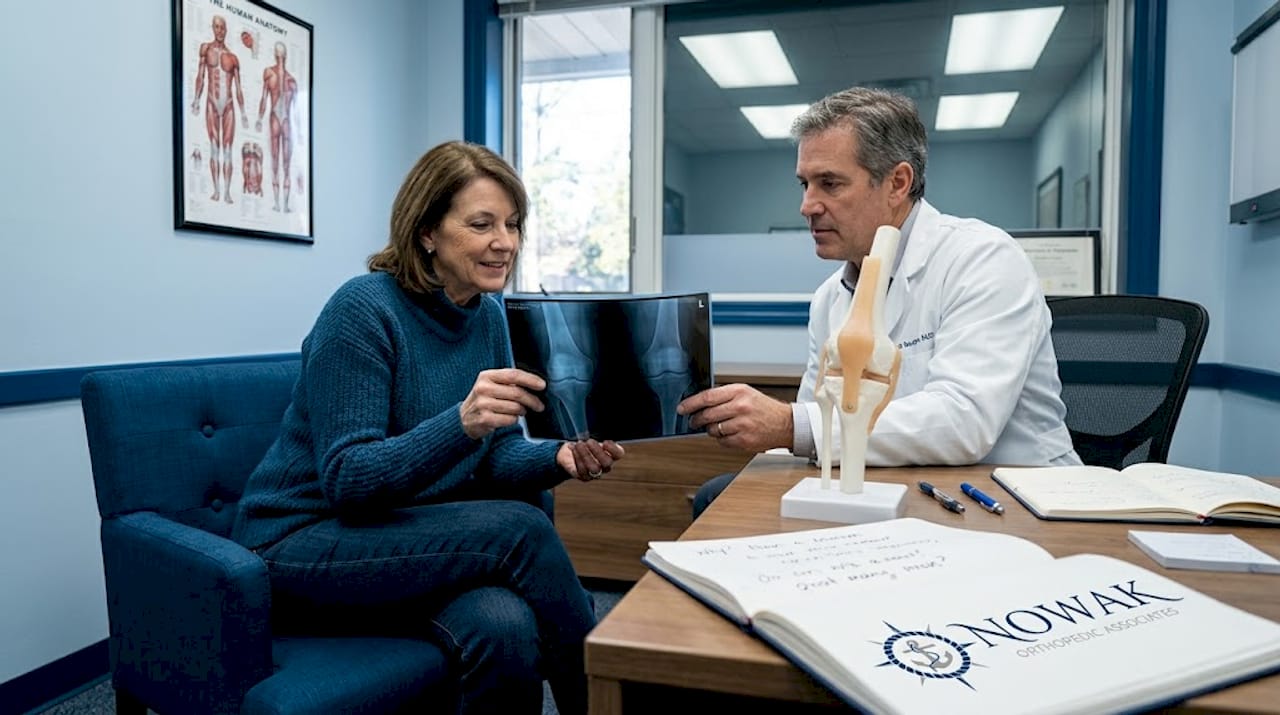
Arthritis prevalence and demographics data from the CDC shows that arthritis affects approximately 21 to 25% of U.S. adults, with OA accounting for around half of all cases. The condition is more prevalent in older adults, women, and people with obesity, making these groups especially important to address with targeted care strategies.
OA develops when the cartilage inside a joint, the smooth tissue that acts as a cushion between bones, gradually wears away. Once cartilage is lost, bones begin to rub together, causing pain, stiffness, and inflammation. Over time, these changes can also affect surrounding muscles, tendons, and ligaments.
| Risk factor | Impact on OA risk |
|---|---|
| Age over 50 | Significantly increased |
| Female sex | Moderately increased |
| Obesity | Strongly increased |
| Previous joint injury | Moderately increased |
| Physically demanding occupation | Moderately increased |
Common arthritis symptoms that patients report include:
- Joint stiffness, especially in the morning or after sitting for long periods
- Swelling that may be visible or felt as warmth around the joint
- Pain during or after movement, such as after walking, climbing stairs, or gripping objects
- Reduced range of motion that makes everyday tasks more difficult over time
“Arthritis doesn’t always look the same from person to person. Some patients experience mild stiffness that comes and goes, while others face constant pain that limits nearly every activity. Recognizing the pattern early makes a real difference in outcomes.”
Degenerative changes are also progressive. Arthritis rarely stays in one joint forever. Many patients who begin with knee OA eventually experience symptoms in the hips, hands, or spine as well. This is why early intervention matters so much. Options like orthopedic injections for arthritis and orthobiologics for joint pain can slow progression and provide meaningful relief without requiring surgery in many cases.
Comparing acute injuries and overuse: Which matters more?
Now, let’s compare how these causes play out in the real world for athletes and active adults. The honest answer is that both matter, but they require very different responses.
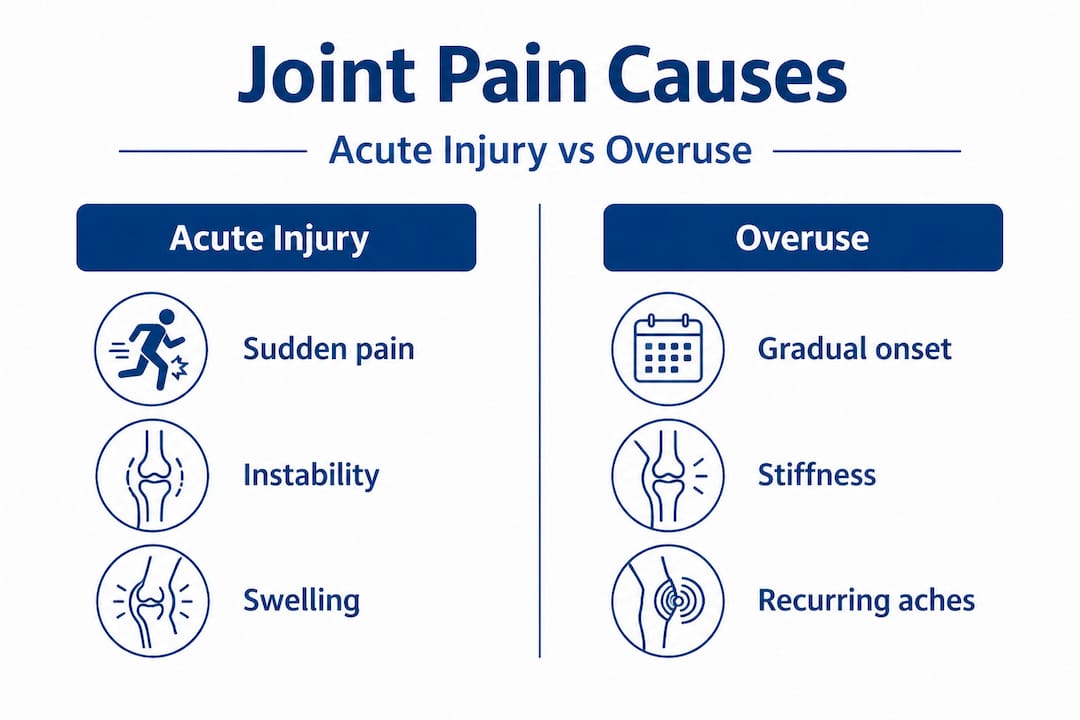
Acute injuries demand immediate attention. A torn ACL, for example, causes immediate instability, pain, and swelling. Left untreated, it can lead to long-term joint damage, instability, and eventually arthritis. Overuse injuries, on the other hand, are often dismissed as normal soreness until they become serious problems.
Research on overuse in sports and mechanical fatigue confirms that repetitive submaximal stress on tendons and ligaments, including the ACL and hamstrings, creates cumulative microdamage that can predispose a joint to eventual failure. In practical terms, this means that a basketball player who ignores persistent knee soreness may face a more serious injury later.
Here’s how to approach each scenario responsibly:
- Recognize the difference. Acute pain after a specific event means stop activity immediately. Gradual pain that builds over days or weeks is a signal to reduce intensity and seek evaluation.
- Don’t train through sharp or worsening pain. Mild muscle soreness after exercise is normal. Joint pain that doesn’t resolve within 48 to 72 hours is not.
- Vary your activities. Cross-training distributes stress across different muscle groups and joints, reducing cumulative damage at any one site.
- Schedule planned rest. Rest is not a sign of weakness. It’s when tissue repairs and strengthens. Build rest days into every training week.
- Seek early evaluation for persistent symptoms. Waiting often means a longer recovery later.
Pro Tip: Rotating between high-impact and low-impact activities, such as alternating running days with swimming or cycling, is one of the most effective ways to prevent overuse injuries without sacrificing fitness.
Detailed information about what treatment options are available for specific injuries can be found through joint procedure examples and a shoulder vs knee procedures comparison guide.
Beyond the usual suspects: Rare and referred causes of joint pain
But not all joint pain fits the classic patterns covered above. Sometimes, there’s an unusual underlying cause that gets missed when only injuries and arthritis are considered.
Edge cases in joint pain origins include reactive arthritis triggered by an infection elsewhere in the body, crystal-induced joint inflammation such as gout, and referred pain that originates in the spine or surrounding nerves but is felt in a joint. In athletes, patellar tendinopathy from eccentric loading is another overlooked contributor to knee pain.
Some important but less common causes to be aware of:
- Reactive arthritis: Joint inflammation that develops after a bacterial infection, such as a urinary tract or gastrointestinal infection. The joint pain itself may appear weeks after the original infection clears.
- Gout: A condition where uric acid crystals build up inside a joint, most often the big toe, ankle, or knee, causing sudden, severe pain episodes that can last days.
- Referred pain: Pain that originates in the spine, a nerve root, or another structure but is felt in a knee, hip, or shoulder. This is common with herniated discs or pinched nerves.
- Patellar tendinopathy: Often called jumper’s knee, this results from repeated jumping and landing and causes pain at the front of the knee below the kneecap.
“If your joint pain doesn’t respond to typical treatments or doesn’t fit the usual pattern for an injury or arthritis, a thorough diagnostic evaluation can uncover what’s really driving the problem.”
Understanding whether your pain fits a common or unusual pattern is one of the reasons a professional assessment is so valuable. Learning about available non-surgical joint pain relief options is a good way to understand the full range of what’s possible before any decisions are made.
What most guides miss: The importance of tailored prevention
After reviewing all these causes, an important truth stands out that you won’t read in most articles. Generic joint pain advice, the kind that says “stretch more, lose weight, and take it easy,” is simply not specific enough to be useful for most people.
Here in New Hampshire, residents are active year-round. Skiing in winter, hiking and running in spring and summer, and team sports in the fall create a population that cycles through very different physical demands depending on the season. A prevention plan that works for a summer runner may not be appropriate for the same person heading into ski season. That seasonal context matters, and it rarely gets addressed in generalized health content.
The same logic applies to treatment. Two patients with knee OA can have completely different presentations, different risk factors, and different functional goals. One may be a 55-year-old recreational cyclist; another may be a 70-year-old retired teacher who just wants to walk without pain. Their treatment plans should not look the same.
We’ve seen consistently that patients who work with an orthopedic specialist to develop a personalized prevention and care strategy have better long-term outcomes than those who follow generic advice alone. A thorough sports injury rehabilitation guide can illustrate just how individualized a proper recovery and prevention plan can be.
The most effective joint care is built around your specific activity level, your medical history, and your personal goals. That kind of precision doesn’t come from a generic article. It comes from an honest conversation with a specialist who understands your full picture.
Explore expert joint care and treatment options
Armed with knowledge, taking the next step toward relief is within reach. At Nowak Orthopedic Associates, we offer individualized care designed around your specific condition, whether that means non-surgical options like PRP injections and SoftWave therapy, or surgical solutions like ACL reconstruction or partial knee replacement. You can explore a full overview through our guide to advanced joint care, or browse the full range of orthopedic services and treatments we provide. If joint pain is affecting your daily life or keeping you from the activities you love, we encourage you to schedule a consultation with Dr. Nowak and take a meaningful step toward lasting relief.
Frequently asked questions
Can joint pain go away on its own?
Mild joint pain can sometimes resolve with rest and self-care, but persistent or worsening pain should be evaluated by a doctor to rule out serious underlying causes.
What are the most common causes of sudden joint pain?
Sudden joint pain is most often caused by acute injuries; less commonly, the edge cases in joint pain origins such as gout or infection-related reactive arthritis can also be responsible.
How is arthritis different from sports injuries in causing joint pain?
Sports injuries cause joint pain via trauma or overuse and tend to produce sudden or activity-specific pain, while Arthritis prevalence and demographics data confirms that arthritis develops gradually and is chronic, affecting 21 to 25% of U.S. adults with ongoing symptoms.
Do women or older adults experience joint pain more often?
Yes, Arthritis prevalence and demographics confirm that arthritis is significantly more common in older adults and women, largely due to hormonal and structural factors that increase joint vulnerability over time.
Is it possible to prevent joint pain from sports activities?
Yes, using proper form, warming up thoroughly, and building rest days into your training schedule all reduce the risk, because overuse in sports and mechanical fatigue develop precisely when the body isn’t given adequate time to recover between sessions.