

TL;DR:
- Preventable sports injuries often result from poor preparation, technique, and recovery habits rather than excessive effort.
- Consistent, under-20-minute multimodal routines focusing on warm-up, strength, and balance can significantly reduce injury risk.
If you’re an active person in Hampton, NH, you know how quickly a preventable injury can wipe out weeks of training, sideline you from your favorite sport, or leave you managing chronic joint pain. The frustrating reality is that most sports injuries don’t happen because athletes work too hard. They happen because preparation, technique, and recovery habits fall short. The good news is that current research gives us a clear, actionable picture of what actually prevents injuries, and it’s more achievable than you might think.
Table of Contents
- Understand common sports injuries and their causes
- Essential preparation: Building an injury-resilient foundation
- Executing your prevention plan: Habits, adherence, and targeted training
- Protecting your joints: Biomechanics, neuromuscular training, and advanced tips
- When injuries happen: Immediate steps and long-term strategies
- A smarter approach: Why context and consistency matter most in injury prevention
- Expert help for injury prevention and joint care in Hampton, NH
- Frequently asked questions
Key Takeaways
| Point | Details |
|---|---|
| Multicomponent routines work best | Combining strength, plyometrics, agility, and balance reduces injury risk far more than focusing on one area. |
| Consistency is crucial | Sticking with prevention programs—even short ones—dramatically lowers your odds of getting hurt during activity. |
| Protect your joints proactively | Sport-specific strength and neuromuscular training boost joint health and reduce the chances of knee, ACL, or shoulder injuries. |
| Respond smartly to injuries | Following proven first-aid and rehab steps keeps minor injuries from becoming major setbacks. |
| Personalized care leads to better outcomes | Working with orthopedic and sports medicine specialists ensures your prevention strategies fit your needs and goals. |
Understand common sports injuries and their causes
With the stakes laid out, let’s look at what types of injuries are most common and why they happen so you can prevent them before they start.
The most frequent types of sports injuries that sideline athletes include:
- Sprains: Overstretched or torn ligaments, most often in the ankle and knee
- Strains: Muscle or tendon tears, commonly affecting the hamstrings and lower back
- Knee injuries: Meniscus tears, ACL ruptures, and patellofemoral pain
- Shoulder injuries: Rotator cuff tears, labral damage, and impingement
- Stress fractures: Small bone cracks from repetitive loading, common in the foot and shin
| Injury type | Primary cause | Risk factors |
|---|---|---|
| Ankle sprain | Sudden change of direction | Poor balance, weak peroneals |
| ACL tear | Landing/pivoting mechanics | Muscle imbalance, poor neuromuscular control |
| Rotator cuff strain | Overuse, poor shoulder mechanics | Weak scapular stabilizers, fatigue |
| Hamstring strain | High-speed sprinting without prep | Low flexibility, inadequate warm-up |
| Stress fracture | Repetitive impact | Low bone density, training spikes |
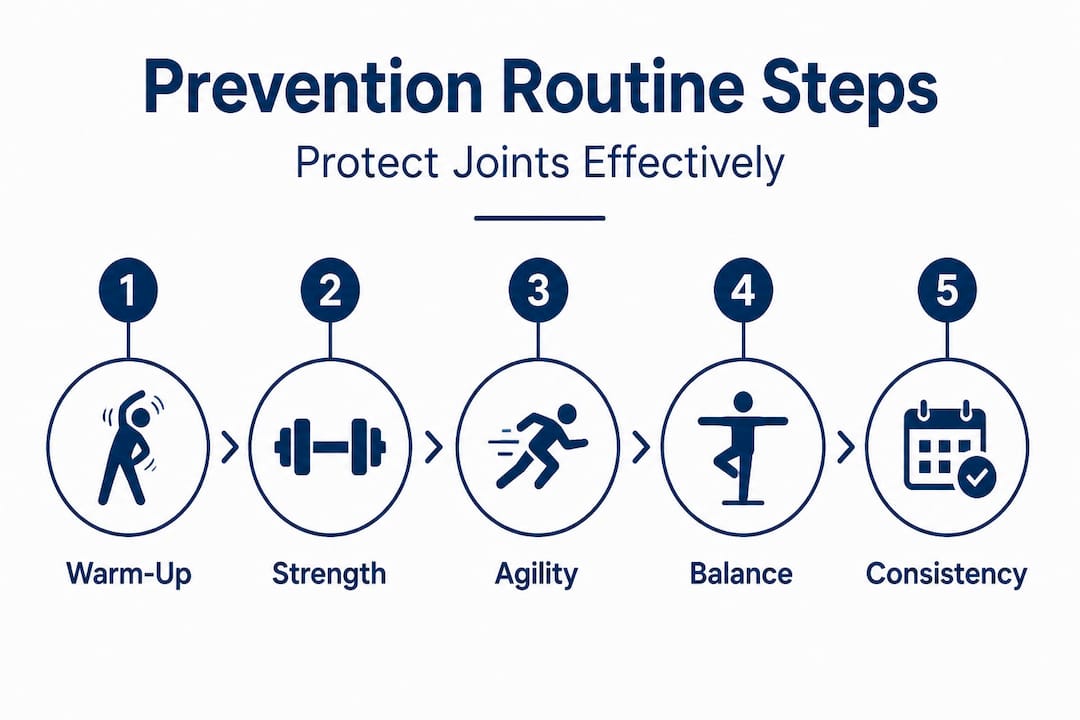
Primary causes fall into a consistent pattern: overuse without adequate recovery, poor movement technique, skipping warm-up, muscle imbalances that shift load onto vulnerable structures, and insufficient rest between sessions. Research confirms that multicomponent programs focusing on warm-up, plyometrics, strength, agility, and balance can reduce total injuries by 35% and lower extremity injuries by 33%.
“The athletes who stay healthy longest are often not the most talented. They’re the most prepared.”
Identifying your personal risk areas early, whether that’s a history of ankle instability or recurring knee discomfort, allows you to tailor your prevention work where it counts most. Smart knee injury prevention starts with understanding what your joints are exposed to in your specific sport.
Essential preparation: Building an injury-resilient foundation
Now that you understand what injuries to watch for, it’s time to arm yourself with preparation habits that truly make a difference.
An effective warm-up and injury-prevention routine isn’t about simply jogging for five minutes before practice. It’s a structured combination of movements that prime your nervous system, increase tissue temperature, activate key muscle groups, and rehearse the movement patterns you’ll use in your sport.
Here’s a minimum effective prep routine you can apply right now:
- Light aerobic movement (3 min): Jogging, skipping, or lateral shuffles to elevate heart rate
- Dynamic stretching (3 min): Leg swings, arm circles, hip circles, and walking lunges
- Glute and hip activation (3 min): Banded clamshells, glute bridges, and lateral band walks
- Core activation (2 min): Plank holds and dead bugs
- Plyometric preparation (3 min): Low-intensity jumps, hops, and lateral bounds
- Agility and balance (3 min): Single-leg balance, cone drills, reactive footwork
- Sport-specific rehearsal (3 min): Practice the first movements of your sport at reduced intensity
This entire sequence runs under 20 minutes. That matters because programs under 20 minutes are the most effective in research settings, with even stronger results seen in female athletes. The evidence supporting these proven joint health steps is robust, and the time commitment is genuinely achievable.
| Program type | Duration | Adherence in studies | Injury reduction |
|---|---|---|---|
| Multicomponent | Under 20 min | High | 35% total, 33% lower extremity |
| Strength only | 30 to 45 min | Moderate | Moderate |
| Flexibility only | 10 to 15 min | High | Low alone |
| Balance only | 15 to 20 min | Moderate | High for ACL |
Pro Tip: Consistency beats intensity every time. A 15-minute routine done six days per week outperforms a 45-minute session done twice a week. Schedule it before every practice, and it becomes automatic within two to three weeks. Explore knee joint preservation options if your knees are already showing early warning signs.
Executing your prevention plan: Habits, adherence, and targeted training
Once your foundation is solid, the key is to establish a concrete prevention routine and make it stick.
Knowing what to do is only half the equation. The science is clear: high adherence to exercise programs is the single most powerful predictor of injury reduction. For hamstring injuries specifically, athletes who reached 75% adherence to their prevention program showed dramatically lower injury rates compared to those who performed the program inconsistently.
Here’s how to build a sustainable prevention habit:
- Anchor it to existing routines: Perform your prevention work immediately before every practice or training session, never as a separate activity
- Track your sessions: A simple checkmark on a calendar builds accountability and shows you when you’re slipping
- Adjust for your body zones: Athletes with prior knee injuries should emphasize quad and hamstring balance work; those with shoulder history need rotator cuff and scapular stability exercises
- Progress load gradually: Increase plyometric intensity or resistance by no more than 10% per week to avoid overload injuries
- Schedule deload weeks: Every three to four weeks, reduce volume by 30% to allow connective tissue to recover and adapt
Pro Tip: Partner up with a training partner or teammate and make your prevention routine a shared commitment. Group accountability consistently outperforms solo intentions when it comes to long-term adherence. Review knee injury prevention strategies and the full sports injury rehab framework to keep your training aligned with your goals.
Protecting your joints: Biomechanics, neuromuscular training, and advanced tips
With habits in place, focusing on sophisticated joint-protection tactics can provide another layer of defense.
Your joints don’t fail in isolation. They fail because of how you move. Biomechanics, the study of how forces act on your body during movement, plays a direct role in joint stress. Faulty landing mechanics, knee valgus (knees caving inward) during squats or jumps, and forward trunk lean during deceleration all increase the load on cartilage, ligaments, and tendons.
Neuromuscular training corrects these patterns. It combines balance, coordination, and strength work to teach your body how to move safely under real athletic conditions. The results are significant: balance-focused programs reduce ACL injury risk by up to 58%. Separately, structured shoulder programs reduce shoulder injuries by 51% in overhead athletes.
Advanced joint-protection habits worth integrating:
- Single-leg training: Squats, deadlifts, and hops on one leg reveal and correct left-right strength imbalances
- Landing mechanics drills: Practice soft, controlled landings from jumps, bending knees to 90 degrees on contact
- Hip hinge patterns: Teaching your body to load the hips during deceleration reduces ACL stress significantly
- Shoulder stability work: Face pulls, external rotations, and Y-T-W exercises strengthen the rotator cuff and support shoulder injury prevention
- Core anti-rotation exercises: Pallof press and single-arm carries train your trunk to resist dangerous twisting forces
- Video feedback: Recording and reviewing your movement during practice helps you catch and correct faulty patterns early
If you want to understand joint pain before it becomes an injury, these drills are your best tool. Addressing movement quality also directly supports long-term knee joint stability.
When injuries happen: Immediate steps and long-term strategies
Even with prevention, injuries can occur. Knowing the right response makes a big difference in joint health and recovery.
Follow these steps after a sports injury:
- Rest immediately: Stop the activity. Continuing through pain risks turning a minor injury into a major one
- Apply RICE: Use RICE for acute injuries (Rest, Ice, Compression, Elevation) during the first 48 to 72 hours
- Evaluate the injury: If swelling, instability, or pain persists beyond 48 hours, seek professional assessment
- Address underlying issues: Before returning to training, identify and correct muscle imbalances or movement faults that contributed to the injury
- Gradual return: Follow a progressive return-to-sport plan that rebuilds load tolerance before full competition
“Pushing through pain is not toughness. It’s a shortcut to a longer recovery.”
Long-term strategies to avoid repeat injuries include regular movement screening, dedicated rehab for any prior injuries, and gradual load progression rather than sudden training spikes. Review the full sports injury treatment workflow and the complete sports injury rehab guide for a detailed return-to-play roadmap.
A smarter approach: Why context and consistency matter most in injury prevention
Taken together, these steps arm you against injuries, but what really sets successful athletes apart is a smart, adaptive mindset.
Here’s something that surprises most athletes: the best prevention program is not the one with the most sophisticated exercises. It’s the one you actually do. Research comparing different intervention styles found that context-sensitive, collaborative approaches outperform rigid, linear programs. In real-world settings, treating injury prevention as a “wicked problem” requiring flexibility reduced injuries by 15%, more than many highly controlled study protocols.
What this means for you is practical. No single program works identically for every athlete. Your body, sport, training history, and schedule are unique. A program designed with your specific risk factors in mind, and adjusted regularly based on how you respond, will outperform any generic template. High adherence to a good program beats low adherence to a perfect one, every single time.
Collaborate with coaches, physical therapists, and orthopedic professionals to build a prevention strategy that fits your life. Use the rehab guide for athletes as a reference point, and revisit your approach every few months. The athletes who stay healthy across a full season are the ones who stay flexible, not just physically, but strategically.
Expert help for injury prevention and joint care in Hampton, NH
Ready to take the next step? Here’s how to get tailored support for your injury prevention journey in Hampton, NH.
At Nowak Orthopedic Associates, our team works with active individuals to build personalized injury prevention plans, assess joint health, and provide the targeted treatment you need to stay in the game. Whether you’re looking for guidance from our sports medicine specialists, exploring options for advanced joint care, or seeking joint pain relief options that go beyond rest and ice, we’re here to help. Contact our Hampton, NH, office today to schedule an evaluation and get back to doing what you love.
Frequently asked questions
What is the most effective injury prevention routine for athletes?
A multicomponent program combining strength, plyometrics, agility, balance, and dynamic warm-up is most effective, especially when sessions stay under 20 minutes and are performed consistently throughout the week.
How important is adherence to injury prevention programs?
High adherence is actually more predictive of injury reduction than program design, meaning doing your routine regularly at 75% or better compliance matters more than which specific program you choose.
What is the first thing to do after a sports injury?
Use RICE immediately (Rest, Ice, Compression, Elevation), then seek professional evaluation if pain, swelling, or instability continues beyond 48 hours.
Can joint-specific exercises help prevent common injuries?
Yes, exercises targeting biomechanics and proprioception have been shown to reduce ACL injury risk by up to 58% and significantly lower the rate of shoulder injuries in overhead athletes.