

TL;DR:
- Understanding shoulder injury terms improves treatment decisions and recovery outcomes.
- Accurate diagnosis relies on imaging and differentiates between Tears, impingements, and capsulitis.
- Patient education and clear communication are essential for effective shoulder injury management.
Sitting in an orthopedic office after a painful shoulder injury and hearing terms like “SLAP tear,” “impingement syndrome,” or “adhesive capsulitis” can feel overwhelming. Most patients leave their first appointment with more questions than answers, and that confusion can delay recovery. When you understand the words being used to describe your shoulder condition, you can ask better questions, make more confident treatment decisions, and work more effectively with your care team. This guide is designed to give New Hampshire patients a clear, accessible foundation for understanding the terminology their orthopedic specialist uses every day.
Table of Contents
- The most common shoulder injuries and what they mean
- Understanding specific terms: tears, impingements, and capsulitis
- When injuries get complicated: dislocations, age factors, and nerve concerns
- Shoulder injury treatment: terms and options from self-care to surgery
- Our take: Why understanding shoulder injury terms changes your outcome
- Get expert orthopedic care and clear answers in New Hampshire
- Frequently asked questions
Key Takeaways
| Point | Details |
|---|---|
| Know injury terms | Understanding words like tear or impingement helps you ask better questions and choose the right care. |
| Diagnosis shapes treatment | The exact terminology used guides your recovery plan, from physical therapy to surgery. |
| Ask for clarification | Never hesitate to have your provider explain confusing terms so you can be more involved in decisions. |
| Recovery timelines vary | Orthopedic injury recovery depends on the diagnosis, treatment type, and your age or activity level. |
The most common shoulder injuries and what they mean
With many shoulder problems falling under complicated-sounding labels, let’s break down what these terms actually represent and how they differ.
Your shoulder is one of the most mobile joints in your body, and that mobility comes with vulnerability. Shoulder injuries include rotator cuff tears (partial or full-thickness, degenerative or acute), impingement syndrome, SLAP tears, frozen shoulder, dislocations, separations, fractures, sprains, and strains. Each of these has a distinct meaning, and mixing them up can lead to incorrect expectations or the wrong treatment path.
Here is a quick breakdown of the most common shoulder injury types:
- Rotator cuff tear: The rotator cuff is a group of four muscles and tendons surrounding the shoulder joint. A tear can be partial (fibers are damaged but not fully severed) or full-thickness (the tendon is completely torn). Tears can also be acute (caused by a sudden fall or force) or degenerative (wear and tear over time).
- Impingement syndrome: This occurs when shoulder tendons or bursa get compressed or pinched during arm movement, often causing pain when reaching overhead.
- SLAP tear: SLAP stands for Superior Labrum Anterior to Posterior. This is a tear in the cartilage ring (labrum) that surrounds the shoulder socket, common in throwing athletes or from a fall.
- Frozen shoulder (adhesive capsulitis): The shoulder capsule becomes thick and tight, severely limiting motion. This is discussed in more detail in the next section.
- Dislocation vs. separation: A dislocation means the ball of the upper arm bone slips out of the shoulder socket. A separation involves the joint where the collarbone meets the shoulder blade (the AC joint), not the ball and socket.
- Sprains vs. strains: A sprain is a ligament injury, while a strain involves a muscle or tendon.
| Term | Structure affected | Typical cause |
|---|---|---|
| Rotator cuff tear | Tendon/muscle | Fall, repetitive motion, aging |
| SLAP tear | Labrum (cartilage) | Overhead sports, trauma |
| Impingement | Tendons, bursa | Repetitive overhead activity |
| Dislocation | Ball and socket joint | Trauma, sports collision |
| Separation | AC joint (collarbone) | Fall on shoulder |
| Sprain | Ligament | Sudden stretch or force |
Understanding these differences affects more than just terminology. A patient with a SLAP tear and a patient with impingement syndrome may have similar pain, but their shoulder injury recovery options and timelines are quite different. One may need surgical repair while the other can recover fully with physical therapy.
Pro Tip: Any time your provider uses a term you do not recognize, ask them to explain it in plain language. A good orthopedic specialist will always welcome that question. Informed patients have better outcomes.
Understanding specific terms: tears, impingements, and capsulitis
Once you know the general injury types, understanding the nuance in terminology for tears or frozen shoulder can further demystify your diagnosis.
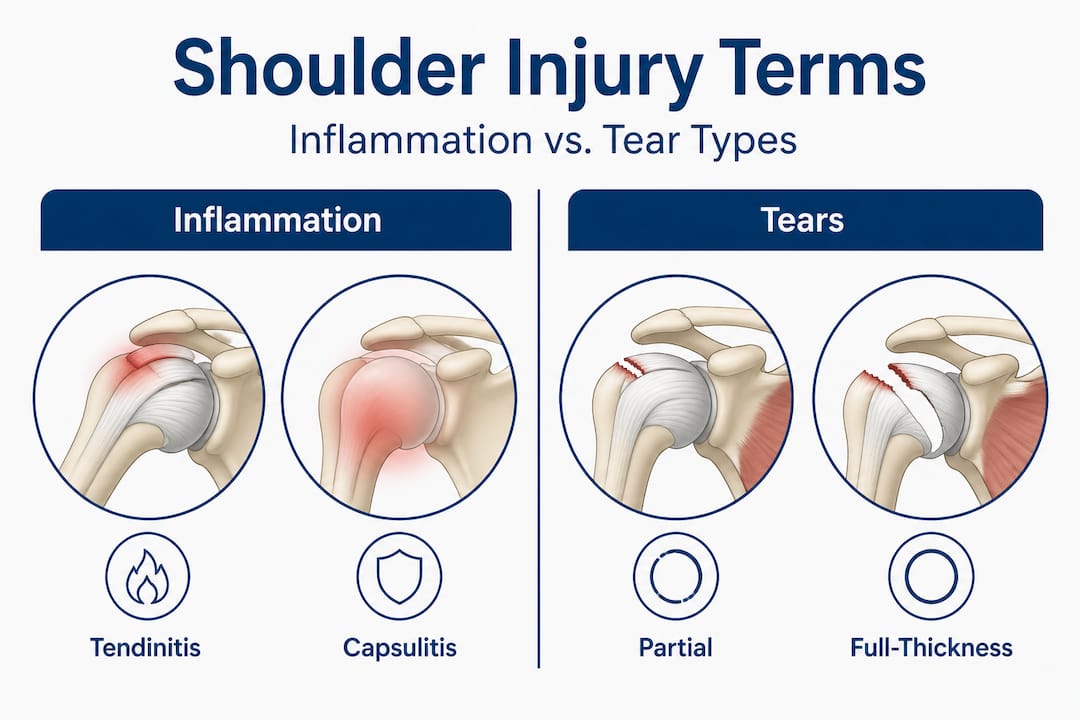
Many patients are unsure what separates tendinitis from a partial tear from a full-thickness tear. Tendinitis means the tendon is inflamed but structurally intact. A partial tear means some fibers are damaged but the tendon still holds together. A full-thickness tear means the tendon is completely ruptured, which typically requires surgery to restore full function. These distinctions drive very different treatment choices, which is why imaging matters so much.
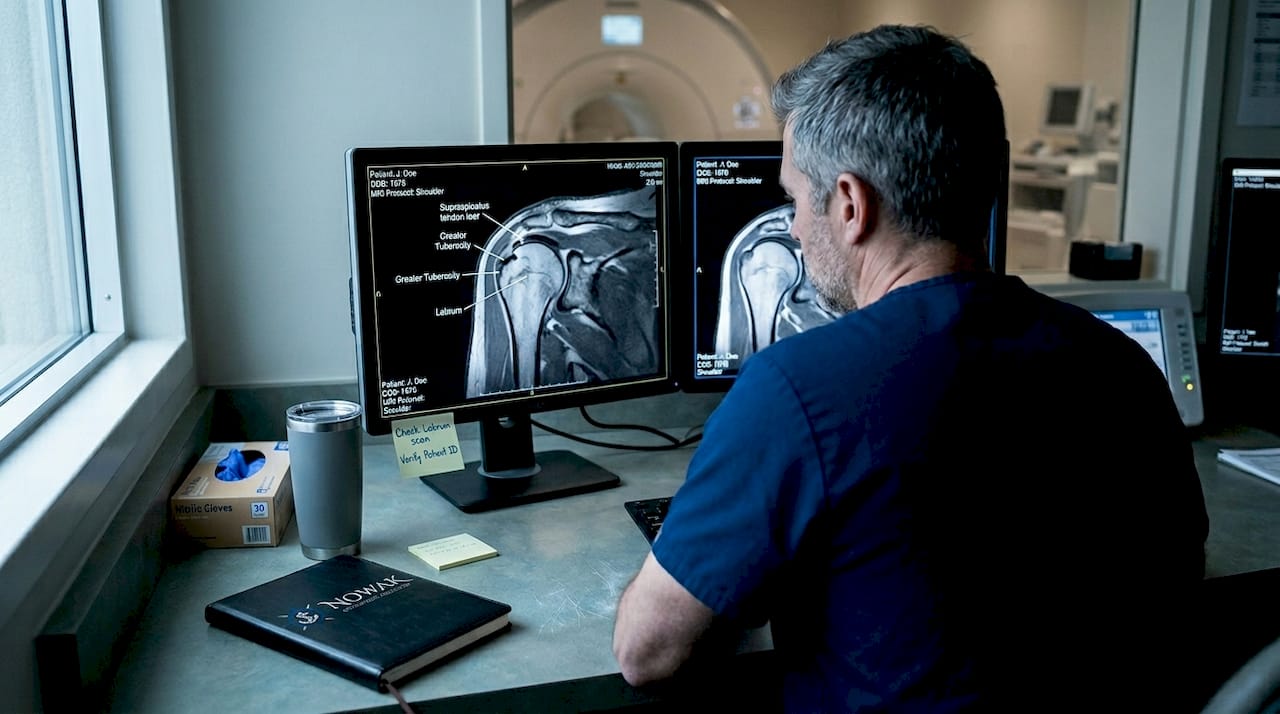
Orthopedic imaging, specifically MRI (magnetic resonance imaging) or diagnostic ultrasound, helps your provider visualize the exact extent of damage. An MRI provides detailed images of soft tissue, while ultrasound allows for real-time, dynamic imaging of tendons. Both tools are commonly used to confirm your diagnosis and determine the right treatment stage.
For impingement specifically, what is actually “getting pinched” is usually either the supraspinatus tendon (part of the rotator cuff) or the subacromial bursa (a small fluid-filled sac that cushions the joint). When these structures become repeatedly compressed, inflammation builds and pain follows, especially with overhead motion.
Frozen shoulder progresses through three recognized stages:
- Freezing stage: Pain increases and motion begins to decrease (can last 2 to 9 months).
- Frozen stage: Pain may ease slightly but stiffness peaks (4 to 12 months).
- Thawing stage: Motion gradually returns (5 to 26 months).
Research shows that frozen shoulder improves in up to 90% of patients within 12 to 18 months with conservative treatment such as physical therapy and corticosteroid injections, without requiring surgery.
Knowing these stages helps patients stay patient during a slow recovery and set realistic expectations. If you are considering shoulder arthroscopy for frozen shoulder, that option is typically reserved for cases that do not respond to conservative care after 12 to 18 months.
When injuries get complicated: dislocations, age factors, and nerve concerns
Beyond classic injuries, more complex scenarios, especially for older adults, require careful attention to both terminology and associated complications.
Shoulder dislocations are described by their direction. Anterior dislocations account for over 95% of all cases, meaning the ball slips forward out of the socket. Posterior and inferior dislocations are much rarer and often associated with more serious trauma. Knowing the direction of your dislocation matters because it guides the reduction technique (returning the joint to its normal position) and the follow-up treatment approach.
Age plays a significant role in how dislocations are managed. In patients over 60, shoulder dislocation frequently coincides with a rotator cuff tear in roughly 20% of cases, making it critical to evaluate both injuries at the same time. Younger patients (under 30) have a high rate of recurrent dislocation, often due to ligament laxity, so long-term stability strategies become the focus of their care.
Here are key complications to be aware of following a shoulder dislocation:
- Rotator cuff tear: Especially in older patients, as noted above.
- Bankart lesion: A tear in the front part of the labrum, very common with anterior dislocations.
- Hill-Sachs lesion: An indentation on the back of the ball of the humerus caused by impact during dislocation.
- Axillary nerve injury: The axillary nerve runs near the shoulder joint and can be stretched or damaged during dislocation, causing numbness or weakness in the outer arm.
Pro Tip: If you or a loved one over 60 experiences a shoulder dislocation, specifically ask your provider about getting an MRI to check for rotator cuff tears and to assess nerve function before finalizing any treatment plan. This step is often overlooked but can be critical for proper shoulder surgery preparation.
Shoulder injury treatment: terms and options from self-care to surgery
Knowing the words for your condition also means knowing the terms for treatment. Here is what you need to track your options.
Many shoulder injuries respond well to conservative (non-surgical) care. Understanding the abbreviations your care team uses keeps you engaged in your own recovery plan.
- RICE: Rest, Ice, Compression, Elevation. Used immediately after an acute injury to reduce swelling and pain.
- NSAIDs: Non-steroidal anti-inflammatory drugs (such as ibuprofen or naproxen) that reduce inflammation and pain.
- PT: Physical therapy, which focuses on strengthening and restoring range of motion (ROM) in the shoulder.
- ROM: Range of motion exercises that prevent stiffness and restore function.
- ABR: Acute Brace or Arm immobilization using a sling, often recommended after dislocation to allow initial healing.
- Corticosteroid injection: An anti-inflammatory medication injected directly into the joint or bursa to reduce pain and swelling.
Most shoulder injuries improve successfully with a combination of these non-surgical treatments, with success rates between 80 and 90 percent for many common conditions. Surgery becomes necessary when conservative care fails, when a full-thickness tear is confirmed, or when instability continues to affect daily life.
Statistic to know: Rotator cuff repair surgery typically requires 4 to 6 months of recovery, including post-operative physical therapy. SLAP repair and Bankart stabilization have similar timelines. Understanding this from the start helps you plan your return to work, sport, or daily activities realistically. Learn more about all shoulder injury treatments and what each phase of recovery involves. If you’re an active person in New Hampshire, a sports injury rehab guide can also help you set realistic return-to-activity benchmarks.
Our take: Why understanding shoulder injury terms changes your outcome
We see something consistent in our practice: the patients who take time to understand their diagnosis tend to recover more effectively than those who stay confused. This is not just an observation. Early strengthening and precise diagnosis enable better return-to-sport outcomes, but only when patients and providers are speaking the same language.
When a patient believes they have “tendinitis” but actually has a full-thickness rotator cuff tear, they may push through pain, delay seeking surgery, and ultimately end up with a harder recovery. The opposite also happens: a patient convinced they need surgery for what turns out to be mild impingement syndrome misses out on the very real success of targeted physical therapy.
Precise terminology also enables better use of imaging. When a patient arrives describing “shoulder weakness” after a fall, knowing the difference between an axillary nerve issue and a rotator cuff tear changes the entire diagnostic approach. Ultrasound-guided assessment of the specific tendon or nerve in question leads to faster, more accurate answers.
We believe that educating patients about their treatment and terminology is not a “nice to have” step, it is core to good orthopedic care. Setbacks from re-injury or prolonged recovery are often traced back to miscommunication, not to the injury itself. Clear language is genuinely therapeutic.
Get expert orthopedic care and clear answers in New Hampshire
If you are navigating a shoulder injury and still unsure what your diagnosis actually means, you deserve clear, jargon-free answers and a provider who takes time to explain them. At Nowak Orthopedic Associates in Hampton, NH, Dr. Roger B. Nowak and the care team specialize in translating complex orthopedic conditions into actionable treatment plans. Read our orthopedic surgeons guide to understand what advanced joint care involves, or explore what to expect at your first orthopedic visit. When you’re ready to move from explanation to action, review our full range of joint pain relief procedures and take the next step toward healing with confidence.
Frequently asked questions
What is the difference between a rotator cuff tear and tendonitis?
A rotator cuff tear means tendon fibers are actually torn or severed, while tendonitis is inflammation of the tendon without structural tearing, and the two require different treatment approaches.
How long does it take to recover from a frozen shoulder?
Most people see meaningful improvement within 12 to 18 months, as range of motion typically improves with consistent physical therapy and injections without requiring surgery.
Are shoulder dislocations always emergencies?
Shoulder dislocations need prompt medical attention for reduction (putting the joint back in place), but ongoing risk varies by age and whether associated injuries like rotator cuff tears or nerve damage are present.
What does PT mean for shoulder injuries?
PT stands for physical therapy, and it is a cornerstone of shoulder recovery, helping restore strength, flexibility, and range of motion after most types of shoulder injury.