

TL;DR:
- Platelet-rich plasma (PRP) therapy uses your own blood’s growth factors to reduce knee pain and promote healing. It is most effective for mild to moderate osteoarthritis and requires precise preparation and guided injection by experienced providers. PRP often offers longer-lasting relief than corticosteroids, with minimal risks and benefits that depend on personalized treatment approaches.
When knee pain takes over your daily life, most people assume the choice comes down to pain medication, physical therapy, or eventually going under the knife. That assumption leaves a lot of people suffering longer than necessary. Platelet-rich plasma therapy, or PRP, is a scientifically supported treatment that uses your body’s own healing biology to reduce pain and improve knee function. It’s gaining serious traction among orthopedic specialists, yet many patients in New Hampshire have never heard a clear explanation of how it works, who benefits most, and what realistic results look like. This guide addresses all of that.
Table of Contents
- What is PRP therapy and how does it work?
- Is PRP therapy effective for knee pain?
- What to expect: Procedure, safety, and recovery
- When is PRP therapy the right choice (and when isn’t it)?
- The real-world truth: Personalizing PRP for your knee
- Explore your knee treatment options with New Hampshire specialists
- Frequently asked questions
Key Takeaways
| Point | Details |
|---|---|
| PRP harnesses your blood | PRP therapy uses your own platelets to stimulate healing and manage inflammation in the knee. |
| Best for early osteoarthritis | People with mild-to-moderate knee osteoarthritis or recent injuries often see the best improvement with PRP. |
| Procedures are brief and safe | Most patients experience only mild, short-term side effects and can return to activity quickly. |
| Results last up to a year | Scientific studies show functional benefits and pain relief may persist for up to 12 months. |
| Individualized care is key | Success depends on the right protocol, candidate selection, and support from orthopedic specialists. |
What is PRP therapy and how does it work?
Now that you know there’s more than the standard routes, let’s break down what PRP therapy really is and how it works.
PRP stands for platelet-rich plasma. It’s a concentrated form of your own blood, processed to amplify the platelets and the growth factors they carry. Platelets are tiny cells your body naturally releases when tissue is damaged. They signal repair, recruit healing cells, and help regulate inflammation. When injected directly into a damaged knee, they go to work in a targeted way.
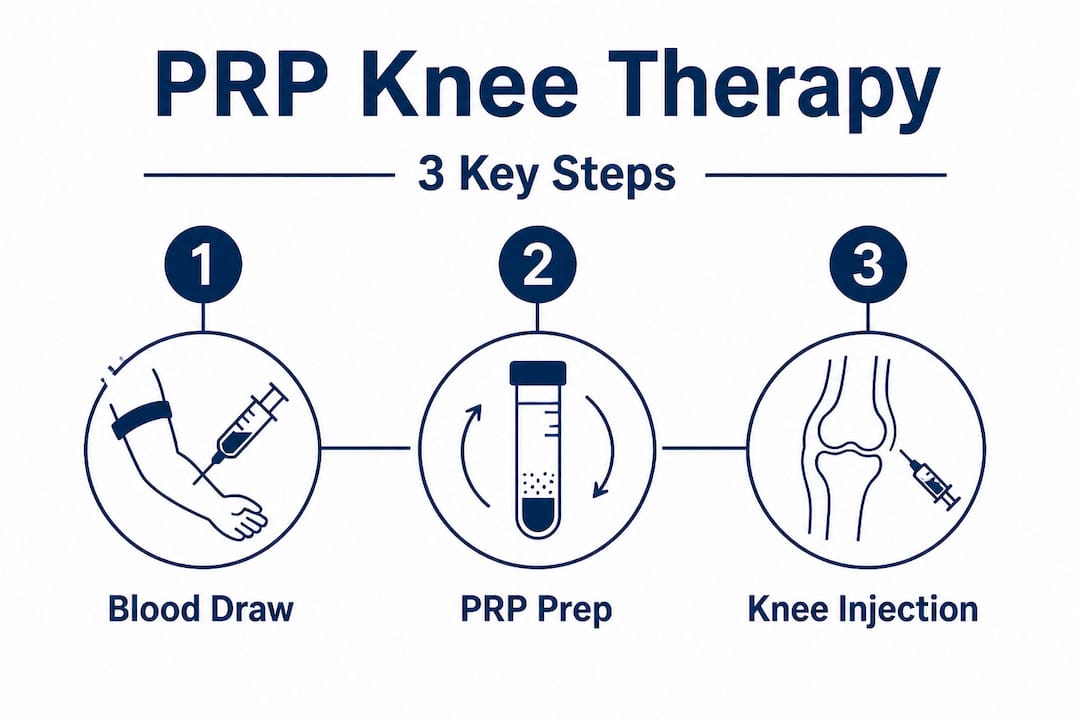
The process happens in four main steps:
- A small amount of blood is drawn from your arm, just like a standard lab draw
- The sample goes into a centrifuge, which spins it at high speed to separate its components
- The platelet-rich layer is extracted and prepared for injection
- The concentrated PRP is injected precisely into the affected knee joint
What makes PRP more than just a simple injection is the biology behind it. Research shows that PRP releases growth factors including PDGF and TGF-beta that stimulate cartilage cell growth, support tissue repair, reduce inflammatory signals, and may help slow cartilage breakdown in osteoarthritis. These bioactive molecules do not just mask pain. They actively encourage the joint environment to shift toward healing.
You can learn more about how PRP injections work and what the preparation process looks like at our practice.
Pro Tip: Ask your provider whether they use leukocyte-poor PRP (LP-PRP) specifically for knee injections. Research suggests this formulation is better tolerated and more effective for knee osteoarthritis than leukocyte-rich versions.
Is PRP therapy effective for knee pain?
Understanding the science is one thing, but does PRP actually make a difference for knee pain in the real world? Here’s what research and patient experiences show.
The short answer is yes, particularly for people with mild to moderate knee osteoarthritis (OA) or joint injuries. The longer answer involves some important nuances worth understanding.
Large-scale analysis of randomized controlled trials provides some of the strongest evidence for PRP injections. A meta-analysis of 28 RCTs covering over 3,200 patients found that PRP consistently outperformed physical therapy alone, delivered longer-lasting relief than corticosteroid (cortisone) shots, and performed as well as or better than hyaluronic acid injections, particularly when LP-PRP was used. These benefits held up at the 12-month mark, which is significant because many other non-surgical options fade in effectiveness well before that.
Clinical outcomes from individual studies reinforce this picture. In one retrospective study of 120 patients with knee OA, PRP improved functional scores on the Lysholm Knee Score from 62 to 81 at three months, a 30% improvement in function. Pain scores on the VAS scale dropped from 5.24 to 2.66, representing over 80% effectiveness in pain reduction. Cartilage condition on MRI also showed measurable improvement.
Here’s a quick comparison of how PRP stacks up against common alternatives:
| Treatment | Pain relief duration | Best for | Drawbacks |
|---|---|---|---|
| PRP injections | Up to 12 months | Mild to moderate OA, injuries | Cost, not always covered by insurance |
| Corticosteroid shots | 4 to 8 weeks | Short-term flare relief | Can weaken tissue with repeated use |
| Hyaluronic acid (HA) | 3 to 6 months | Mild OA | Variable results, multiple injections |
| Physical therapy alone | Ongoing maintenance | All stages | Slower symptom relief |
PRP is most effective for people with early to mid-stage knee OA (Kellgren-Lawrence grades I to II) and for those recovering from athletic injuries. It is not a replacement for surgery in cases of severe joint degeneration.
If you want to understand how PRP compares to newer orthobiologic options, comparing PRP and orthobiologics can help you see the full picture. You can also explore other joint pain relief options that may complement or work alongside PRP.
What to expect: Procedure, safety, and recovery
If you’re considering PRP, here’s what the actual treatment process and recovery look like.
PRP therapy is an outpatient procedure. Most patients are in and out within an hour or less, and there’s no general anesthesia involved. Here’s a typical sequence of what happens:
- Initial evaluation: Your provider reviews your imaging, confirms your diagnosis, and determines if PRP is appropriate for your situation.
- Blood draw: A small sample of your blood is collected from your arm.
- PRP preparation: The sample is processed in a centrifuge to isolate the platelet-rich layer.
- Guided injection: Using ultrasound or fluoroscopic guidance for precision, the PRP is injected into the target area of the knee.
- Brief monitoring: You rest for a short period before being cleared to leave.
After the injection, it’s normal to experience mild soreness, temporary swelling, or stiffness around the knee for a few days. This is simply your body responding to the procedure and the increased healing activity in the joint.
Large-scale safety data is reassuring. Studies covering over 15,000 PRP patients for knee OA report only minor, temporary side effects, and fewer adverse events than corticosteroid injections. Serious complications are rare. Most people return to light daily activities within a day or two, though you should avoid strenuous exercise for a brief period after each injection.
For more details on what knee OA details and treatment options look like for your specific condition, our resources can help you prepare the right questions before your appointment. Additional procedure details on PRP injections are available if you want to go deeper before your consultation.
Pro Tip: Avoid anti-inflammatory medications like ibuprofen for at least a week before and after your PRP injection. These medications can blunt the very inflammatory response that PRP relies on to initiate healing.
When is PRP therapy the right choice (and when isn’t it)?
Finally, not all knee pain responds equally well to PRP. Here’s when this therapy is most likely, and least likely, to help.
Best candidates for PRP therapy:
- Adults with mild to moderate knee osteoarthritis (KL grades I or II)
- Athletes or active individuals recovering from ligament or cartilage injuries
- Patients who have not responded adequately to cortisone injections or physical therapy
- Those who want to delay or potentially avoid surgical intervention
Situations where PRP is less likely to help:
- Advanced knee OA with significant bone-on-bone contact
- Severe joint deformity requiring realignment or replacement
- Active infection near the joint
- Bleeding disorders or certain blood conditions
The evidence also highlights an important limitation: variable efficacy due to non-standardization across clinics means that not all PRP is prepared the same way. LP-PRP is consistently preferred for knee applications, but protocols, platelet concentrations, and injection volumes differ between providers. This variability is one reason some guidelines remain cautious, and why choosing an experienced orthopedic provider matters significantly.
Cost and insurance coverage are real-world considerations. Most major insurance plans classify PRP for knee OA as experimental and do not cover it. Discuss pricing and payment options with your provider upfront.
For a broader look at comparing PRP to other treatments, or to review your full range of joint pain procedures, we encourage you to explore your options with a qualified orthopedic specialist.
The real-world truth: Personalizing PRP for your knee
After reviewing the evidence and nuances, here’s what actually makes the biggest difference for PRP outcomes in real clinical practice.
The patients who benefit most from PRP are not simply those who have the diagnosis that fits. They are the patients who receive the right formulation, the right dosing, and the right guidance from a provider who integrates PRP into a broader plan for their joint health. A PRP injection delivered without consideration of your activity level, OA severity, body composition, and rehabilitation needs is simply a less effective one.
We’ve seen that protocol quality matters as much as the therapy itself. LP-PRP, ultrasound-guided delivery, and appropriate injection spacing are not optional extras. They are the difference between average and meaningful results. Asking a provider how they prepare their PRP, what concentration they use, and how they determine candidacy is not overly technical. It’s smart patient advocacy.
Combining PRP with guided rehab, activity modification, and a longer-term orthopedic strategy consistently produces better outcomes than PRP alone. The therapy is not a standalone cure. It’s a tool, and like any tool, its value depends entirely on how skillfully it is used. For New Hampshire patients exploring their options, expert advice on PRP choices can help clarify which path makes the most sense for your specific situation.
Explore your knee treatment options with New Hampshire specialists
At Nowak Orthopedic Associates in Hampton, NH, we understand how disruptive knee pain can be to your daily life and activity. Our regenerative medicine clinic offers PRP therapy as part of a fully individualized treatment plan, designed around your specific diagnosis, goals, and lifestyle. Whether you’re managing early-stage knee OA, recovering from a sports injury, or looking to preserve your knee health for years to come, we can help you determine if PRP knee injections are the right fit. Explore your knee joint preservation options and schedule a consultation with our team to get a clear, personalized plan for your recovery.
Frequently asked questions
How many PRP injections will I need for knee pain?
Most protocols recommend 3 to 5 injections spaced 7 to 14 days apart for the best results, though your provider may adjust this based on your condition’s severity and your initial response.
Is PRP better than cortisone shots for the knee?
Research shows that PRP provides longer-lasting pain relief than cortisone injections, with benefits lasting up to 12 months and fewer adverse events over time.
Does insurance cover PRP injections for knees?
Most insurance plans do not cover PRP for knee osteoarthritis because it is still classified as experimental by major payers, so out-of-pocket costs are common and should be discussed during your consultation.
Who should avoid PRP therapy?
PRP is generally not recommended for patients with advanced knee arthritis, active joint infections, or bleeding disorders, as outcomes are less reliable in these situations and alternative treatments may be more appropriate.
How soon will I feel results after PRP for my knee?
Many patients notice gradual improvement within a few weeks, with the most significant benefits typically seen at two to three months after completing the injection series.