

TL;DR:
- Elbow pain often results from overuse, poor technique, or sudden training load increases, but prevention is possible through proper habits. Incorporating ergonomic routines, targeted exercises, load management, and consistent monitoring reduces injury risks across sports and occupational activities. A holistic approach addressing the entire kinetic chain is essential for long-term elbow health and injury prevention.
Elbow pain has a way of shutting down a training block without warning. One day you’re playing tennis, swinging a golf club, or throwing a baseball, and the next day you’re sidelined by a nagging ache that refuses to quiet down. For athletes and active adults in New Hampshire, this kind of setback is frustrating and, in many cases, entirely preventable. A structured, evidence-based prevention workflow gives you the tools to identify your risks, build protective habits, and stay active without sacrificing your elbow health.
Table of Contents
- Understand your risk factors and mechanics
- Essential preparation: Tools, exercises, and ergonomic habits
- Execution: Integrate protective strategies into your routine
- Troubleshooting and fine-tuning: Common mistakes and advanced tips
- Check your progress: Self-assessment and knowing when to seek care
- Why elbow injury prevention workflows need a holistic approach
- Connecting with expert orthopedic support
- Frequently asked questions
Key Takeaways
| Point | Details |
|---|---|
| Know your risks | Understanding your personal risk factors and training habits is the first step to preventing elbow injuries. |
| Prioritize whole-body strength | Strengthening your core, shoulder, and forearm together is more effective than focusing on the elbow alone. |
| Adopt daily prevention habits | Simple routines like ergonomic adjustments and regular micro-breaks cut your injury risk. |
| Monitor and adapt | Check your progress regularly, respond early to warning signs, and seek orthopedic advice when issues persist. |
Understand your risk factors and mechanics
Having grasped the importance of prevention, the first step involves understanding what makes you susceptible to elbow injuries in the first place.
The elbow takes on significant stress during repetitive activities. Throwing athletes accumulate stress on the medial (inner) side of the joint with every pitch. Tennis players face loading on both the lateral (outer) and medial sides depending on stroke mechanics. Office workers and laborers who perform repetitive gripping or lifting can develop chronic overuse conditions over time.
Common risk factors include:
- Repetitive motion without adequate recovery time
- Poor technique in sport-specific skills such as pitching, serving, or swinging
- Excessive grip tension when using rackets, clubs, or tools
- Muscle fatigue that shifts load to passive structures like tendons and ligaments
- Ergonomic problems such as incorrect keyboard height or poor lifting mechanics
- Rapid training load increases beyond what the tissue can tolerate
Proper technique and ergonomic adjustments are crucial for preventing elbow disorders across occupational and athletic settings. Reviewing your injury prevention strategies with a professional can help you pinpoint gaps in your current approach. Understanding elbow instability causes is equally important when the joint feels loose or unpredictable during activity.
| Sport or activity | Primary risk factors |
|---|---|
| Baseball/softball | High pitch counts, poor arm path, fatigue |
| Tennis | Racket grip size, string tension, backhand technique |
| Golf | Grip pressure, swing mechanics, overuse |
| Weightlifting | Excessive elbow flexion load, programming errors |
| Office/desk work | Repetitive mouse use, poor wrist/forearm position |
| Carpentry/trades | Vibration, repetitive gripping, awkward postures |
Pro Tip: Set a recurring alarm every 45 to 60 minutes during desk work or repetitive tasks. Stand, gently flex and extend your elbow, and rotate your forearm for 30 seconds. This micro-break routine reduces cumulative load on tendons before it becomes a problem.
Essential preparation: Tools, exercises, and ergonomic habits
Once you know your risks, effective preparation sets the groundwork for safe activity.
Preparation means more than stretching before a game. It involves selecting the right equipment, establishing ergonomic routines, and committing to a consistent exercise program that builds resilience in the tissues surrounding the elbow.
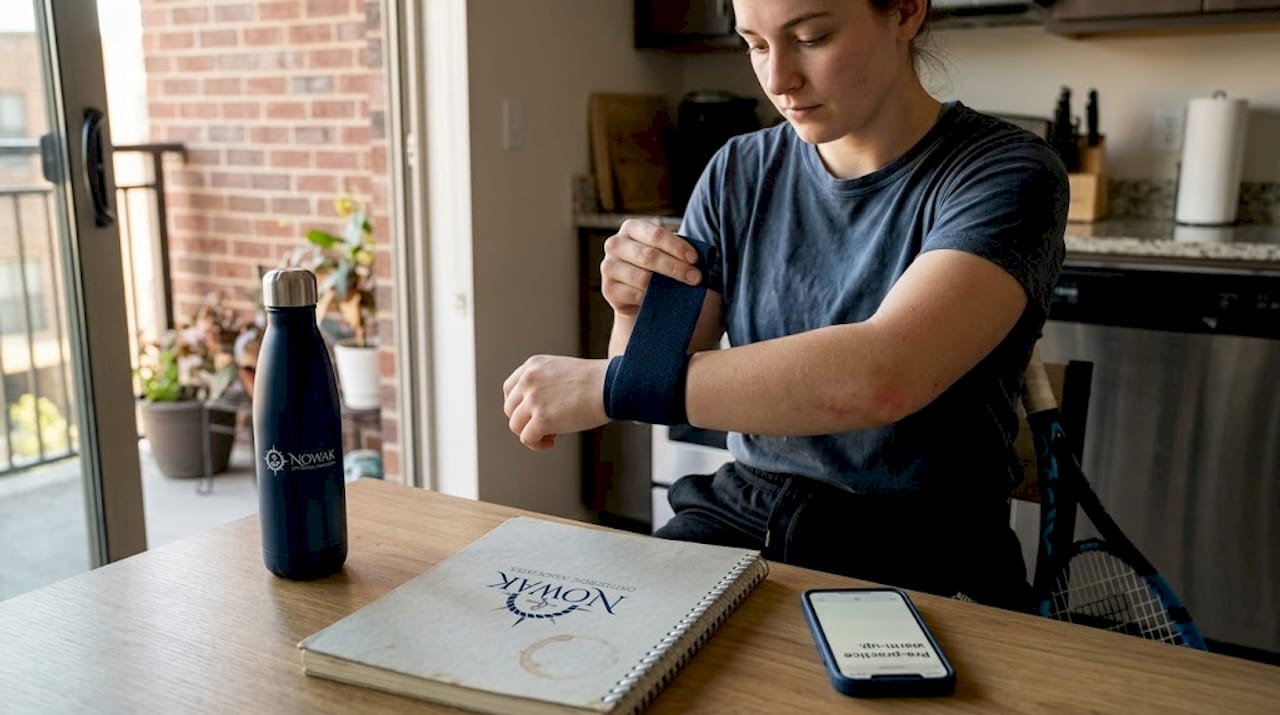
Research confirms that eccentric exercises outperform most other physical therapy modalities for elbow tendon health, and combining them with ASTYM (instrument-assisted soft tissue mobilization) yields even higher rates of symptom resolution. Building this into your routine before injury occurs is far more effective than waiting for pain to arrive.
| Prevention tool | Best use case | Approximate cost |
|---|---|---|
| Counterforce brace | Tennis elbow, overuse | Low |
| Wearable motion sensor | Pitch count tracking, mechanics | Moderate |
| Ergonomic forearm support | Desk workers, gamers | Low |
| Foam roller (forearm) | Recovery, tension release | Low |
| Padded grip sleeve | Racket/tool users | Low |
A sample five-minute pre-activity prep routine:
- Wrist flexor stretch: Hold for 30 seconds each side, palm facing up.
- Wrist extensor stretch: Hold for 30 seconds each side, palm facing down.
- Forearm pronation/supination: 15 controlled reps each direction.
- Eccentric wrist curls: 10 slow lowering reps with light resistance.
- Shoulder external rotation with band: 15 reps each side to load the kinetic chain.
Additional habits that protect your elbow daily include:
- Apply the 20-20-20 rule during screen work: every 20 minutes, rest your arms for 20 seconds
- Keep forearms parallel to the floor when typing
- Lift objects with a neutral wrist rather than a bent position
- Log your training volume weekly to catch load spikes early
Pro Tip: Use a simple training log or a wearable fitness tracker to record your daily forearm and elbow workload. Tracking trends over two to four weeks helps you spot patterns of overuse before sports injuries develop.
Execution: Integrate protective strategies into your routine
With the right tools and habits in place, the next step is putting prevention into everyday motion.
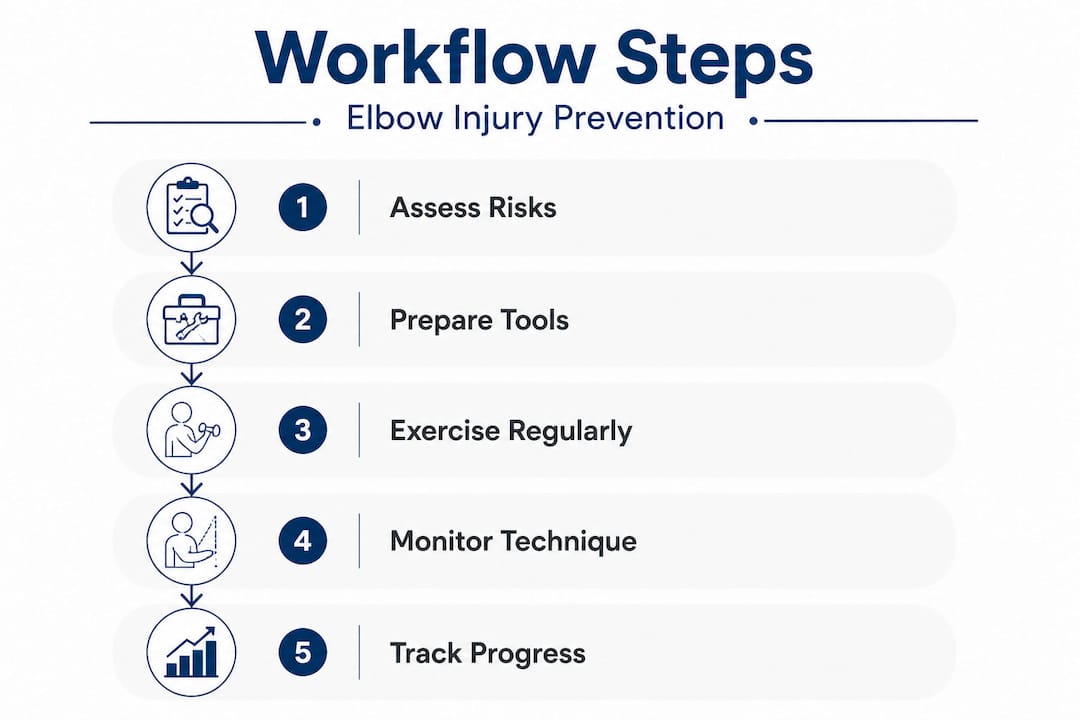
Prevention does not work if it only happens in the gym. You need to embed protective strategies into every activity, from warming up before a match to adjusting how you grip your steering wheel during a long commute.
For throwing athletes, pitch count management is non-negotiable. Young pitchers especially face significant risk when pitch counts exceed recommended thresholds without adequate rest days. For adult recreational athletes, the principle still applies: monitor your total throwing volume per session and per week. Any sudden spike in volume is a warning sign.
Kinetic chain strengthening, which targets the core, shoulder, and forearm as a connected system rather than isolated parts, is essential for active adults. Load management and kinetic chain work produce 80 to 90% non-operative success rates for common elbow conditions like lateral epicondylitis (tennis elbow) at one year.
Key kinetic chain exercises for elbow injury prevention:
- Dead bugs: Builds core stability that reduces shoulder and elbow compensation
- Band pull-aparts: Activates scapular stabilizers and offloads the elbow
- Pallof press: Trains rotational core control, critical for throwing and swinging
- Farmer’s carry: Strengthens grip and forearm endurance simultaneously
- Reverse wrist curls: Directly targets the extensor tendons on the outer elbow
“Manual therapy combined with a structured exercise program can reduce pain scores significantly in as little as four weeks.”
Consult a detailed elbow pain relief guide if you are already experiencing discomfort while executing these strategies. For a full overview of clinical options, reviewing available elbow care options helps clarify when conservative measures are enough.
Troubleshooting and fine-tuning: Common mistakes and advanced tips
Regular use of preventive strategies is a great start, but staying on track requires attention to detail and early correction.
The most common mistakes athletes make include:
- Ignoring mild pain signals and continuing to train through early tendon irritation
- Skipping warm-up when time is short or the weather feels warm
- Overrelying on injections or braces without addressing the root cause
- Plateau in exercise progression that stops providing adaptive stimulus to tendons
- Inconsistent recovery, especially neglecting sleep and nutrition
Orthoses, wearables, and multimodal physical therapy outperform isolated injections for improving grip strength and preventing recurrence. This is a key finding for anyone tempted to rely solely on corticosteroid shots to manage flare-ups. Meanwhile, research confirms that no single nonoperative protocol is superior to another, which means a multimodal approach combining exercise, ergonomics, and load management should be prioritized.
A useful statistic worth knowing: manual therapy combined with exercise consistently drops pain scores by 0.53 to 2.1 points on a 10-point scale within 4 to 12 weeks of consistent practice. Small numbers, but clinically meaningful when you are trying to stay active.
Understanding golfer’s elbow causes is useful here because medial (inner) elbow pain is often misidentified or attributed to the wrong activity.
Pro Tip: Rotate your exercise blocks every three to four weeks. Alternate between phases focused on endurance, strength, and mobility rather than performing the exact same routine indefinitely. This prevents both physical overload and the mental fatigue that causes people to abandon prevention entirely.
Check your progress: Self-assessment and knowing when to seek care
To ensure your efforts are working, regular check-ins and knowing when to act are essential.
Wearables providing biomechanical feedback offer early warning on injury risk, and supervised prevention protocols achieve 78% symptom resolution rates. Self-monitoring between professional check-ins keeps your prevention on course.
Signs your prevention workflow is working:
- Full, pain-free range of motion through elbow flexion and extension
- Grip strength feels consistent or is improving week over week
- No new onset of tenderness along the lateral or medial elbow
- Training volume increases without corresponding discomfort
Red-flag symptoms that require a professional evaluation:
- Pain persisting beyond two to three weeks despite rest and conservative care
- Numbness or tingling down the forearm or into the fingers
- Significant grip weakness that appeared suddenly
- Visible swelling or warmth around the elbow joint
- A “pop” sensation followed by acute pain
| Weekly tracking metric | How to measure | Target |
|---|---|---|
| Pain score (0-10) | Self-report after activity | 0-2 consistently |
| Grip strength | Simple dynamometer or squeeze test | Stable or improving |
| Range of motion | Compare both elbows | Symmetrical |
| Training volume | Logbook or app | No spikes above 10% per week |
| Recovery quality | Sleep tracking, perceived fatigue | Rested before training |
Consulting elbow orthopedic specialists at the right time prevents small problems from becoming surgical ones.
Why elbow injury prevention workflows need a holistic approach
At Nowak Orthopedic Associates, we see a consistent pattern: athletes who focus exclusively on the elbow miss the bigger picture. The elbow does not work in isolation. It is part of a kinetic chain connecting your hand, wrist, forearm, shoulder, and core. When any link in that chain is weak or faulty, the elbow compensates, and compensation over time creates injury.
Research supports this view clearly. Studies confirm that no single superior nonoperative protocol exists for elbow conditions, and that a multimodal, holistic strategy consistently outperforms narrow interventions. In practice, this means combining targeted exercises with ergonomic adjustments, load monitoring, and periodic reassessment.
We also believe strongly that high-cost interventions are not always necessary. Simple, consistent effort with eccentrics, mobility work, and smart training programming often achieves the same outcomes as expensive procedures. The key is personalized feedback and a willingness to adjust when something is not working.
Reviewing all available elbow surgery options helps put surgery in perspective: it is a tool of last resort, not a first response. Most active adults who commit to this kind of structured prevention workflow never need it.
Connecting with expert orthopedic support
Prevention goes a long way, but sometimes pain persists despite your best efforts. When that happens, working with an experienced orthopedic team accelerates both recovery and long-term protection. At Nowak Orthopedic Associates in Hampton, NH, we combine sports medicine services with individualized treatment plans that address the root cause of your elbow pain, not just the symptoms. Our advanced joint care guide outlines what a thorough orthopedic evaluation looks like, and our dedicated Regenerative Medicine Clinic offers non-surgical orthopedic treatments including PRP injections, SoftWave therapy, and guided stretch therapy. Reach out to our team when you are ready to move forward with expert guidance.
Frequently asked questions
What are the most common causes of elbow injuries in athletes?
Most elbow injuries stem from repetitive stress, improper mechanics, and insufficient recovery time in sports like tennis, golf, and baseball. Proper technique and workload management prevent the majority of these injuries.
Can I prevent elbow pain without expensive equipment or injections?
Yes, regular strengthening exercises, ergonomic adjustments, and simple orthoses or wearables are often just as effective as advanced interventions. Eccentric exercises and multimodal prevention consistently deliver strong results without high costs.
When should I see a specialist about my elbow?
If you have persistent pain, loss of motion, or symptoms not improving after a few weeks of home prevention, consult an orthopedic expert promptly. Specialist assessment is recommended for any ongoing or worsening elbow symptoms.
Does strengthening only the elbow protect against injuries?
No, studies show that strengthening the forearm, core, and shoulder provides significantly better protection than isolated elbow exercises. Kinetic chain strengthening is more effective at reducing injury risk across active adults.
How often should I check my technique and adjust my routine?
Assess your mechanics and adjust your workflow every few weeks, or immediately when you notice performance drops or discomfort. Regular assessment and adjustment are vital for sustained elbow injury prevention.