

TL;DR:
- Degenerative joint conditions involve complex biological processes like inflammation and nerve signaling beyond simple cartilage wear. Proper diagnosis distinguishing degenerative from inflammatory diseases guides targeted treatment strategies, emphasizing non-surgical options and personalized care. Understanding these nuances improves outcomes, making early, informed intervention essential for effective relief.
Most people assume joint pain is straightforward: cartilage wears down, bones rub together, and pain follows. That’s the story, right? Not exactly. Research now shows that degenerative joint conditions involve complex biological processes, including inflammation, metabolic changes, and nerve signaling, that go far beyond simple mechanical breakdown. For adults in New Hampshire dealing with persistent knee, shoulder, or hip pain, understanding what’s really happening inside a joint can make a significant difference in how quickly you get effective relief. This guide covers what these conditions truly are, why symptoms develop, and what evidence-based options are available.
Table of Contents
- What are degenerative joint conditions?
- How pain and symptoms develop: Beyond the surface
- Degenerative vs. inflammatory joint conditions: Why it matters
- Current best practices for relief and treatment
- Why understanding the nuances behind joint pain leads to better outcomes
- Next steps: Find your expert-guided relief options in New Hampshire
- Frequently asked questions
Key Takeaways
| Point | Details |
|---|---|
| Not just wear and tear | Degenerative joint conditions involve complex processes beyond mechanical grinding, including metabolism and inflammation. |
| Pain isn’t always visible | Joint pain often stems from subtle inflammation and nerve changes, not just what shows up on X-rays. |
| Clear diagnosis guides treatment | Distinguishing degenerative from inflammatory arthritis is essential for the right care plan. |
| Start with evidence-based steps | Education, exercise, and weight control form the foundation of effective joint condition management. |
| Advanced relief is available | Persistent symptoms may benefit from minimally invasive or surgical treatments—tailored to each person’s needs. |
What are degenerative joint conditions?
The term “degenerative joint condition” refers to a group of diseases where the structures inside a joint break down faster than the body can repair them. That includes cartilage (the smooth protective tissue covering bone ends), ligaments, the joint lining, and the underlying bone itself.
Osteoarthritis (OA) is the most common example, and it affects millions of Americans across every age group, not just older adults. But the category also includes post-traumatic arthritis (joint damage that develops after an injury), degenerative meniscus tears, and certain forms of spinal joint disease.
One key point worth understanding: tissue breakdown in OA involves metabolic processes that exceed the joint’s ability to self-repair, rather than being only a matter of grinding wear. This means that metabolic health, inflammation levels, and genetics all play a role, not just age or activity. In fact, OA spans inflammatory, metabolic, and post-traumatic mechanisms, which is why no two patients experience it the same way.
Common degenerative causes of joint pain include:
- Gradual cartilage loss in weight-bearing joints like the knee and hip
- Post-traumatic changes in joints that were previously injured (torn ligaments, old fractures)
- Degenerative meniscus tears in the knee, often without a specific injury event
- Bone spur formation (osteophytes) as the joint attempts to stabilize itself
| Condition | Primary region | Main symptoms | Typical age group |
|---|---|---|---|
| Osteoarthritis | Knee, hip, hand, spine | Aching, stiffness, reduced range of motion | 45 and older, but can be younger |
| Post-traumatic arthritis | Any joint after injury | Pain, swelling, instability | Any age after significant trauma |
| Degenerative meniscus tear | Knee | Clicking, pain with activity, swelling | 40 and older |
| Cervical/lumbar spondylosis | Spine | Stiffness, radiating pain, limited flexibility | 50 and older |
Understanding which condition is actually present is the first step toward targeted, effective treatment.
How pain and symptoms develop: Beyond the surface
Having defined the core of these conditions, it’s important to understand why symptoms, not just joint damage, actually develop. This is one of the most misunderstood aspects of degenerative joint disease.
Here’s what surprises many patients: you can have significant structural changes on an X-ray and feel very little pain. Conversely, you can have moderate joint changes and experience severe, daily discomfort. OA pain is not explained purely by structural damage; the pathophysiology involves mechanisms that go far beyond what imaging shows.
Clinical insight: Pain in osteoarthritis is shaped by local inflammation within the joint, changes in the surrounding nerves (called peripheral and central sensitization), altered muscle mechanics, and even psychological factors like stress and sleep disruption. This is why a one-size-fits-all approach rarely works.
The main drivers of pain and symptom development include:
- Synovial inflammation — The joint lining becomes irritated, releasing chemicals that amplify pain signals.
- Nerve sensitization — Nerves in and around the joint become more reactive over time, lowering the pain threshold.
- Muscle weakness and altered movement patterns — When a joint hurts, surrounding muscles often weaken or tighten, which changes how force is distributed and worsens symptoms.
- Bone marrow lesions — Areas of stress and damage in the bone beneath cartilage can be significant pain generators, even when the cartilage itself looks only mildly affected.
Tracking your pain relief strategies and identifying patterns, like whether pain is worse in the morning, after activity, or at rest, provides your provider with critical information that imaging simply cannot capture.
Pro Tip: Before your appointment, write down exactly when your pain starts, what makes it better or worse, and whether it radiates to other areas. This specific detail helps your orthopedic provider narrow down the pain mechanism and select the most targeted treatment.
Degenerative vs. inflammatory joint conditions: Why it matters
Understanding what makes your joint condition different is key, especially when it comes to choosing the right treatment strategy. Degenerative and inflammatory joint diseases are often lumped together by patients, but they have meaningfully different causes, lab patterns, and treatment priorities.
OA differs from rheumatoid arthritis primarily in its cause: OA is driven by tissue degeneration, while rheumatoid arthritis (RA) is an immune-mediated condition where the body attacks its own joint lining. Getting this distinction right determines whether you need an orthopedic surgeon, a rheumatologist, or both.
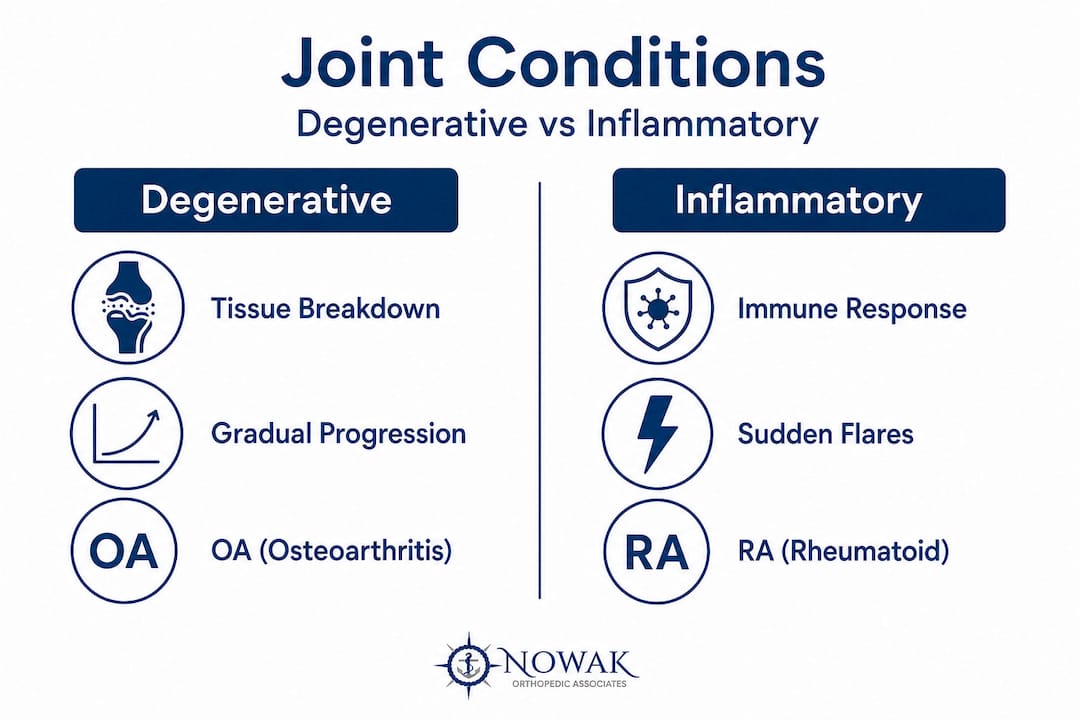
| Feature | Osteoarthritis (degenerative) | Rheumatoid arthritis (inflammatory) |
|---|---|---|
| Primary cause | Cartilage and tissue breakdown | Immune system attacking joints |
| Onset | Gradual, often asymmetric | Often symmetric, can be sudden |
| Morning stiffness | Brief (less than 30 minutes) | Prolonged (often over an hour) |
| Lab markers | Usually normal | Elevated CRP, positive RF or anti-CCP |
| Typical treatment | Exercise, injections, surgery | Disease-modifying drugs, biologics |
| Who to see | Orthopedic surgeon | Rheumatologist (primarily) |
Why does this distinction matter for you?
- Treating OA with immune-suppressing drugs won’t address cartilage loss, and treating RA with joint injections alone won’t stop the immune attack.
- Knee joint preservation in NH depends on correctly identifying whether the joint is deteriorating mechanically or being attacked systemically.
- Misdiagnosis delays the treatments most likely to help and can allow further damage to accumulate.
- Correct diagnosis also determines urgency. RA can progress rapidly without disease-modifying therapy, while OA management is typically more stepwise.
Current best practices for relief and treatment
With a clear diagnosis in mind, the next step for relief is understanding which treatment options have the best evidence and when to escalate your care. The good news is that many people with degenerative joint conditions can experience meaningful improvement without jumping straight to surgery.
Non-surgical management is broadly supported and typically includes lifestyle interventions such as education, physical activity, and weight management, with joint replacement reserved for severe cases that haven’t responded to other approaches.
A stepwise approach generally looks like this:
- Education and self-management — Understanding your condition allows you to make informed choices about activity levels, flare triggers, and when to seek care.
- Exercise and physical therapy — Strengthening the muscles around affected joints reduces load on the cartilage and improves stability. This is among the most effective and evidence-supported interventions available.
- Weight management — Every extra pound adds roughly four pounds of force across the knee joint. Even modest weight reduction can produce significant symptom relief.
- Medications — Anti-inflammatory medications and topical agents can reduce pain during flares without the risks of more invasive options.
- Injections — Corticosteroid injections reduce inflammation, while hyaluronic acid injections (viscosupplementation) restore lubrication. Platelet-rich plasma (PRP) injections, an orthobiologic regenerative therapy, use your own blood’s growth factors to support tissue healing.
- Minimally invasive procedures and surgery — When conservative care isn’t enough, arthroscopic procedures, cartilage restoration (such as the OATS procedure), and partial or total joint replacement provide durable, well-studied options.
Key statistics: 607 million people worldwide had osteoarthritis in 2021, with knee OA accounting for more than 56% of all cases. This scale of impact has driven extensive research into which treatments actually work.
Helpful questions to ask your provider include:
- Is my condition primarily degenerative, inflammatory, or both?
- Am I a candidate for non-surgical options, and what is the realistic timeline for improvement?
- What are the risks if I delay more advanced treatment?
Pro Tip: Starting a non-surgical relief guide early, before symptoms become severe, gives you the best chance of avoiding or delaying surgery while maintaining your quality of life. Many patients who commit to structured physical therapy and weight management see improvements within eight to twelve weeks.
Explore orthopedic procedures for relief to see a full breakdown of what minimally invasive and surgical options look like in practice, or review joint procedure outcomes for realistic recovery expectations.
Why understanding the nuances behind joint pain leads to better outcomes
Looking at all the steps for relief, it’s worth pausing to consider what makes the most difference for real, lasting progress. And from our perspective at Nowak Orthopedic Associates, the single biggest obstacle we see is oversimplification.

When patients or providers treat all joint pain as basic wear and tear, important signals get missed. A patient with post-traumatic knee arthritis and active synovial inflammation needs a different approach than someone with mild cartilage thinning and strong quadriceps. Both might describe “knee pain,” but the underlying biology is very different.
The same applies to pain behavior. A patient whose pain flares at night and at rest may have a significant bone marrow or inflammatory component that responds well to targeted injection therapy. A patient whose pain is strictly activity-related may benefit most from movement-based rehab and load management. Missing these patterns doesn’t just slow results — it can lead to unnecessary procedures or prolonged suffering.
We’ve also seen that patients who understand the nuances of their condition become active partners in their care. They ask better questions. They stick with their rehab programs longer because they understand why those programs work. And they’re more likely to reach out early when something changes, which allows us to adjust the treatment plan before things escalate.
Don’t settle for a generic plan. Ask about new advances in orthobiologics for joint relief and whether individualized options are available for your specific type of degeneration. The details you share during an appointment matter more than you might think.
Next steps: Find your expert-guided relief options in New Hampshire
If you’re ready to move from understanding to action, connecting with a specialist can open the door to the right solutions for your unique situation. At Nowak Orthopedic Associates in Hampton, NH, we offer the full spectrum of care, from education and non-surgical therapies to minimally invasive arthroscopic procedures and advanced joint restoration.
Every patient receives a personalized assessment to identify which combination of treatments fits their diagnosis, activity goals, and overall health. Explore our orthopedic joint care guide to understand what a thorough evaluation involves, or learn what to expect from your first orthopedic visit. When you’re ready to review specific procedure options, our joint pain relief procedures page provides detailed information on everything we offer. Relief is possible — and it starts with the right diagnosis.
Frequently asked questions
What is the difference between degenerative and inflammatory joint conditions?
Degenerative conditions like OA mainly involve joint tissue breakdown over time, while inflammatory types like rheumatoid arthritis result from immune-mediated attacks on joint structures rather than mechanical degeneration.
Why might joint pain get worse even if X-rays look the same?
Because OA pain mechanisms involve nerve sensitization, synovial inflammation, and altered muscle patterns, symptoms can intensify or improve independent of what structural changes are visible on imaging.
Are there effective non-surgical options for degenerative joint conditions?
Yes. Core non-surgical interventions including physical activity, education, and weight management are well-supported by evidence, with surgery typically reserved for cases that don’t respond to these approaches.
What is the prevalence of osteoarthritis compared to other joint conditions?
Osteoarthritis is the most common joint condition globally; 607 million people were affected in 2021, with knee OA making up more than half of all cases worldwide.