

TL;DR:
- Shoulder impingement affects both everyday individuals and athletes, responding well to targeted treatment. Accurate diagnosis involves a thorough clinical evaluation, focusing on movement patterns and specific tests, to distinguish between subacromial and internal impingement. Most individuals improve with conservative therapies, including physical therapy and activity modifications, though recovery timelines vary based on adherence and underlying biomechanics.
Shoulder pain is easy to dismiss as a normal part of getting older or simply overdoing it at the gym. But that assumption keeps many people in the Seacoast NH area from getting the right help at the right time. Shoulder impingement is a specific, well-defined condition that affects both everyday adults and competitive athletes, and it responds very well to targeted treatment. Understanding what it actually is, how it is diagnosed, and what your recovery path looks like can make the difference between months of frustration and a clear, confident road back to full activity.
Table of Contents
- What is shoulder impingement?
- Types of shoulder impingement: Subacromial vs internal
- Diagnosing shoulder impingement: Clinical approach
- Effective treatment strategies: Evidence-based management
- Recovery timelines and prognosis: What to expect
- A fresh perspective: Why generic approaches fall short for local adults and athletes
- Explore orthopedic solutions for shoulder pain recovery
- Frequently asked questions
Key Takeaways
| Point | Details |
|---|---|
| Impingement explained | Shoulder impingement involves compression of tendons and tissue, mostly when lifting the arm. |
| Subtype matters | Different impingement types require unique treatment approaches, especially for athletes. |
| Clinical diagnosis prevails | History and physical exam are key—imaging is not always needed for diagnosis. |
| Physical therapy is essential | Structured exercise and manual therapy are best-supported for recovery. |
| Recovery takes time | Most patients improve, but full recovery relies on consistent rehab and activity changes. |
What is shoulder impingement?
Your shoulder is one of the most mobile joints in the body, and that mobility comes with trade-offs. A narrow passage called the subacromial space sits between the top of the upper arm bone (humerus) and the arch of bone above it (the coracoacromial arch). Tendons from the rotator cuff and a small fluid-filled sac called the bursa pass through this space every time you lift your arm.
When that space narrows due to inflammation, poor posture, muscle imbalances, or repetitive overhead activity, the structures inside get pinched and irritated. As the NHS explains, shoulder impingement occurs when a tendon and/or bursa is compressed in the subacromial space as the arm is lifted, narrowing the space and irritating inflamed structures. That compression is the core problem, and it explains why symptoms tend to flare during specific movements.
Common symptoms include:
- A sharp or aching pain on the outside or front of the shoulder
- Pain that worsens when lifting the arm overhead or reaching behind your back
- Night pain, particularly when lying on the affected side
- Weakness when reaching or carrying objects
- A painful arc of motion roughly between 60 and 120 degrees of arm elevation
One important point: shoulder impingement is not simply “wear and tear.” It is a biomechanical problem, meaning the way your shoulder moves and how your muscles control that movement plays a large role. Reviewing shoulder injury terminology can help you communicate more effectively with your provider and understand exactly which structures are involved.
Types of shoulder impingement: Subacromial vs internal
Not all shoulder impingement is the same. Recognizing the subtype matters because each one has distinct anatomy, a different at-risk population, and a different treatment emphasis.
| Feature | Subacromial (external) impingement | Internal impingement |
|---|---|---|
| Location | Subacromial space | Posterior glenoid rim and rotator cuff |
| Common population | General adults, overhead workers | Overhead throwers, competitive athletes |
| Key motion trigger | Forward arm elevation, daily lifting | Arm in late cocking position (abduction/external rotation) |
| Primary structures | Supraspinatus tendon, subacromial bursa | Infraspinatus, posterior rotator cuff |
| Rehab focus | Postural correction, scapular stability | Rotator cuff strengthening, posterior capsule flexibility |
As StatPearls makes clear, [“impingement” can describe different anatomic concepts that affect different athlete populations and require different rehab programming and activity modifications. This distinction is one clinicians must consider carefully.
Pro Tip: If you play baseball, tennis, or volleyball in the Seacoast NH area, ask your provider specifically whether internal impingement is part of your picture. The late cocking phase of throwing is the classic trigger, and a program built only around subacromial impingement will leave gaps in your recovery.
Subacromial impingement is the more common presentation and tends to affect adults whose jobs or hobbies involve sustained or repetitive overhead work, such as painting, roofing, or competitive swimming. Internal impingement is less common but is frequently seen in overhead-throwing athletes and can be harder to recognize without a thorough clinical evaluation. Exploring shoulder treatment options at a specialized practice helps ensure your specific subtype is addressed.
Diagnosing shoulder impingement: Clinical approach

Accurate diagnosis is where recovery either accelerates or stalls. Many patients arrive having been told they simply have a “shoulder problem” after a brief exam or a single imaging study. That is often not enough.
A thorough clinical evaluation for shoulder impingement generally follows these steps:
- Detailed history. When did the pain start? What makes it worse? Do you have overhead job demands or sport-specific activities? Has there been any previous shoulder injury?
- Postural and movement screening. The clinician observes how you carry your shoulder at rest and how your scapula (shoulder blade) moves during arm elevation.
- Provocative tests. Specific maneuvers such as the Neer test, Hawkins-Kennedy test, and empty can test are used to reproduce your pain and implicate specific structures.
- Strength and range-of-motion testing. Weakness in specific rotator cuff muscles or loss of motion in certain directions provides important diagnostic clues.
- Imaging when needed. X-rays can rule out bony changes or calcification. MRI is reserved for cases where a rotator cuff tear or structural damage is suspected.
StatPearls reinforces that clinical diagnosis relies heavily on history and focused physical exam rather than imaging alone, and that early recognition and addressing biomechanics are important steps. This is why a rushed appointment that skips the movement screen often misses the real driver of your symptoms.
Pro Tip: Before your appointment, write down which specific movements trigger your pain, how long symptoms have been present, and any recent changes in your activity level. This information helps your clinician form a faster, more accurate picture. Reading up on shoulder injury recovery can also help you set realistic goals heading into your evaluation.
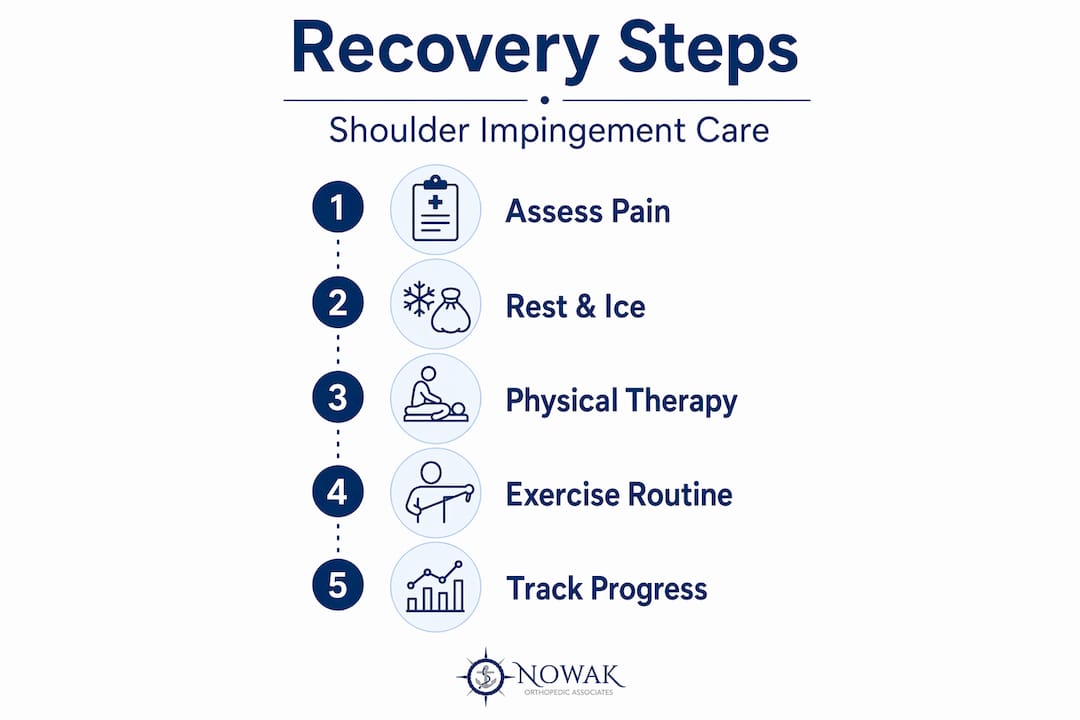
Effective treatment strategies: Evidence-based management
The good news is that most people with shoulder impingement improve without surgery. The evidence base for conservative care is strong, and outcomes are genuinely favorable when the right interventions are applied consistently.
| Treatment approach | Evidence level | Primary benefit |
|---|---|---|
| Structured physical therapy and exercise | Strong | Pain reduction, improved function |
| Manual therapy combined with exercise | Moderate to strong | Enhanced mobility, faster symptom relief |
| Corticosteroid injections | Moderate | Short-term pain control to enable rehab |
| Passive modalities (ultrasound, TENS, laser) | Weak to mixed | Minimal independent benefit |
| Surgical intervention (when conservative care fails) | Varies | Reserved for persistent structural causes |
StatPearls confirms that conservative management centers on structured physical therapy and exercise, with manual therapy as a valuable addition, while passive modalities carry weaker and more mixed evidence on their own.
Key elements of an effective program include:
- Rotator cuff and scapular stabilizer strengthening. These muscles control the position of the humeral head within the joint, reducing compression in the subacromial space.
- Postural correction and thoracic mobility work. A rounded upper back elevates the risk of subacromial narrowing. Improving thoracic extension opens the space.
- Activity modification. Temporarily reducing overhead volume is not giving up. It is managing load while tissue recovers.
- Manual therapy. Joint mobilizations and soft tissue work from a skilled therapist can restore range of motion and reduce pain more quickly than exercise alone.
Patients who want to understand the broader landscape of non-surgical orthopedic treatment will find detailed context on how these approaches fit together, and those exploring joint pain relief strategies can review additional evidence-based options. For those interested in supportive tools during recovery, shoulder relief tools are also available.
Recovery timelines and prognosis: What to expect
Recovery from shoulder impingement is rarely a straight line, and one of the most valuable things we can do for our patients is set honest expectations from the start.
Most people begin noticing meaningful improvement within six to twelve weeks of consistent, structured physical therapy. Full resolution of symptoms, however, often takes longer. For athletes returning to overhead sport or adults resuming physically demanding work, the realistic timeline can extend to four to six months or beyond.
Key factors that influence your prognosis include:
- Adherence to your exercise program. This is the single strongest predictor of outcome. Patients who complete their home exercises consistently progress faster.
- Duration of symptoms before treatment. Earlier intervention generally leads to quicker recovery.
- Presence of contributing structural issues. Partial rotator cuff tears or significant bony changes may slow progress.
- Activity modification compliance. Continuing to perform the movements that aggravate the condition during recovery extends healing time significantly.
StatPearls notes that prognosis with appropriate conservative care is generally favorable, though recovery takes time and outcomes depend on adherence and resolving the underlying biomechanical drivers. Reviewing your shoulder recovery timeline and understanding the shoulder prognosis landscape can help you stay motivated through the process.
A fresh perspective: Why generic approaches fall short for local adults and athletes
We see patients come to us after spending months following generic shoulder advice, completing generic rotator cuff programs, and wondering why they are still in pain. The honest answer is that “shoulder impingement exercises” as a category are only as useful as the subtype assessment that precedes them.
An overhead-throwing athlete from the Seacoast NH area who has internal impingement does not need the same program as a 55-year-old carpenter with classic subacromial compression. Treating both with the same routine fails both patients. The carpenter may need significant postural work and scapular retraining. The athlete may need posterior capsule stretching, rotator cuff strengthening in sport-specific positions, and a carefully staged return to throwing. Generic programs ignore these distinctions entirely.
Biomechanical analysis should drive every care plan. That means watching how your scapula moves, how your thoracic spine contributes to shoulder elevation, and whether your throwing mechanics or work posture are re-creating the problem daily. Without addressing those drivers, even the best exercise program becomes a temporary fix.
Our practical advice: always ask your provider which subtype of impingement you have and how each element of your rehab addresses that specific subtype. If you cannot get a clear answer, that is a signal to seek a more thorough evaluation. A closer look at comprehensive relief strategies can help you understand what a truly individualized plan looks like in practice.
Explore orthopedic solutions for shoulder pain recovery
If you are dealing with shoulder pain in the Seacoast NH area and are not sure where to turn, Nowak Orthopedic Associates offers the kind of individualized, subtype-focused evaluation that the evidence supports. Our sports medicine specialists work with local athletes and active adults to design recovery programs based on your specific anatomy, activity demands, and goals. The orthopedic surgeons guide covers what to expect from advanced joint care, and our relief guide outlines non-surgical options step by step. You deserve a clear plan, not a generic protocol.
Frequently asked questions
Is shoulder impingement always caused by injury?
No. Shoulder impingement can occur from overuse, poor posture, or repetitive overhead activity, not just from a single traumatic event. Gradual onset is actually more common than injury-related onset.
Can physical therapy alone resolve shoulder impingement?
Yes, in most cases. Structured physical therapy and exercise are often highly effective, particularly when combined with manual therapy, and many patients avoid surgery entirely with consistent conservative care.
How long does it take to recover from shoulder impingement?
Recovery can be protracted, often ranging from six weeks to several months, and outcomes depend strongly on adherence to physical therapy and modifying the activities that drive symptoms.
Are passive treatments like ultrasound or TENS effective for shoulder impingement?
Evidence is mixed. Routine passive modalities like ultrasound and TENS tend to perform worse than structured exercise and manual therapy when evaluated as stand-alone interventions.
Should athletes modify their activities during shoulder impingement recovery?
Yes. Reducing provocative overhead mechanics temporarily is an important part of recovery, especially for overhead throwers, allowing inflamed structures to settle while shoulder capacity is rebuilt through targeted exercise.