

TL;DR:
- A structured, evidence-based rehabilitation workflow significantly improves recovery by reducing hospital stays and enhancing pain management. Tailoring the rehab process to procedures and individual patient needs, with clear milestones and proper education, promotes faster, safer healing. Personalization and adherence to validated protocols are essential for optimal orthopedic recovery outcomes.
The difference between a frustrating recovery and a smooth one often comes down to your rehabilitation workflow, not just the surgery itself. Research shows that structured, evidence-based recovery programs can meaningfully reduce hospital stays, improve pain control, and get you back to your normal activities faster. Yet many patients leave the operating room without a clear plan, unsure which movements are safe, how quickly to progress, or when to ask for help. This guide walks you through each stage of an optimized rehab workflow so you can recover with confidence.
Table of Contents
- Understanding the post-surgery rehabilitation workflow
- Preparation: What to know and gather before starting rehab
- Executing the rehab workflow: Steps, timing, and supervision
- Troubleshooting and adapting your workflow
- The nuanced truth about rehab efficiency: Matching workflow to procedure
- Connect with advanced orthopedic recovery solutions
- Frequently asked questions
Key Takeaways
| Point | Details |
|---|---|
| Evidence-based rehab wins | Proven workflows reduce complications and hospital stays after orthopedic surgery. |
| Personalized workflow matters | Matching rehab oversight to procedure complexity yields safer, faster recovery. |
| Education is vital | Patient knowledge and good home setup are key prerequisites for successful rehabilitation. |
| Timing over quantity | More therapy sessions aren’t always better; milestone progress and timing are just as important. |
| Troubleshooting aids recovery | Adapting rehab plans to overcome practical barriers ensures optimal outcomes. |
Understanding the post-surgery rehabilitation workflow
A rehabilitation workflow is the organized sequence of actions, checkpoints, and decisions that guide your recovery from surgery to full function. Think of it as a roadmap. Without it, even motivated patients can stall, overdo it, or miss important healing windows.
For minimally invasive orthopedic procedures, the gold standard today is the Enhanced Recovery After Surgery model, commonly called ERAS. This approach bundles several proven strategies: preoperative patient education, multimodal analgesia (using multiple pain management methods rather than relying on opioids alone), early mobilization, and nutritional and physiologic optimization. Each component has measurable benchmarks, making ERAS a framework built on real data rather than habit.
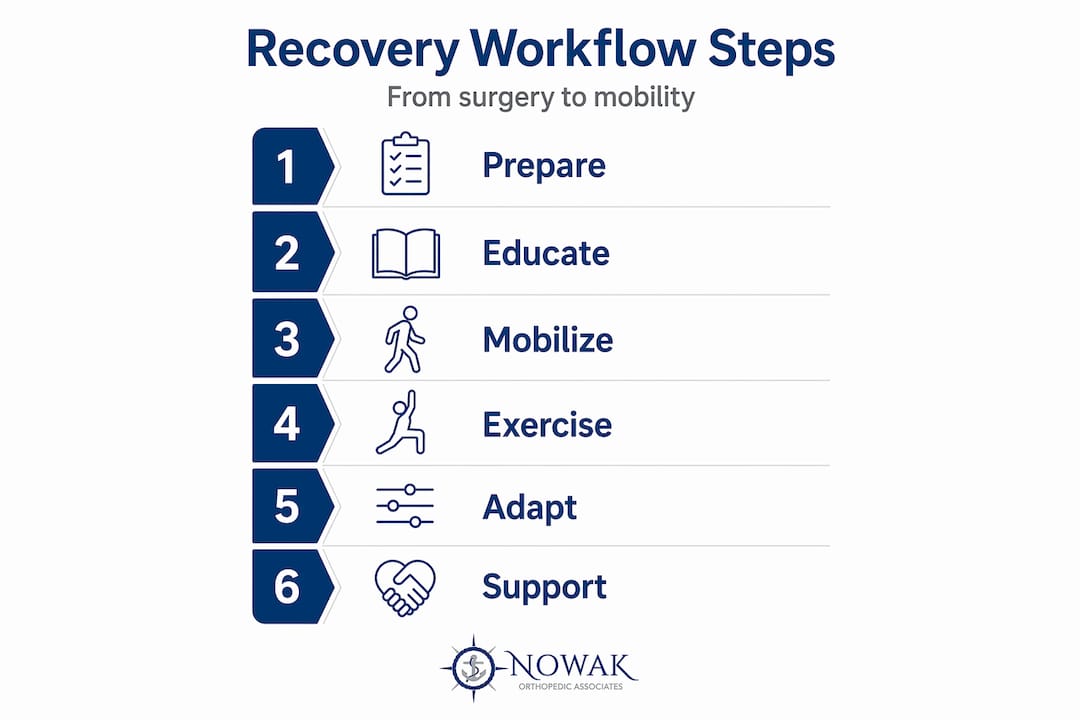
Traditional recovery models often kept patients in bed longer and relied heavily on strong pain medications. ERAS flips that model. Early movement, coordinated pain control, and informed patients replace passive waiting. The result is a recovery that feels more purposeful and, in many cases, moves faster.
Understanding the workflow also means knowing the difference between supervised physical therapy (PT) and home exercise programs. Supervised PT gives you direct feedback from a licensed therapist, which is especially valuable after complex procedures. Home programs offer flexibility and can be just as effective for certain surgery types when the exercises are taught correctly. Exploring optimal knee recovery steps or reviewing your joint pain relief procedures with your care team helps clarify which path fits your situation.
| Feature | ERAS pathway | Traditional recovery |
|---|---|---|
| Mobilization timing | Early (within hours) | Delayed (24-48+ hours) |
| Pain management | Multimodal (non-opioid focus) | Opioid-centered |
| Patient education | Preoperative and ongoing | Minimal, post-op only |
| Hospital stay | Shorter on average | Longer average stay |
| Home program integration | Early and structured | Often informal |
Key components of a strong rehabilitation workflow include:
- Preoperative education so you know what to expect
- Clear milestone markers (range of motion, weight-bearing status, strength targets)
- A defined schedule for supervised PT visits and home exercises
- A pain management plan that supports movement without overmedication
- Nutritional support to fuel tissue repair
Preparation: What to know and gather before starting rehab
With an understanding of recovery workflow options, here’s what you need to organize before your home or supervised rehab begins.
Preparation is not just packing a bag for the hospital. It means entering your recovery phase fully informed and physically ready. Preoperative education, multimodal analgesia, and nutrition optimization are foundational ERAS strategies with proven results, including measurably shorter hospital stays. When you understand your procedure, you are far less likely to fear normal sensations or avoid necessary movements during recovery.
Here is a practical preparation checklist to work through before surgery or before your rehab program begins:
- Review your procedure in detail. Ask your surgeon about what structures were repaired, what loads or movements to avoid, and why. Knowing the “why” behind restrictions reduces anxiety. Resources like this pre-surgery knee recovery prep guide offer procedure-specific context.
- Understand your pain management plan. Multimodal analgesia may include anti-inflammatory medications, nerve blocks, ice therapy, and prescribed exercises. Ask specifically which non-opioid options are available to you.
- Set up your home environment. Clear pathways, position your bed or sleeping area for easy access, and gather supplies including ice packs, compression wraps, and any prescribed assistive devices.
- Prepare nutritious meals in advance. Protein supports tissue repair. Aim for easy-to-prepare, high-protein meals for the first week. Hydration matters too, especially if you are reducing opioid use.
- Confirm your first PT appointment before discharge. Gaps between surgery and your first rehab visit can slow momentum significantly.
- Identify your support person. You will need help with transportation, household tasks, and encouragement, especially in the first 72 hours. Looking into non-surgical relief steps can also help you understand complementary options like PRP or SoftWave therapy during recovery.
| Preparation area | Action item | Why it matters |
|---|---|---|
| Education | Review procedure details with surgeon | Reduces anxiety, improves compliance |
| Pain control | Confirm multimodal plan pre-op | Supports early mobilization |
| Home setup | Clear pathways, gather equipment | Prevents falls and delays |
| Nutrition | Stock high-protein, easy meals | Fuels tissue healing |
| Scheduling | Book PT before discharge | Closes gaps in workflow |
Pro Tip: Write down three specific questions for your care team before every appointment. Patients who arrive with prepared questions tend to leave with clearer instructions and better outcomes.
Executing the rehab workflow: Steps, timing, and supervision
With all preparations in place, it’s time to execute an efficient and evidence-based recovery plan.
The first 48 hours after minimally invasive surgery set the tone for your entire recovery. Moving early, even gently, signals to your body that healing is underway. Here is a step-by-step guide to how an optimized rehab workflow typically unfolds:
- Hours 0 to 24: Focus on pain control and initial mobilization. Sitting up, ankle pumps, and short assisted walks (with appropriate support) begin here for many procedures.
- Days 2 to 7: Gentle range-of-motion exercises start. Your therapist or surgeon will define your weight-bearing status. Ice and elevation continue to manage swelling.
- Weeks 2 to 4: Supervised PT visits address strength, balance, and gait. Home exercises reinforce progress between visits.
- Weeks 4 to 8: Criteria-based progression begins. This means you advance not just because time has passed, but because you meet specific strength and mobility benchmarks.
- Weeks 8 and beyond: Return-to-activity milestones are assessed. For complex reconstructions, this phase may extend months further.
The AAOS clinical practice guideline for rotator cuff injuries explicitly distinguishes between supervised PT and well-taught home exercise programs, recognizing that both have a role depending on the patient and procedure. For meniscus repairs, criterion-based progression based on both time and measurable functional milestones is the current consensus standard, with duration varying by the complexity of the repair or resection.
Safety note: Progressing through milestones too quickly is one of the most common causes of setbacks in orthopedic rehab. If you are unsure whether you have met a criterion for progression, stop and confirm with your therapist or surgeon before advancing.
Reviewing a shoulder surgery recovery checklist or looking at procedure outcomes examples can give you a clearer sense of realistic timelines for your specific surgery.
Pro Tip: Match the intensity of supervision to your surgical risk level. A complex ACL reconstruction with meniscus involvement warrants more frequent supervised visits than a minor arthroscopic debridement. Ask your surgeon to categorize your case clearly.
Troubleshooting and adapting your workflow
Even the best plans can encounter problems. Here’s how to troubleshoot and adapt for optimal outcomes.

Common barriers to a smooth rehab workflow include uncontrolled pain that limits early movement, difficulty arranging transportation to PT, and fatigue that reduces compliance with home programs. Early and ultra-early mobilization after hip and knee arthroplasty can reduce length of stay without increasing adverse events, but real-world barriers like staff availability and orthostatic hypotension (dizziness when standing) do affect implementation. Acknowledging these barriers honestly helps you plan around them.
One of the most important lessons from current research: more therapy is not always better. A study examining early mobilization and physiotherapy after distal radial fractures found that early mobilization with multiple physiotherapy visits did not consistently outperform well-structured delayed or home-based approaches for long-term outcomes. Timing and education matter more than raw volume of visits.
Practical troubleshooting tips for adapting your workflow:
- Pain spike: Contact your care team before skipping exercises. Modifications are usually available.
- Missed PT appointment: Complete your home program that day and reschedule as soon as possible to avoid losing momentum.
- Swelling increase: Elevate and ice; reduce activity to the previous phase level temporarily and notify your therapist.
- Progress plateau: Request a formal reassessment. Plateaus often indicate the need for a targeted exercise change, not just more repetitions.
- Transportation barriers: Ask about telehealth PT check-ins or home PT services as alternatives.
For athletes returning from sports injuries, the athlete recovery workflow resource provides sport-specific guidance on managing these common setbacks.
The nuanced truth about rehab efficiency: Matching workflow to procedure
Here is where we want to offer a perspective that goes beyond standard recovery advice. Many patients and even some care providers assume that more supervised therapy automatically means better outcomes. The data does not always support that assumption.
The AAOS rotator cuff guideline acknowledges that well-taught home exercise programs can match supervised PT for certain presentations. Meanwhile, the EU-US Meniscus Rehabilitation Consensus makes clear that some procedures require careful time-and-criteria milestone management, not simply frequent clinic visits. These are different problems with different solutions.
What we have observed at Nowak Orthopedic Associates is that patients who understand why each step exists tend to comply better and progress faster than patients who are simply given a list of exercises. Knowing that you are walking early because it prevents blood clots and reduces swelling is more motivating than being told to walk because the protocol says so.
Personalization matters enormously. A healthy, active 35-year-old recovering from an arthroscopic meniscus repair has a very different optimal workflow than a 65-year-old recovering from a partial knee replacement with underlying diabetes. Protocol intensity should follow patient physiology and procedural complexity, not a one-size-fits-all schedule. Reviewing surgical optimization resources can help frame the conversation with your care team about what level of oversight your specific case truly requires.
Pro Tip: At your first post-op appointment, ask your surgeon to classify your recovery as low, moderate, or high complexity. That single answer should guide how aggressively you pursue supervised PT versus a home-based approach.
Connect with advanced orthopedic recovery solutions
If you are ready to move forward with a recovery plan designed specifically for your procedure and lifestyle, Nowak Orthopedic Associates is here to help. Dr. Roger B. Nowak and our team build individualized recovery workflows for patients recovering from shoulder, knee, elbow, and hand surgeries, including both minimally invasive arthroscopic procedures and more complex reconstructions. Explore joint procedure examples to understand what your recovery path may look like, browse our full orthopedic services overview to see the breadth of care available, or read our advanced joint care guide for deeper clinical context. We are committed to helping every patient recover as safely and efficiently as possible.
Frequently asked questions
What is the main benefit of following an evidence-based post-surgery rehab workflow?
ERAS pathways result in shorter hospital stays and less pain for hip and knee arthroplasty patients, with similar benefits observed across other orthopedic procedures. The structured approach reduces guesswork and minimizes complications.
Is home exercise after surgery as effective as supervised physical therapy?
For some surgery types, well-taught home programs can be just as effective as supervised PT, particularly for rotator cuff conditions when the exercises are properly instructed at the outset.
How soon should I begin moving after minimally invasive orthopedic surgery?
Ultra-early mobilization can safely begin within 12 hours for many patients and is associated with lower length of stay, though the timing should always be confirmed with your surgeon based on your procedure and health status.
Are more physiotherapy visits always better for recovery?
No. Research on wrist fractures shows that early mobilization with multiple PT visits did not consistently outperform delayed or home-based rehab programs, suggesting that timing and education quality matter more than visit frequency alone.