

TL;DR:
- Knee osteoarthritis is a degenerative condition characterized by cartilage breakdown, causing pain and reduced mobility. Early diagnosis and a personalized, stepwise approach involving weight management, exercise, and cautious use of medications can effectively slow disease progression. Ongoing management and tailored treatments are essential because OA’s course varies over time and with individual circumstances.
Knee pain is not simply an unavoidable consequence of getting older, even though many people accept it that way. Osteoarthritis of the knee is a specific, diagnosable condition with distinct features that set it apart from other causes of joint discomfort. Unlike inflammatory conditions such as rheumatoid arthritis, where
stiffness lasting hours is a defining sign, knee osteoarthritis typically produces stiffness that resolves within an hour. Understanding this distinction matters enormously, because the right treatment depends entirely on the right diagnosis. This guide walks you through what knee osteoarthritis really is, how to recognize it, and what evidence-based treatments actually work.
Table of Contents
- What is osteoarthritis of the knee?
- Recognizing symptoms and risk factors
- First-line management: Non-surgical evidence-based options
- Medication, injections, and advanced care options
- Special considerations: Post-injury OA and high-risk occupations
- The real challenge: Why knee osteoarthritis demands a personalized, persistent approach
- Expert knee care and next steps
- Frequently asked questions
Key Takeaways
| Point | Details |
|---|---|
| Recognize key symptoms | Brief morning stiffness and gradual pain are hallmarks—see a doctor if you notice these changes. |
| First-line strategies | Exercise, weight loss, and education are the most effective ways to manage and slow OA progression. |
| Medication and injections | Medication and injections may help but should not replace non-surgical approaches as the foundation of care. |
| Personalized management | Regular adjustments and support make long-term knee OA care more successful and sustainable. |
What is osteoarthritis of the knee?
Knee osteoarthritis (OA) is a degenerative joint condition in which the cartilage that cushions the ends of the bones inside your knee gradually breaks down. Cartilage acts as a shock absorber, allowing your knee to move smoothly. When it wears away, bone begins to rub against bone, causing pain, swelling, and reduced mobility.
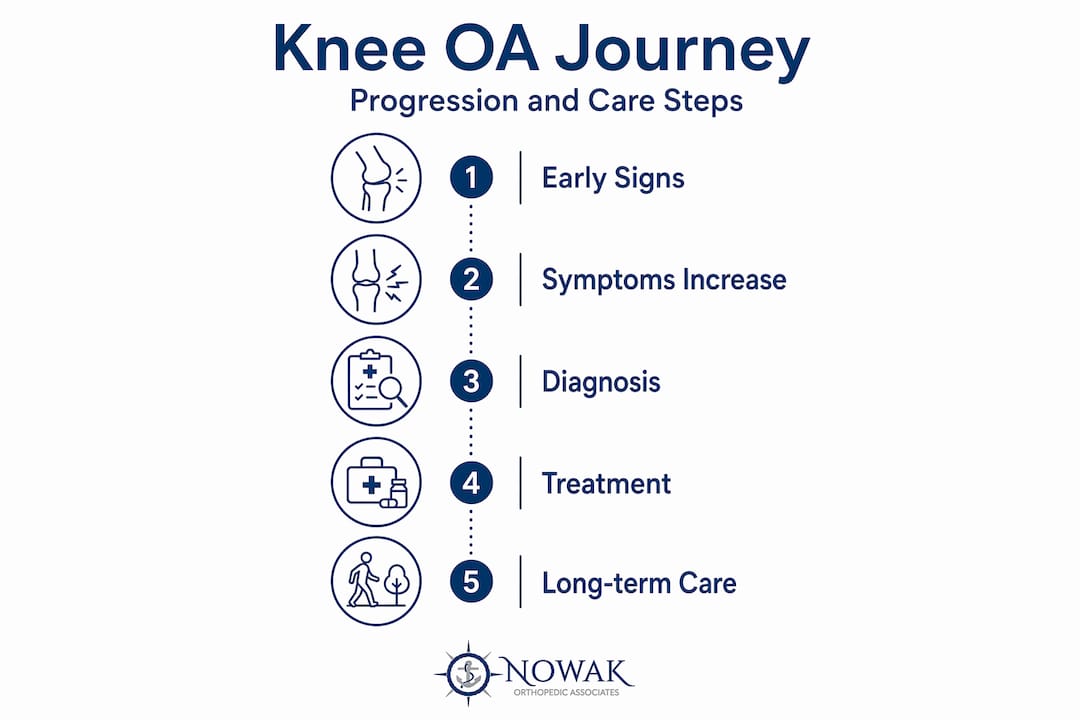
This is not the same as rheumatoid arthritis (RA), which is an autoimmune disease. With RA, your immune system attacks the joint lining, typically causing prolonged morning stiffness lasting more than one hour and affecting multiple joints symmetrically. With knee OA, the pain is multifactorial, involving both mechanical forces and low-grade inflammation, and stiffness typically fades within 30 to 60 minutes of moving around.
You can learn more about the full picture of knee osteoarthritis on our website, including how it is graded and diagnosed.
Common causes and contributing factors include:
- Natural aging and cumulative wear on the joint
- Previous knee injury (such as a torn ligament or meniscus)
- Excess body weight placing added stress on the joint
- Genetic predisposition to joint degeneration
- Occupational tasks that require repeated kneeling, squatting, or heavy lifting
| Factor | How it affects OA |
|---|---|
| Aging | Reduces cartilage resilience and repair capacity |
| Obesity | Increases mechanical load and promotes joint inflammation |
| Prior injury | Alters joint alignment and accelerates cartilage loss |
| Occupation | Repeated high-load movement speeds up joint wear |
| Genetics | May affect cartilage quality and inflammatory response |
Knee OA does not develop overnight. It typically progresses slowly over years, which is why many people dismiss early warning signs as ordinary aches.

Recognizing symptoms and risk factors
If you have knee osteoarthritis, you are likely experiencing a familiar pattern: pain that builds gradually over weeks or months, stiffness when you first wake up or sit for a long period, and a feeling that your knee just does not move as freely as it used to.
The most common symptoms include:
- Aching or sharp pain during or after activity, especially going up and down stairs
- Morning stiffness that typically lasts less than 60 minutes
- Swelling around the joint, sometimes with warmth
- Crepitus, a grinding or clicking sensation when bending the knee
- Decreased range of motion, making it harder to fully bend or straighten the leg
- Instability or a feeling that the knee might give way
Risk factors help predict who is most likely to develop OA. Age is the single strongest predictor, with prevalence rising sharply after age 50. However, it is not the only one.
People who carry excess body weight face a significantly compounded risk. Obesity accelerates OA progression through both mechanical overloading and systemic inflammation triggered by adipose tissue, a combination that speeds cartilage breakdown more than mechanical stress alone.
Pro Tip: Do not wait for severe pain before seeking an evaluation. Early diagnosis gives you far more treatment options and a better chance of slowing disease progression before significant cartilage loss occurs.
Other meaningful risk factors include being female (particularly after menopause), a history of joint injuries, and jobs that demand prolonged kneeling or heavy load-bearing. The presence of multiple risk factors compounds your overall likelihood of developing symptomatic OA.
First-line management: Non-surgical evidence-based options
When it comes to treating knee OA, the guidelines are clear and consistent. The American Academy of Orthopaedic Surgeons (AAOS), the Osteoarthritis Research Society International (OARSI), and the American College of Rheumatology (ACR) all agree: non-pharmacologic management is first-line, meaning exercise, weight loss, and patient education should come before medications or procedures.
This is not a compromise. It is the strongest evidence-based recommendation available.
Here is why weight loss alone is so powerful. The knee bears roughly four times your body weight with every step. That multiplier means every pound you lose removes four pounds of force on the knee joint per stride. A modest weight loss of just 10 pounds translates to 40 fewer pounds of pressure with each step.
| Weight loss | Reduction in knee load per step |
|---|---|
| 5 lbs | 20 lbs less force |
| 10 lbs | 40 lbs less force |
| 20 lbs | 80 lbs less force |
| 30 lbs | 120 lbs less force |
A 5 to 10 percent reduction in body weight can reduce knee load by 30 to 50 percent and meaningfully reduce pain and disability. That is a profound result from a non-surgical, non-pharmaceutical intervention.
Recommended exercise types for knee OA:
- Aerobic exercise such as walking, cycling, or swimming to maintain cardiovascular health and support weight management
- Strength training focused on the quadriceps and surrounding muscles to offload stress from the joint
- Aquatic exercise which reduces gravitational load while still building strength and endurance
- Tai Chi which improves balance, flexibility, and pain levels with very low joint impact
Our non-surgical treatment guide goes into greater detail on how to structure these approaches alongside other conservative care strategies.
Pro Tip: Supervised exercise programs with a physical therapist or structured group setting tend to produce better long-term adherence and outcomes compared to unsupervised home programs. If you have been inconsistent with exercise in the past, supervised care may make a real difference.
Medication, injections, and advanced care options
When non-surgical strategies are not enough on their own, medications and injections can play a valuable supporting role. The key is understanding what each option does, and what the evidence actually supports.
Commonly used medications for knee OA include:
- Topical NSAIDs (nonsteroidal anti-inflammatory drugs): First-choice pain relievers, applied directly to the skin over the knee with fewer gastrointestinal side effects than oral forms
- Oral NSAIDs: Effective for moderate to severe pain but carry risks for the stomach, kidneys, and heart with prolonged use
- Acetaminophen: Offers modest pain relief and is safer for many patients, though its effectiveness for OA is limited
- Duloxetine: A medication originally used for depression and nerve pain, now conditionally recommended for patients who cannot tolerate NSAIDs or have a neuropathic component to their pain
- Tramadol: Used cautiously for patients with limited other options due to its dependence potential
When medications fall short, injections become relevant. Here is how the two most common options compare:
| Injection type | Mechanism | Evidence strength | Duration of relief |
|---|---|---|---|
| Corticosteroid | Reduces joint inflammation | Strong for short-term relief | Weeks to a few months |
| Hyaluronic acid | Supplements natural joint fluid | Weak per AAOS guidelines | Variable and inconsistent |
Corticosteroid injections are supported for short-term pain relief when other treatments have not worked. Hyaluronic acid injections (viscosupplementation) are a different story. The AAOS does not support routine viscosupplementation because current evidence does not consistently show meaningful benefit over placebo.
For patients interested in non-surgical advanced options, our practice also offers regenerative therapies such as PRP injections and SoftWave therapy. You can explore our full orthopedic injections overview to understand how these options fit into an overall care plan.
Special considerations: Post-injury OA and high-risk occupations
Not everyone with knee OA follows the same path. Two groups deserve particular attention because their OA often develops faster and presents unique management challenges: people with a history of significant knee injuries and those in physically demanding occupations.
A previous ACL tear, meniscus injury, or fracture near the knee dramatically increases your risk of developing OA earlier than you otherwise would. The injury changes joint alignment and load distribution, accelerating cartilage wear even years after the original trauma heals. Post-injury OA requires aggressive rehabilitation focused on restoring proper biomechanics, not just managing pain.
Key management priorities for post-injury OA and high-load occupations include:
- Correcting movement patterns and gait through targeted physical therapy
- Strengthening muscles that protect and stabilize the knee, particularly the quadriceps and hip abductors
- Using supportive bracing where appropriate to reduce joint stress during activity
- Modifying occupational tasks or seeking ergonomic adjustments to reduce cumulative knee loading
- Monitoring for symptom changes more closely, since progression may be faster than average
Workers in construction, agriculture, cleaning, and nursing are among those at elevated risk due to repeated heavy kneeling and load-bearing tasks.
Pro Tip: If your knee OA developed after an injury or is connected to your job, ask specifically for a physical therapist who specializes in biomechanical assessment. A generic strengthening program may not address the underlying movement problems driving your symptoms.
The real challenge: Why knee osteoarthritis demands a personalized, persistent approach
Most articles about knee OA present a tidy checklist: exercise, lose weight, take medication if needed, consider surgery as a last resort. That framework is not wrong, but it leaves out the most important truth most people learn only after months of frustrating trial and error.
Knee OA is not a condition you fix once and move on from. It changes. Your pain level shifts with seasons, activity changes, life stress, and the natural progression of the disease. A treatment that works well at one stage may need to be adapted or replaced entirely as your situation evolves. This is where most people stumble.
The patients we see who manage their OA best are not necessarily the ones who follow the most aggressive treatment plan. They are the ones who stay engaged with their care, communicate honestly about what is and is not working, and remain willing to adjust. Setbacks are not failures. They are feedback.
That also means the goal is not to find one perfect solution. It is to build a care approach that can flex with you over time. That might mean leaning heavily on exercise and weight management early on, adding injections or regenerative therapies when flare-ups occur, and exploring surgical options like partial knee replacement only if conservative care has been exhausted. A thoughtful step-by-step management approach makes all the difference.
Expert knee care and next steps
At Nowak Orthopedic Associates in Hampton, NH, we understand that no two patients experience knee osteoarthritis the same way. Dr. Roger B. Nowak and our care team provide individualized treatment plans that reflect where you are right now, whether you are newly diagnosed, managing a flare, or considering more advanced options. From supervised rehabilitation and targeted injections to regenerative therapies and surgical interventions, our full range of services is designed to reduce your pain and restore your mobility. Explore our evidence-based non-surgical options or speak with an orthopedic specialist to take your next step confidently.
Frequently asked questions
Is osteoarthritis of the knee reversible?
Knee OA cannot be reversed, but with consistent management, symptoms can be significantly reduced and disease progression can be slowed. Currently, there are no approved disease-modifying drugs that restore lost cartilage.
How can I manage knee OA pain without medication?
Exercise, weight loss, and structured self-management are first-line non-drug strategies proven to reduce pain and improve function in people with knee osteoarthritis.
When should I see an orthopedic specialist for knee pain?
See a specialist if your knee pain persists despite several weeks of home care, or if you notice significant swelling, joint instability, or difficulty walking normally. Early evaluation leads to better outcomes.
Are knee injections safe and effective for OA?
Corticosteroid injections provide short-term relief for many patients when other treatments have not worked, but not all injections carry equal evidence. Viscosupplementation, for example, is not routinely recommended by current AAOS guidelines due to inconsistent clinical results.