

TL;DR:
- Many popular competitive sports pose high risks of joint injuries, especially in knees and ankles. Understanding movement patterns and early intervention can significantly reduce injury likelihood; athletes who follow prevention strategies often experience fewer long-term issues. Proper training, timely treatment, and specialized orthopedic care help athletes stay active without compromising joint health.
If you play competitively or train hard, the sports that risk joint injuries are likely ones you already love. Football, basketball, soccer, tennis, volleyball — these aren’t fringe activities. They’re deeply woven into how millions of people stay fit, compete, and connect. Yet knees buckle, shoulders tear, and hips give out at rates that most athletes don’t fully appreciate until it happens to them. Understanding which sports carry the highest joint risks, and why, puts you in a far better position to train smarter, prevent injury, and make informed decisions if something does go wrong.
Table of Contents
- Evaluating joint injury risk factors in sports
- Team sports with high knee and ankle injury rates
- Hip and groin injury prevalence in multidirectional sports
- Joint injuries in overhead and jumping sports
- Comparing joint injury risks: a summary table
- Our perspective: the injury you don’t feel yet is the one that catches you
- Protect your joints with specialized orthopedic care in New Hampshire
- Frequently asked questions
Key Takeaways
| Point | Details |
|---|---|
| Know your sport’s risk | Different sports pose varying joint injury risks, with pivoting and contact sports having the highest incidence. |
| Movement quality matters | Proper technique and neuromuscular control significantly reduce joint injury likelihood. |
| Preventive training helps | Consistent neuromuscular and strength training can cut non-contact knee injuries by more than half. |
| Early rehab is crucial | Phased, active rehabilitation after injury protects joints from long-term damage and recurrence. |
| Individual factors affect risk | Gender, prior injuries, and biomechanics influence joint vulnerability, necessitating personalized care. |
Evaluating joint injury risk factors in sports
Before looking at specific sports, it helps to understand what makes certain movements dangerous for your joints. Not all injuries come from collisions or bad luck. Many follow predictable patterns tied to how your body absorbs force during specific actions.
Most sports knee injuries stem from four primary causes: rapid changes of direction, poor or awkward landings, direct contact, and equipment or playing surface problems. Each puts different stress on the ligaments, tendons, and cartilage that hold your joints together.
The four main risk factors worth knowing:
- Rapid direction changes: Cutting and pivoting movements create rotational stress on the ACL (anterior cruciate ligament) and meniscus.
- Awkward landings: Landing with a straight or inward-collapsing knee dramatically increases ligament load.
- Direct contact: Tackles, collisions, and falls can transmit force directly to joint structures.
- Surface and equipment issues: Hard courts, worn cleats, and improper footwear all alter how force travels through the lower extremity.
Beyond movement patterns, your individual biology matters. Prior injury is one of the strongest predictors of future injury. Muscle strength, movement mechanics, and even hormonal factors play real roles. Women face approximately 1.51 times higher ACL injury risk than men, partly due to anatomical differences in hip width and knee alignment, and partly because of neuromuscular patterns that cause the knee to collapse inward during landings and pivots. This isn’t a weakness; it’s a trainable pattern, and understanding it opens the door to targeted prevention through knee injury prevention tips.
With this framework in mind, let’s explore specific sports that pose higher joint injury risks.
Team sports with high knee and ankle injury rates
Having examined general risk factors, we now look at specific team sports with elevated injury patterns.
Football, basketball, and soccer are among the most popular sports in the country and also among the most demanding on knees and ankles. All three require sudden stops, explosive jumps, lateral cuts, and frequent directional changes at high speed. The result is a predictable concentration of ligament and tendon injuries.
Contact sports like football, basketball, and soccer account for 45% of emergency visits related to sports injuries, including knee and ankle damage.
What makes this more concerning is the shift in how these injuries are occurring. ACL tears in basketball, soccer, and football have increased 400% since the 1990s, and the majority are now non-contact injuries. That means no tackle, no collision. Just a player planting their foot, cutting hard, and the knee giving way under its own mechanical load, often worsened by fatigue.
Key injury patterns in team sports:
- Knee ligament tears (ACL, MCL): Most common in basketball and soccer, frequently occurring during deceleration or pivoting.
- Ankle sprains: High recurrence risk in basketball, especially on hard courts with repeated landings.
- Patellar tendinopathy: Overuse of the patellar tendon from repetitive jumping, common in volleyball and basketball.
- Meniscus tears: Often accompany ACL injuries, requiring surgical intervention when severe.
The encouraging reality is that neuromuscular training, programs that teach athletes to land and cut with better control, can cut non-contact knee injury rates by more than 50%. Consistency matters here. Athletes who follow structured prevent sports injuries strategies before and during their season see measurable reductions in joint injury rates.
Hip and groin injury prevalence in multidirectional sports
While knees and ankles dominate the conversation around joint damage in sports, hip and groin injuries represent a significant and often underestimated source of time lost from training and competition. These injuries are especially prevalent in sports requiring cutting, multidirectional sprinting, and kicking.
Research on hip and groin injuries in sport across 9 million exposure hours found an incidence rate of 0.71 injuries per 1,000 hours of exposure, accounting for approximately 11% of all sports injuries analyzed.
| Variable | Finding |
|---|---|
| Overall incidence | 0.71 per 1,000 exposure hours |
| Proportion of all injuries | ~11% |
| Match vs. training risk | Significantly higher during matches |
| Male vs. female risk | Males 1.8x higher injury rate |
Sports causing joint pain in the hip and groin region include soccer, ice hockey, Australian rules football, and rugby. Kicking, changing direction under load, and sprint-stopping mechanics place repeated stress on the hip labrum (the cartilage ring around the hip socket), the adductor muscles, and the pubic symphysis. Athletes who treat hip and groin injuries early, before they become chronic, tend to recover faster and avoid the cascade of compensatory problems that follow untreated hip pain.
Alongside hip and groin areas, shoulder and elbow joints also face risks in specific sports.
Joint injuries in overhead and jumping sports
Jumping and overhead sports create distinct injury profiles that many athletes overlook until symptoms become impossible to ignore. Tennis, volleyball, swimming, and baseball all place repetitive stress on joints in ways that accumulate quietly over months and seasons.
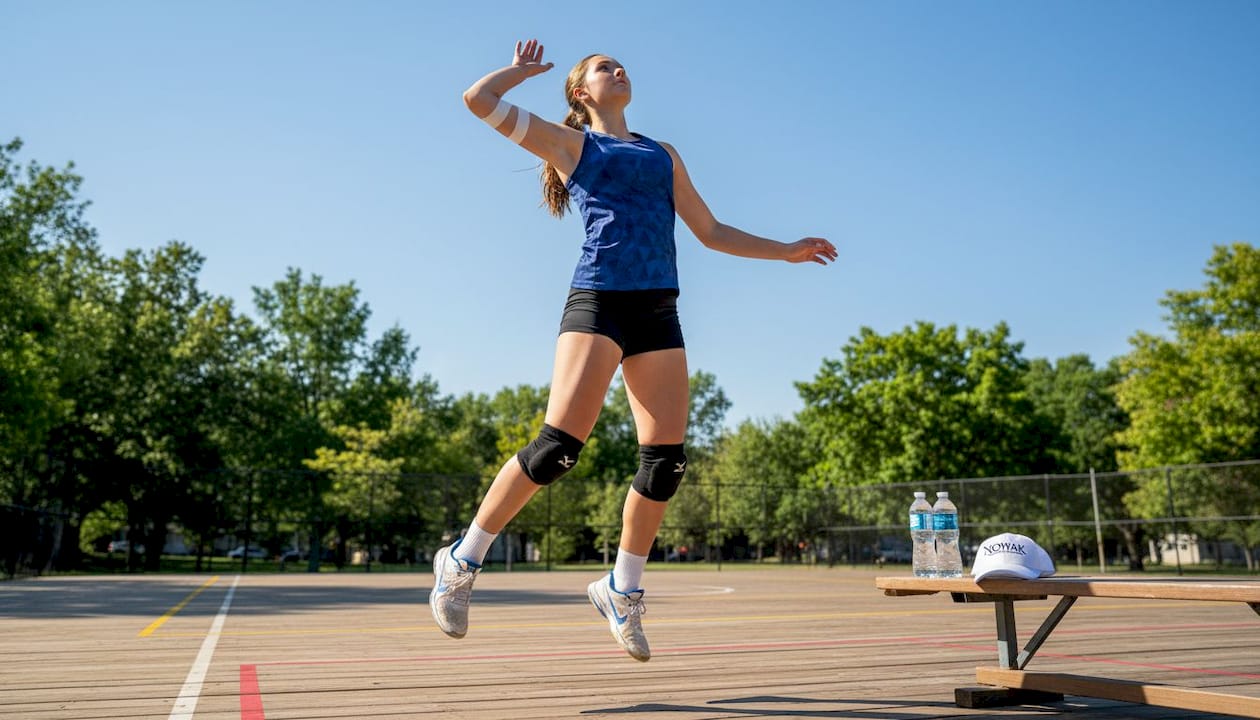
Chondromalacia patellae, a softening and breakdown of the cartilage behind the kneecap, affects up to 30% of sports injuries in jumping and pivoting sports. The outdated response was rest. The current evidence points toward phased, progressive loading as the more effective path, gradually reintroducing stress to the tendon and cartilage in a controlled way that promotes tissue repair without aggravating inflammation.
For overhead athletes, the shoulder joint bears the brunt of repeated throwing, serving, and spiking motions. These forces can cause labral tears, often described as a fraying or tearing of the cartilage that lines the shoulder socket, sometimes long before pain becomes noticeable. Rotator cuff injuries (damage to the group of four muscles stabilizing the shoulder) frequently co-occur.
Preventive strategies for overhead and jumping sports:
- Rotator cuff strengthening three times weekly reduces the incidence of shoulder labral tears in overhead athletes.
- Eccentric loading exercises for the patellar tendon are more effective than rest for tendinopathy management.
- Phased return to sport protocols protect joint integrity during recovery and reduce reinjury rates.
- Fatigue monitoring during practice helps identify when technique breakdown (and injury risk) is highest.
Pro Tip: If you play an overhead sport and notice dull aching in the back of your shoulder after practice, don’t wait for it to become sharp pain before seeking evaluation. Labral damage caught early is far easier to address than a full tear requiring surgical repair.
Explore more about protecting your joints through a joint injury rehabilitation guide built for active athletes.
Comparing joint injury risks: a summary table
Understanding these differences allows athletes to make informed decisions about participation and joint care.
Elite youth football data shows ligament injury incidence reaches 20.61 per 1,000 hours during matches, compared to just 5.82 per 1,000 hours in training. That gap underscores how significantly competition intensity amplifies joint injury risk across all sports.
| Sport | Primary joints at risk | Typical injuries | Relative risk level |
|---|---|---|---|
| Football | Knee, ankle | ACL tear, ankle sprain, meniscus damage | Very high |
| Basketball | Knee, ankle | ACL tear, patellar tendinopathy, ankle sprain | Very high |
| Soccer | Knee, hip, groin | ACL tear, adductor strain, hip labral tear | High |
| Tennis | Shoulder, elbow, knee | Labral tear, lateral epicondylitis, patellar issues | Moderate to high |
| Volleyball | Knee, shoulder | Patellar tendinopathy, rotator cuff injury | Moderate to high |
| Baseball/softball | Shoulder, elbow | Rotator cuff tear, UCL injury, labral damage | Moderate |
Which sports hurt joints most severely in the long term depends not just on the sport itself, but on training load, movement quality, recovery time, and how quickly injuries are treated. Athletes who follow a structured sports injury prevention guide and adopt proven joint injury prevention habits dramatically shift the odds in their favor.
Our perspective: the injury you don’t feel yet is the one that catches you
In our experience working with athletes across all levels, the most damaging mindset isn’t recklessness. It’s the belief that “if it doesn’t hurt, it’s fine.” Many of the most serious joint injuries we see, full ACL ruptures, advanced labral tears, significant cartilage loss, were preceded by months of low-grade pain the athlete quietly managed with ice and ibuprofen.
High-risk sports for injuries don’t cause damage all at once. They accumulate it. Each season of insufficient recovery, each practice where fatigued mechanics go uncorrected, and each minor sprain that “healed on its own” adds to the total load on your joint structures. By the time a significant injury occurs, it rarely comes out of nowhere.
The athletes who stay in their sport longest aren’t necessarily the toughest. They’re the most informed. They know which movements stress which joints. They invest in prehabilitation (strengthening work done before injury occurs) as seriously as they invest in performance training. And when something feels off, they get it evaluated early rather than hoping it resolves.
You don’t have to stop playing the sport you love to protect your joints. You do need to take the biological reality of what your sport demands seriously.
Protect your joints with specialized orthopedic care in New Hampshire
At Nowak Orthopedic Associates in Hampton, NH, we work with athletes at every level who want to stay active, recover well, and avoid unnecessary time on the sidelines. Dr. Roger B. Nowak is a board-certified orthopedic surgeon specializing in minimally invasive arthroscopic procedures for the knee, shoulder, elbow, and hand, including ACL reconstruction, rotator cuff repair, meniscus repair, and labral procedures. For athletes who want to avoid surgery, our Regenerative Medicine Clinic offers PRP injections, SoftWave therapy, and orthobiologic treatments designed to support natural healing and reduce inflammation. Whether you’re dealing with an acute injury or managing chronic joint pain from years of sport, we can help you find a clear path forward. Contact us to schedule a consultation.
Frequently asked questions
Which sports have the highest risk of joint injuries?
Contact sports like football, basketball, and soccer carry the highest joint injury risks, particularly to the knees and ankles, given their reliance on pivoting, jumping, and collisions. Contact sports account for 45% of emergency visits related to sports joint injuries.
Can joint injuries in sports be prevented?
Yes, many joint injuries are preventable with the right training. Targeted neuromuscular control programs can reduce non-contact knee injuries by more than 50%, and neuromuscular training is now a standard recommendation for athletes in high-risk sports.
Why do female athletes have higher ACL injury risk?
Female athletes have higher ACL injury risk due to anatomical differences in hip and knee alignment, hormonal effects on ligament laxity, and neuromuscular patterns during landings. Women face approximately 1.51 times the ACL injury risk compared to men.
What are common joint injuries in overhead sports?
Overhead sports frequently cause shoulder labral tears and rotator cuff injuries through repetitive mechanical stress. Rotator cuff strengthening three times weekly is an effective preventive strategy for overhead athletes.
How important is rehabilitation after a joint injury in sports?
Rehabilitation is critical. Phased loading and neuromuscular retraining after injury outperform rest alone for restoring joint function and reducing the risk of reinjury.