

TL;DR:
- Recovering from elbow injuries requires a phased approach that balances protection, mobility, and strength rebuilding. Understanding your injury type and setting realistic goals help optimize your rehabilitation timeline and outcomes. Adhering to guided exercises, avoiding premature activity, and consulting specialists ensure safe recovery and return to full function.
Recovering from an elbow injury is rarely straightforward, especially if you are an athlete returning to sport or managing a degenerative condition like tennis elbow. The elbow is a complex hinge joint that relies on precise coordination between bone, tendon, and ligament, and pushing too hard too soon can set you back weeks. Following a clear, step by step elbow injury rehab plan is one of the most important things you can do to protect your recovery and restore full function. This guide walks you through each phase, from the first days after injury to returning to the activities you love.
Table of Contents
- Preparing for your rehab: understanding your injury and setting realistic goals
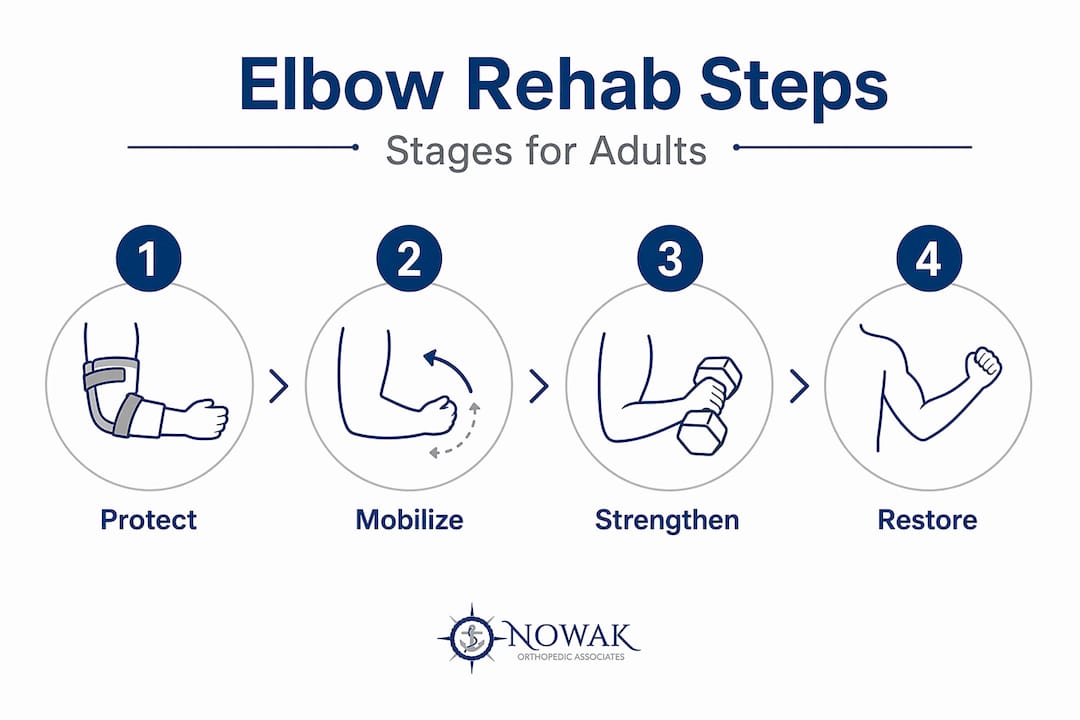
- Step 1: Immediate and early rehab phase — weeks 0 to 3
- Step 2: Increasing mobility and beginning elbow motion — weeks 3 to 6
- Step 3: Strengthening and functional restoration — weeks 6 to 12+
- Common rehab challenges and how to troubleshoot them
- Why phased rehab and a holistic approach are key to your elbow recovery
- Find expert elbow injury care and rehab support in New Hampshire
- Frequently asked questions
Key Takeaways
| Point | Details |
|---|---|
| Phased rehab approach | Following structured rehab phases improves elbow recovery and prevents stiffness. |
| Early motion matters | Starting wrist and shoulder movement early keeps joints mobile while protecting the elbow. |
| Eccentric exercises help | Targeted eccentric strengthening supports tendon healing in tennis and golfer’s elbow. |
| Short immobilization | Limiting immobilization time reduces stiffness and aids functional return after dislocations. |
| Professional guidance | Consult therapists or orthopedic surgeons if progress stalls or pain worsens during rehab. |
Preparing for your rehab: understanding your injury and setting realistic goals
Before you start any elbow injury rehabilitation program, you need to know exactly what you are dealing with. Elbow injuries fall into a few broad categories: fractures, dislocations, and tendinopathies such as tennis elbow (lateral epicondylitis) and golfer’s elbow (medial epicondylitis). Each one has a different healing timeline and requires a different approach to elbow rehab exercises.
Understanding the role of an elbow orthopedic surgeon is valuable here, especially if your injury involved structural damage. A proper diagnosis shapes every decision you make in rehab.
General recovery timelines to keep in mind:
- Fractures: 3 to 6 months to regain functional range of motion with daily exercises
- Dislocations: most function returns by 6 to 12 weeks with gradual mobilization
- Tendinopathies (tennis or golfer’s elbow): up to 12 months for full tendon recovery, especially with prolonged cases
Setting realistic functional goals is just as important as knowing your timeline. Ask yourself: do you want to return to a sport, resume a physically demanding job, or simply be pain-free with daily tasks? Your goal shapes your elbow injury recovery plan and keeps you motivated when progress feels slow.
Pro Tip: Write down three specific functional goals before you start rehab, for example, “throw a ball without pain” or “lift a coffee cup comfortably.” Review them weekly. Concrete goals prevent discouragement and help your care team calibrate your program.
Step 1: Immediate and early rehab phase — weeks 0 to 3
With your goals set, it is time to begin the practical rehab steps. The earliest phase of rehab is about protecting healing tissue while preventing the stiffness that can become a long-term problem.
Elbow fracture rehab starts within 48 hours focusing on wrist and shoulder exercises while the elbow is immobilized, avoiding active elbow extension for 6 weeks. The same principle applies to most early-phase elbow injuries.
Here is what early-phase rehab typically includes:
- Immobilize correctly. Wear your splint or brace as prescribed. Do not remove it early.
- Begin wrist circles and flexion/extension. Gentle wrist movement maintains circulation and prevents forearm stiffness.
- Perform shoulder pendulum exercises. Let gravity do the work to maintain shoulder mobility while your elbow heals.
- Practice light grip exercises. Squeezing a soft ball or sponge maintains grip strength and stimulates blood flow.
- Elevate and ice. Keep swelling down during the first 72 hours with elevation and 15 to 20 minute ice applications.
Key points to protect during this phase:
- Avoid active elbow extension (straightening your arm under muscle power) until your provider clears you
- Do not skip shoulder exercises thinking they are unrelated; shoulder mobility is part of your elbow surgery recovery and overall arm function
- Pain above a 3 out of 10 during any exercise is a signal to stop and reassess
Pro Tip: Warmth before exercise and ice after is a simple routine worth starting immediately. A warm shower or warm towel on the forearm loosens tissue before movement; ice afterward manages post-exercise inflammation.
Step 2: Increasing mobility and beginning elbow motion — weeks 3 to 6
Once immobilization is reduced, your focus shifts to recovering elbow range of motion. This is the phase where many people either progress well or develop lasting stiffness because they moved too aggressively or, conversely, avoided movement out of fear of pain.
Active elbow flexion and extension begin around week 6 for fractures; for dislocations, gentle flexion and forearm rotation start between weeks 2 and 6 to avoid stiffness. Your therapist will set the exact timeline based on imaging and clinical assessment.
Exercises to add in this phase:
- Active-assisted elbow flexion. Use your other hand to gently guide the injured arm into a bend, aiming to increase range by 5 to 10 degrees weekly.
- Forearm pronation and supination. Rotate your forearm palm-down then palm-up, holding a light object like a hammer handle for resistance.
- Gravity-assisted elbow extension. Sit with your arm resting on a table and let the forearm slowly straighten under its own weight. Never force this movement.
- Elbow flexion stretches. Slowly bend the elbow toward your shoulder, hold for 30 seconds, and release.
| Injury type | Motion to start first | Avoid initially |
|---|---|---|
| Fracture | Wrist and shoulder (weeks 0 to 3) | Active extension (weeks 0 to 6) |
| Dislocation | Gentle flexion and supination (weeks 2 to 6) | Forced extension |
| Tendinopathy | Full range stretching from week 1 | Heavy gripping |
Managing post-splint elbow mobility carefully at this stage significantly reduces the risk of permanent stiffness. If you notice your extension is plateauing, this is the time to flag it with your provider, not wait.
Pro Tip: Heat a damp towel for two minutes and apply it to your elbow for 10 minutes before your motion exercises. Warm connective tissue moves more freely and with less discomfort, making your elbow stiffness prevention efforts far more effective.
Step 3: Strengthening and functional restoration — weeks 6 to 12+
With restored mobility, the rehab focus moves to rebuilding strength and returning to real-world tasks. This is where the work feels more meaningful, and it is also where patience matters most.
Eccentric strengthening exercises performed two or more times weekly with gradual progression help tendon recovery; lack of improvement in 6 to 8 weeks warrants re-evaluation. Eccentric exercise means slowly lowering a resistance, lengthening the muscle under load. For tennis elbow, this looks like slowly lowering a light dumbbell from a wrist-extended position. It is uncomfortable at first but one of the most evidence-supported strategies in tendinopathy rehab.
Strengthening exercises for this phase:
- Wrist flexion and extension curls with a light dumbbell (0.5 to 1 kg to start)
- Eccentric wrist curls for golfer’s elbow rehab, focusing on the slow lowering phase
- Forearm pronation and supination with resistance using a hammer or weighted bar
- Elbow flexion curls with gradual load progression every two weeks
- Scapular squeezes and shoulder external rotation to support the full arm kinetic chain
Do not skip the shoulder and scapular work. A weak shoulder shifts excess load onto the elbow during overhead and throwing activities, which is a common reason elbow tendinopathies recur in athletes.
Pro Tip: Track your reps and weight each session in a simple notebook or phone app. Tendon adaptation is slow, and visual progress logs help you recognize steady gains that feel invisible day to day.
Common rehab challenges and how to troubleshoot them
Understanding common setbacks keeps you prepared and less likely to abandon your elbow injury rehabilitation program when things get difficult.
- Pain flare-ups: A dull ache after exercise that resolves within 24 hours is acceptable. Persistent or worsening pain means you have exceeded your tissue’s current capacity. Drop the load or reps by 20 percent and rebuild.
- Plateau in range of motion: This often signals scar tissue formation. A physical therapist can use joint mobilization or soft tissue techniques to address this.
- Swelling returning after exercise: Ice immediately and reduce intensity. Recurring swelling after weeks of progress may indicate an underlying structural issue.
Prolonged immobilization increases stiffness risk significantly. Early guided mobilization and symptom-based progression reduce complications and improve long-term outcomes for most elbow injuries.
Practical guidance on when to escalate:
- No measurable improvement in strength or range after 6 to 8 weeks of consistent rehab
- Pain above 5 out of 10 that does not resolve within 24 hours of exercise
- New neurological symptoms such as numbness, tingling, or weakness in the hand
Pro Tip: Keep a symptom diary noting pain levels before and after each session. Patterns emerge quickly, and this data is incredibly useful when managing elbow pain with a clinician.
Why phased rehab and a holistic approach are key to your elbow recovery
Here is something we see consistently: patients who understand why a phased approach exists follow it far more faithfully than those who just follow instructions without context.
Phased rehab balances pain control with tissue protection, progressing from gentle range of motion to eccentric strengthening and kinetic-chain work for overhead athletes. Skipping phases does not speed up healing. It disrupts it. Bone and tendon heal on biological timelines that no amount of motivation or willpower can override.
The second point that gets overlooked, especially among athletes, is the kinetic chain. The elbow does not work in isolation. Every overhead throw, tennis swing, or push starts at the shoulder and scapula, passes through the elbow, and ends at the wrist. If your shoulder is weak or your scapular stability is poor, your elbow absorbs forces it was never meant to handle alone.
We also see patients who focus entirely on pain relief and stop rehab the moment they feel better, months before the tendon or bone has fully remodeled. Feeling better is not the same as being healed. Completing the elbow injury prevention workflow phase protects you from reinjury and reduces the likelihood of chronic problems.
Patient education is genuinely part of treatment. When you understand the reasoning behind each phase, you become an active participant in your recovery rather than a passive one.
Find expert elbow injury care and rehab support in New Hampshire
Learning the rehab steps is a strong start, but partnering with a specialist ensures your program is built around your specific injury, not a generic template. At Nowak Orthopedic Associates in Hampton, NH, we provide thorough orthopedic evaluations and advanced joint care tailored to your condition, whether you are recovering from a fracture, managing tennis elbow, or returning to competitive sport. Dr. Roger B. Nowak offers individualized elbow treatment plans that may include physical therapy, PRP injections, SoftWave therapy, or surgical options such as lateral epicondylectomy when conservative care is not enough. Our sports medicine services support athletes at every level across New Hampshire. Ready to take the next step? Schedule your first visit and get a personalized recovery plan.
Frequently asked questions
How long does it typically take to recover from an elbow fracture with rehab?
Full elbow range of motion after fracture typically takes 3 to 6 months with daily exercises and guided therapy. Consistent effort and proper phasing are the main factors that determine how quickly you return to full function.
When can I start moving my elbow after a dislocation?
Short immobilization of 1 to 2 weeks is generally recommended before starting gradual active motion after an elbow dislocation. Starting too late increases stiffness risk significantly.
What are eccentric exercises and why are they important for tennis or golfer’s elbow rehab?
Eccentric exercises stretch and strengthen forearm muscles by slowly lowering a resistance while lengthening the tendon, promoting tissue remodeling with manageable discomfort as a guide. They are among the most effective tools for tendinopathy recovery.
How can I avoid elbow stiffness during rehab?
Following a phased protocol with early controlled mobilization and avoiding prolonged immobilization are the two most reliable ways to prevent elbow stiffness after injury or surgery. Always progress range-of-motion work as soon as your provider clears you to do so.