

TL;DR:
- Tendon injuries in elderly adults result from age-related degeneration, systemic diseases, and cumulative microtrauma, requiring early diagnosis and targeted treatment. Imaging modalities like ultrasound and MRI are essential for accurate identification, and approaches such as eccentric exercises and surgery offer effective management. Preventative strategies include progressive strength training, balance programs, medication awareness, and managing systemic conditions to reduce rupture risks.
Tendon injuries in elderly adults are defined as structural damage to the fibrous connective tissues linking muscle to bone, occurring most often as chronic tendinopathy, partial tears, or complete ruptures. Aging directly reduces tendon thickness, blood flow, and collagen organization, making seniors far more vulnerable to these injuries than younger adults. Systemic conditions common in older populations, including rheumatoid arthritis, diabetes, and long-term use of fluoroquinolone antibiotics, compound that vulnerability significantly. Understanding tendon injuries in elderly patients is the first step toward protecting mobility, preventing falls, and maintaining quality of life.
What causes tendon injuries in seniors?
Tendinopathy in older adults is a chronic degenerative disorder caused by repetitive microtrauma and reduced blood flow, not simply inflammation. This distinction matters because it explains why anti-inflammatory medications alone rarely resolve the problem. The tendon’s internal structure gradually loses its organized collagen architecture, and the tissue becomes less capable of tolerating even routine loads.
Several biological and systemic factors drive senior tendon injury causes:
- Age-related vascular decline reduces nutrient delivery to tendon tissue, slowing repair after every minor stress.
- Collagen disorganization replaces healthy parallel fiber alignment with irregular, weaker scar-like tissue over time.
- Repetitive microtrauma accumulates when the healing response cannot keep pace with daily mechanical demands.
- Systemic diseases such as rheumatoid arthritis and diabetes increase tendinopathy risk and raise the likelihood of sudden rupture.
- Fluoroquinolone antibiotics (ciprofloxacin, levofloxacin) are directly associated with tendon weakening and rupture, particularly in the Achilles.
Compared to younger adults, who typically injure tendons through acute overload during sport, seniors develop tendon damage through cumulative degeneration. A 60-year-old who has never played sports can still rupture a quadriceps tendon stepping off a curb, because the underlying tissue has been quietly weakening for years.
Pro Tip: If a senior in your care has recently started a fluoroquinolone antibiotic and reports new tendon pain, contact their physician promptly. This is a recognized drug side effect, not routine soreness.
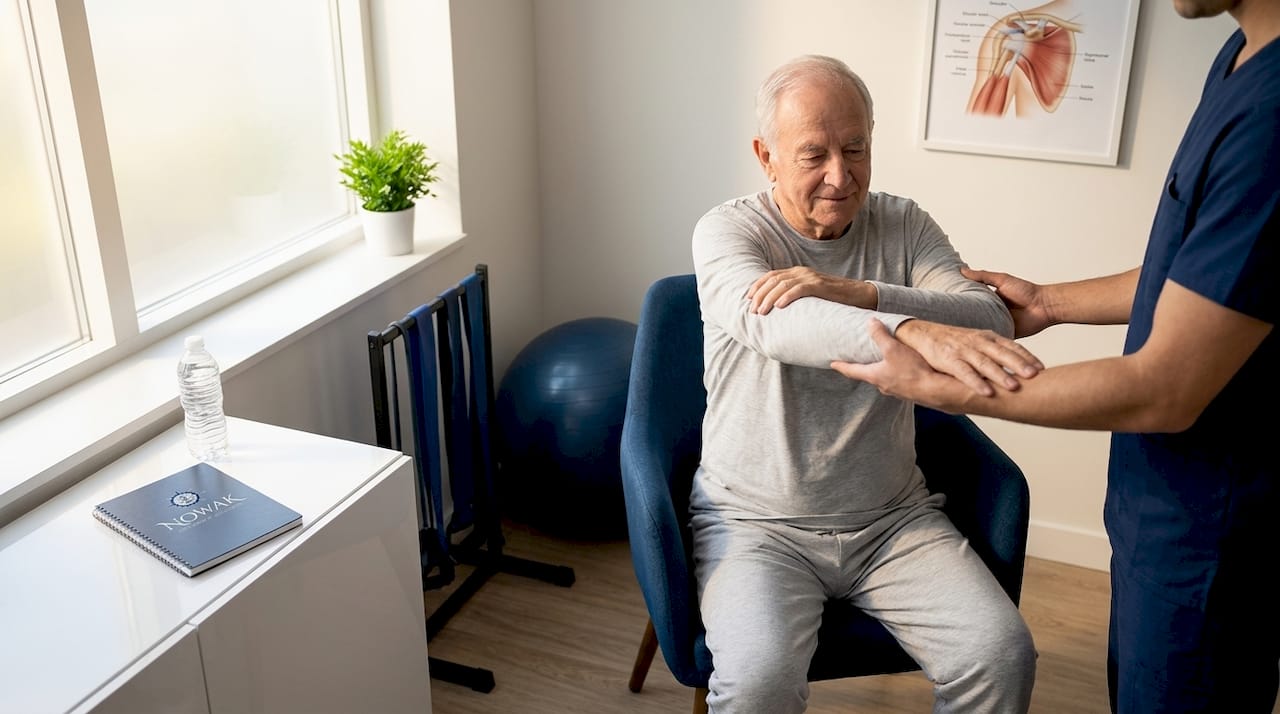
How do common tendon injuries present in elderly patients?
The most common tendon injuries in seniors affect the rotator cuff (shoulder), Achilles tendon (ankle), and quadriceps tendon (knee). Each presents with a recognizable pattern, though diagnosis in older adults carries specific challenges that clinicians and caregivers should recognize.
Typical tendon injury symptoms in elderly patients include:
- Pain with movement that worsens during activity and eases with rest, particularly in the early stages of tendinopathy.
- Localized tenderness directly over the tendon, distinct from the diffuse joint pain of osteoarthritis.
- Restricted range of motion caused by pain guarding or, in rupture cases, actual loss of mechanical continuity.
- Swelling or a palpable gap at the tendon site, which signals a complete or near-complete tear.
- Sudden weakness without a clear traumatic event, which in seniors often indicates a chronic tear that has finally progressed to rupture.
The diagnostic challenge is real. Osteoarthritis, bursitis, and general deconditioning can mask tendon injury symptoms, leading to delayed or missed diagnoses. A published case report documents a 78-year-old woman with bilateral quadriceps rupture who experienced a one-week diagnostic delay because her knee weakness was initially attributed to other causes. She ultimately regained functional ambulation after surgery, but the delay underscores the cost of misattribution.
Musculoskeletal ultrasound is a valuable tool for rapid and accurate diagnosis of tendon ruptures when physical examination is obscured by swelling or pain. MRI provides greater anatomical detail for surgical planning. Both modalities are routinely available at orthopedic practices equipped to treat seniors.
| Injury type | Common location | Key diagnostic sign |
|---|---|---|
| Tendinopathy | Achilles, rotator cuff, patellar | Pain on palpation, no structural gap |
| Partial tear | Rotator cuff, Achilles | Weakness with preserved some motion |
| Complete rupture | Quadriceps, Achilles | Inability to extend knee or plantarflex foot |
What are the best treatments for tendon injuries in older adults?
Treatment selection depends on injury severity, the patient’s overall health, and functional goals. The table below summarizes the primary options and their trade-offs for older adults.
| Treatment | Best suited for | Key consideration |
|---|---|---|
| Activity modification and eccentric exercise | Chronic tendinopathy | First-line; promotes structural healing over time |
| Corticosteroid injection | Short-term pain relief | Rupture risk in weight-bearing tendons; not curative |
| Surgical repair | Complete ruptures, failed conservative care | Requires rehab; outcomes favorable in motivated seniors |
| PRP and regenerative therapies | Partial tears, chronic tendinopathy | Emerging evidence; low risk profile |
Structured rehabilitation with eccentric loading is the foundation of non-surgical tendon management. Eccentric exercises, where the muscle lengthens under load, stimulate collagen remodeling and are well-tolerated by most older adults when properly supervised. NSAIDs and corticosteroids address symptoms but do not repair the underlying degenerative tissue.
Corticosteroid injections deserve specific caution. They provide short-term pain relief for tendinopathy but carry rupture risks, particularly when injected directly into weight-bearing tendons like the Achilles. Patients and caregivers should understand this trade-off before consenting to injection therapy. For guidance on injection risks and options, a consultation with a board-certified orthopedic surgeon is the safest path.
For complete ruptures, surgery followed by early supervised rehabilitation produces strong results. A 2026 cohort study found that percutaneous Achilles repair in patients aged 50 and older showed better 12-month patient-reported outcomes and lower re-rupture rates than non-operative management. This evidence supports surgical consideration even in older patients, provided they are medically fit.
Pro Tip: Regenerative therapies such as platelet-rich plasma (PRP) injections and SoftWave therapy are increasingly used for chronic tendinopathy in seniors who want to avoid surgery. Ask your orthopedic provider whether these options are appropriate for your specific injury.
How can elderly individuals prevent tendon injuries?
Preventing tendon injuries in elderly adults centers on reducing cumulative overload while building the strength and balance needed to protect tendons during daily activity. The following strategies are grounded in current evidence and practical for most seniors.
- Progressive strength training builds the musculotendinous unit’s capacity to absorb load. Gradual progression, not sudden intensity spikes, is the key principle. Avoiding sudden loading spikes is one of the most effective ways to prevent overload injuries.
- Structured balance programs such as Tai Ji Quan and the Otago program reduce falls by 20 to 58% in older adults, according to systematic reviews. Fewer falls mean fewer acute tendon ruptures.
- Medication awareness requires that seniors and caregivers flag any new tendon pain when fluoroquinolone antibiotics or corticosteroids are prescribed, and discuss alternatives with their physician.
- Managing systemic conditions including diabetes and rheumatoid arthritis through appropriate medical care reduces the systemic inflammation and vascular impairment that accelerate tendon degeneration.
- Avoiding overreliance on pain medications is critical. Masking pain with NSAIDs or opioids can lead seniors to continue activities that further damage already-compromised tendons.
For seniors interested in evidence-based injury prevention strategies, structured programs supervised by a physical therapist or orthopedic specialist provide the safest and most effective framework.
Key takeaways
Tendon injuries in elderly adults result from age-related degeneration, systemic disease, and cumulative overload, and they require early diagnosis, targeted treatment, and structured rehabilitation to restore function.
| Point | Details |
|---|---|
| Aging changes tendon biology | Reduced blood flow and collagen disorganization make seniors far more susceptible to tendinopathy and rupture. |
| Diagnosis requires imaging | Ultrasound and MRI confirm tendon injuries that physical exam alone may miss in older patients. |
| Surgery works in older adults | Percutaneous Achilles repair in patients 50+ shows better 12-month outcomes than non-operative care. |
| Eccentric exercise is first-line | Structured rehab with eccentric loading promotes structural healing, not just symptom relief. |
| Fall prevention protects tendons | Programs like Tai Ji Quan and Otago reduce falls by 20 to 58%, directly lowering rupture risk. |
What I’ve learned treating tendon injuries in older patients
After years of treating tendon injuries across all age groups, the pattern I see most often in elderly patients is not dramatic trauma. It is a slow accumulation of damage that goes unrecognized until a minor event, a step off a curb, a stumble on a rug, triggers a complete rupture of tissue that was already critically compromised.
The clinical mistake I caution against most is attributing new knee weakness or shoulder pain in a senior exclusively to osteoarthritis without ruling out a tendon rupture. Clinicians must carefully assess active knee extension after minor trauma in elderly patients to avoid missing complete extensor mechanism ruptures. A thorough physical exam followed by ultrasound when findings are unclear can prevent the kind of diagnostic delay that costs patients weeks of function.
I also want to address a misconception about corticosteroid injections. They have a role, but that role is narrow. Injecting directly into a weight-bearing tendon like the Achilles carries a real rupture risk that must be clearly explained to patients before they consent. I prefer to use injections selectively and to pair them with a structured rehabilitation plan rather than treating them as a standalone solution.
For caregivers, the most valuable thing you can do is monitor for the specific signs that distinguish tendon injury from general aging: sudden localized weakness, a palpable gap, or pain that is sharply worse with a specific movement. Early reporting leads to early diagnosis, and early diagnosis leads to better outcomes. Rehabilitation protocols that balance tendon protection with early mobilization consistently produce the best functional results in my experience.
— Dr. Roger Nowak
Specialized orthopedic care for tendon injuries in seniors
At Nowak Orthopedic Associates in Hampton, NH, Dr. Roger B. Nowak and his team provide individualized care for elderly patients dealing with tendon injuries at every stage, from early tendinopathy to complete ruptures requiring surgical repair. Whether you or a loved one needs a precise diagnosis, a conservative rehabilitation plan, or a discussion about surgical options such as rotator cuff repair or Achilles tendon repair, the practice offers the full spectrum of orthopedic care.
For patients who want to explore non-surgical paths, the Regenerative Medicine Clinic at Nowak Orthopedic Associates offers PRP injections, SoftWave therapy, and guided stretch therapy. Learn more about tendon repair surgery and what recovery looks like, or contact Nowak Orthopedic Associates directly to schedule a personalized assessment.
FAQ
What is tendinopathy and how does it differ from a tendon tear?
Tendinopathy is a chronic degenerative condition caused by repetitive microtrauma and reduced blood flow, producing pain and stiffness without a structural break. A tendon tear involves actual disruption of tendon fibers, ranging from partial to complete rupture.
Which tendons are most commonly injured in seniors?
The rotator cuff, Achilles tendon, and quadriceps tendon are the most frequently injured tendons in older adults. These tendons bear significant mechanical load during walking, climbing stairs, and reaching overhead.
Can elderly patients have surgery for a tendon rupture?
Yes. Research from 2026 shows that percutaneous Achilles repair in patients aged 50 and older produces better 12-month outcomes than non-operative treatment. Surgical candidacy depends on overall health and functional goals, not age alone.
How long does tendon rehabilitation take in older adults?
Recovery timelines vary by injury severity and treatment type, but most seniors undergoing supervised rehabilitation for tendinopathy see meaningful improvement within 8 to 12 weeks. Surgical repair typically requires 4 to 6 months of structured rehab before full function returns.
What medications increase tendon injury risk in seniors?
Fluoroquinolone antibiotics such as ciprofloxacin and levofloxacin are directly associated with tendon weakening and rupture in older adults. Long-term corticosteroid use also reduces tendon integrity and should be monitored carefully by a physician.