

TL;DR:
- Pickleball’s rapid growth has led to a rise in preventable musculoskeletal injuries like ankle sprains and tennis elbow. Proper warm-up, footwear, strength training, and body awareness are essential for injury prevention and long-term participation. Early recognition and treatment of injuries, along with personalized care, help players stay healthy and active on the court.
Pickleball is the fastest-growing sport in the United States, and with that growth comes a predictable rise in musculoskeletal injuries that sideline active adults for weeks at a time. Understanding common pickleball injuries and how to prevent them is the difference between staying on the court all season and spending it recovering. The most frequent injuries include lateral ankle sprains, tennis elbow (lateral epicondylitis), calf strains, rotator cuff impingements, and wrist injuries. Each one is largely preventable with the right warm-up habits, footwear, strength training, and body awareness.
What are the most common pickleball injuries and why do they happen?
Lateral ankle sprains are the most common pickleball injury, caused by the sport’s constant lateral movement and sudden direction changes. When a player pivots quickly to reach a shot, the ankle can roll outward, stretching or tearing the ligaments on the outer side. Recovery takes weeks, and without proper rehabilitation, recurrence rates are high.
Here is a breakdown of the injuries you are most likely to encounter on the pickleball court:
- Lateral ankle sprains: Sudden cuts and side-to-side shuffles put the ankle in a vulnerable position, especially when players wear improper footwear.
- Tennis elbow (lateral epicondylitis): Repetitive wrist and forearm motions during dinking and driving overload the tendons that attach at the outer elbow. This is a classic overuse injury.
- Calf strains: Cold muscles combined with explosive sprints to reach a drop shot are a reliable recipe for a calf pull, particularly in players over 40.
- Rotator cuff injuries: Overhead serves and put-aways drive repetitive stress through the shoulder, leading to impingement and, in severe cases, partial or full rotator cuff tears.
- Wrist and hand injuries: Awkward paddle contact and falls onto an outstretched hand produce sprains, fractures, and tendon irritation.
- Eye injuries: A pickleball traveling at speed can cause corneal abrasions or retinal detachment if it makes direct contact with an unprotected eye.
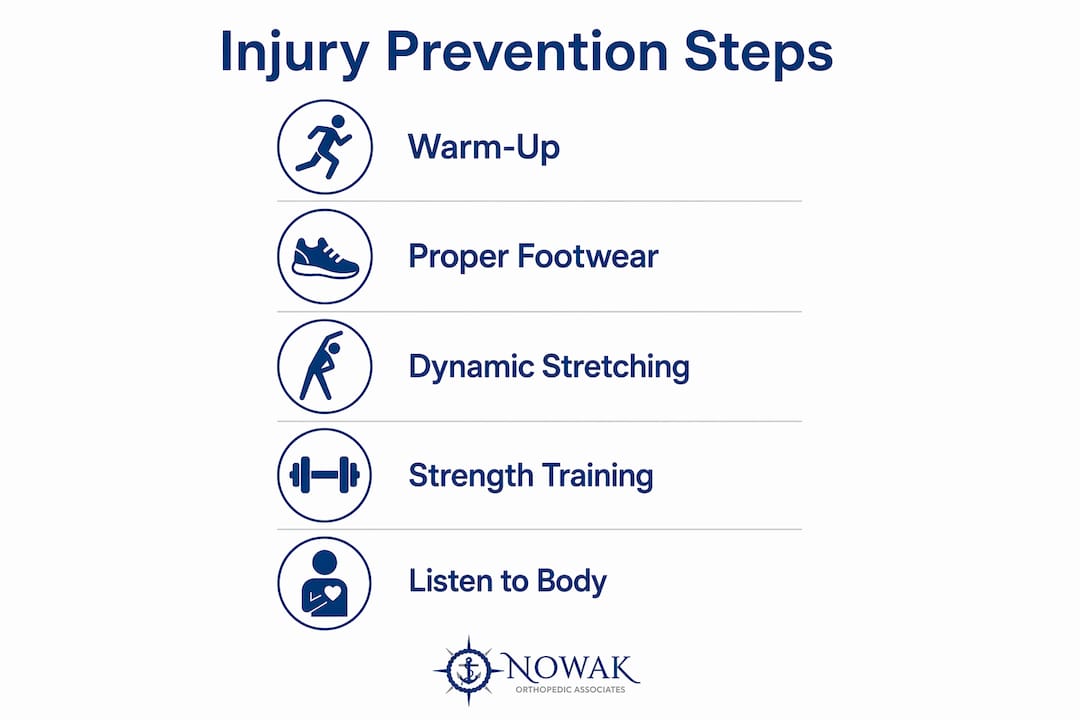
The common thread across all of these is preparation. Most pickleball injuries do not happen because the sport is inherently dangerous. They happen because players skip warm-ups, wear the wrong shoes, or ignore early warning signs.
How does proper warm-up and dynamic stretching prevent pickleball injuries?
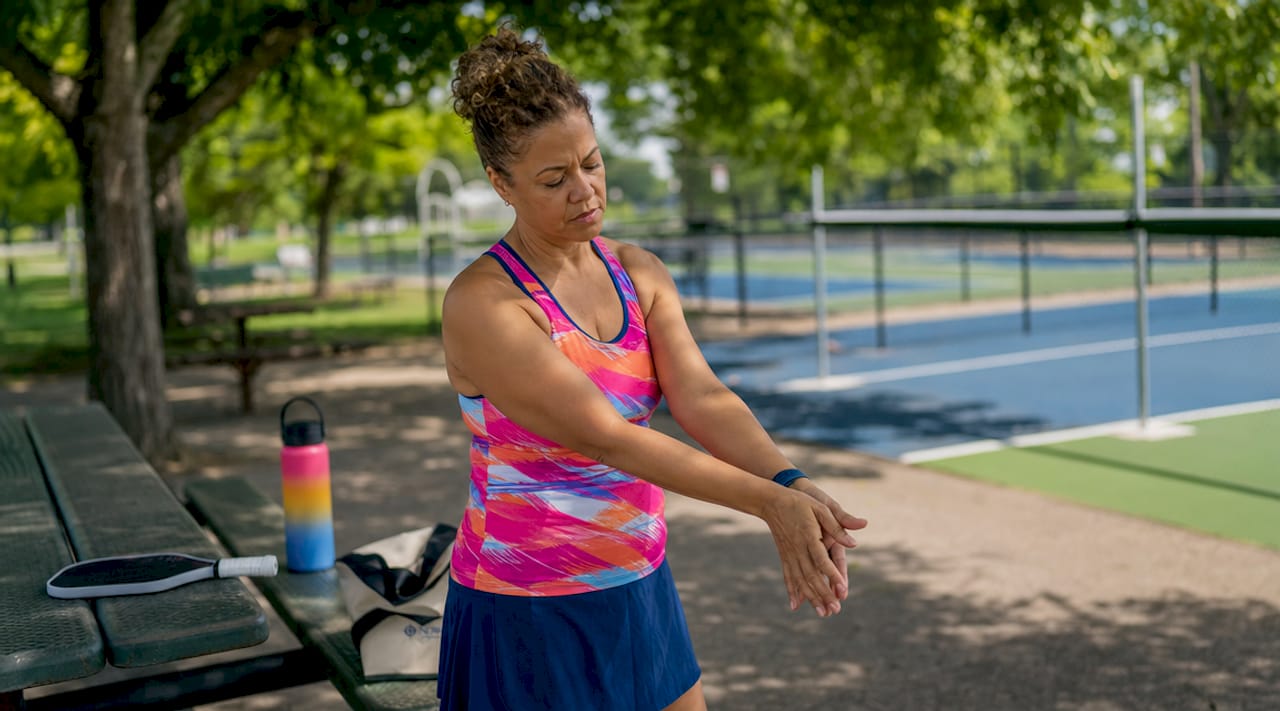
A dynamic mobility warm-up lasting 5 to 10 minutes reduces lower-extremity injury rates more effectively than static stretching performed before play. Static stretching, the kind where you hold a position for 30 seconds, can actually reduce muscle power output when done immediately before activity. Dynamic movement, by contrast, increases blood flow, raises muscle temperature, and primes the neuromuscular system for the demands of the court.
A practical pre-game warm-up for pickleball players should include:
- Light jogging or brisk walking for two minutes to elevate heart rate.
- Leg swings (forward and lateral) for 10 repetitions per leg to mobilize the hip and knee.
- Lateral lunges for 10 repetitions per side to activate the glutes and inner thighs.
- Arm circles and shoulder rotations for 30 seconds each direction to prepare the rotator cuff.
- Wrist circles and finger extensions to warm up the forearm tendons before gripping the paddle.
Pro Tip: Never skip the wrist and forearm warm-up. Tennis elbow develops gradually, and the forearm tendons are already under stress from daily activities before you even pick up a paddle. Two minutes of wrist circles and gentle forearm stretches before play can meaningfully reduce cumulative tendon load over a season.
What footwear and equipment choices reduce injury risk in pickleball?
The single most impactful equipment decision a pickleball player can make is choosing the right shoe. Court shoes provide lateral support that running shoes simply cannot offer. Running shoes are engineered for forward motion, with a raised heel and flexible sole that actually destabilizes the ankle during side-to-side movement. Court shoes, recommended by the American Academy of Orthopaedic Surgeons (AAOS), feature a wider base, lower heel stack, and stiffer lateral sides that keep the ankle in a safe position during quick cuts.
| Feature | Court shoes | Running shoes |
|---|---|---|
| Lateral support | High | Low |
| Heel height | Low | Elevated |
| Sole flexibility | Moderate | High |
| Best use | Side-to-side sports | Forward motion only |
| Ankle sprain risk | Reduced | Elevated |
Beyond footwear, two additional equipment choices matter significantly:
- Protective eyewear: Polycarbonate sport goggles prevent retinal detachment and corneal abrasions from ball impacts and cost approximately $30. This is one of the highest-value injury prevention investments available to any pickleball player.
- Paddle grip size: A grip that is too small forces the forearm muscles to overwork to maintain control, accelerating the onset of tennis elbow. A grip that is too large limits wrist mobility. Ask a knowledgeable retailer to help you size your grip correctly before purchasing.
What strength and conditioning exercises best support pickleball injury prevention?
Off-court training is where long-term injury resilience is built. Mount Sinai sports medicine experts recommend strength training focused on the core, legs, and rotator cuff, even just 15 minutes a few times per week, to reduce injury risk and support joint stability. This is not about building bulk. It is about creating the muscular support system that keeps joints safe under the demands of play.
Key exercises to prioritize include:
- Eccentric heel drops (heel-drop protocol): Stand on a step, rise on both feet, then lower slowly on one foot. Perform 3 sets of 15 repetitions twice daily. This protocol has been the gold standard for Achilles tendon injury prevention since 1998 and directly addresses the calf strain risk common in pickleball.
- Scapular rows and Y-T-W raises: These exercises strengthen the muscles that stabilize the shoulder blade, reducing the rotator cuff impingement risk that comes with overhead play. Use light resistance bands or dumbbells.
- Single-leg balance work: Standing on one leg for 30 to 60 seconds, progressing to unstable surfaces, trains the ankle stabilizers that prevent lateral sprains.
- Core planks and lateral band walks: A stable core and strong hip abductors reduce the compensatory movement patterns that lead to knee and lower back pain.
Pairing these exercises with bone-supporting activities builds the structural foundation that keeps joints resilient across a long playing career.
Pro Tip: Consistency matters more than intensity here. Fifteen minutes of targeted strengthening three times per week produces measurable results within six to eight weeks. Players who skip this step and rely on in-game movement alone are training their weaknesses, not correcting them.
How to listen to your body and adjust your playing habits
Sharp pain during play is not soreness. It is a signal that something is being damaged, and playing through it extends recovery time significantly. The 4 to 6 week window after an initial injury is particularly critical. Tissue that has not fully healed is vulnerable to re-injury, and a second injury to the same structure is almost always more severe than the first.
Practical habits that protect you from worsening an existing problem:
- Distinguish between muscle fatigue and joint pain. Fatigue fades within minutes of rest. Joint pain that persists or sharpens with movement warrants stopping play.
- Build session length gradually. New players and those returning after a break should limit initial sessions to 30 to 45 minutes and increase duration by no more than 10 percent per week.
- Learn to fall correctly. Most catastrophic pickleball injuries result from falls. Avoid backpedaling, which dramatically increases fall risk. Instead, use a drop step, turn, and run technique to retrieve deep shots. If a fall is unavoidable, tuck and roll rather than extending arms to catch yourself.
Seek a medical evaluation for any pain that persists beyond two weeks, limits your range of motion, or is accompanied by swelling. Early orthopedic assessment prevents minor injuries from becoming surgical problems.
For guidance on protecting your joints during activity, structured prevention resources can help you build a personalized plan before pain becomes a problem.
Key takeaways
Preventing pickleball injuries requires consistent attention to warm-up quality, footwear selection, off-court strength training, and early recognition of pain signals.
| Point | Details |
|---|---|
| Ankle sprains are most common | Wear court shoes with lateral support to reduce the primary injury risk in pickleball. |
| Dynamic warm-ups outperform static stretching | A 5 to 10 minute dynamic routine prepares muscles and joints better than holding stretches before play. |
| Off-court strength training works | Just 15 minutes of targeted exercise several times weekly builds the joint stability that prevents overuse injuries. |
| Eccentric heel drops protect the Achilles | Three sets of 15 reps twice daily is the gold-standard protocol for calf and Achilles injury prevention. |
| Fall technique prevents catastrophic injury | Use a drop step and tuck-and-roll method rather than backpedaling or catching yourself with outstretched hands. |
What I have learned treating pickleball players in New Hampshire
I see a consistent pattern in the pickleball patients who come through Nowak Orthopedic Associates. The injury almost never surprises them. They felt something building for weeks, maybe a nagging ache in the elbow or a twinge in the shoulder after overhead shots, and they kept playing because it was not bad enough to stop. By the time they sit across from me, what started as tendinopathy has progressed to a partial tear or a chronic impingement that requires significantly more intervention.
The players who stay healthy long-term are not necessarily the most athletic. They are the ones who treat warm-up as non-negotiable, invest in proper court shoes, and stop playing when something feels wrong rather than waiting to see if it gets worse. Small, consistent choices compound over a season. The footwear decision alone, switching from running shoes to a proper court shoe, eliminates the single most common injury category I treat in this sport.
If you have persistent joint pain that is not resolving with rest, do not wait it out. Early evaluation gives us far more options, including non-surgical treatments like PRP injections, SoftWave therapy, and guided physical therapy, than a delayed presentation does.
— Dr. Roger Nowak
How Nowak Orthopedic Associates supports pickleball players
Nowak Orthopedic Associates in Hampton, NH provides orthopedic care specifically suited to the injuries active pickleball players face, from lateral ankle sprains and tennis elbow to rotator cuff impingements and knee pain. Dr. Roger B. Nowak and the team offer individualized treatment plans that include physical therapy, PRP injections, SoftWave therapy, and surgical options when necessary. Whether you are dealing with a new injury or a recurring problem that has not responded to rest, advanced joint care is available to help you recover and return to the court safely. For players already managing an injury, our sports injury rehab program provides a structured path back to full activity.
FAQ
What is the most common pickleball injury?
Lateral ankle sprains are the most frequent pickleball injury, caused by the sport’s rapid side-to-side movement and sudden direction changes. Wearing proper court shoes significantly reduces this risk.
Are running shoes acceptable for pickleball?
Running shoes are not recommended for pickleball. They lack the lateral support and low heel profile that court shoes provide, making ankle sprains more likely during side-to-side play.
How do I prevent tennis elbow from pickleball?
Use a correctly sized paddle grip, warm up your forearm and wrist before play, and strengthen the forearm extensors with resistance band exercises off the court. Catching the early signs of tendon irritation before they progress is the most effective strategy.
When should I see a doctor for a pickleball injury?
Seek orthopedic evaluation for any pain that persists beyond two weeks, involves visible swelling, or limits your range of motion. Early assessment preserves more non-surgical treatment options.
Can strength training really prevent pickleball injuries?
Yes. Even 15 minutes of targeted strength training several times per week, focusing on the core, legs, and rotator cuff, meaningfully reduces injury risk by improving joint stability and muscular endurance.