

TL;DR:
- Shoulder injuries increase during summer sports due to rapid activity resumption after months of underloading. Preventive strategies include consistent prehab exercises, proper technique, and gradual ramp-up of activity to reduce overuse risks. Early assessment and treatment with physical therapy can significantly shorten recovery times and prevent severe damage.
Shoulder injuries during summer sports surge because rapid activity increases and repetitive overhead motions strain a joint that spent months underloaded. The rotator cuff, labrum, and surrounding tendons are particularly vulnerable when athletes jump back into tennis, swimming, baseball, and volleyball without adequate preparation. This pattern is so consistent that orthopedic specialists recognize it as a predictable seasonal trend. Understanding why shoulder injuries spike during summer sports, and what you can do about it, is the first step toward protecting yourself this season.
Why shoulder injuries spike during summer sports
The core reason is a mismatch between what your shoulder can currently handle and what you suddenly ask it to do. After months of reduced activity, muscles lose elasticity and strength, and seasonal activity exposes previously unchallenged muscles and movement patterns. That gap between capacity and demand is where injuries happen.
Several specific factors drive this seasonal pattern:
- Repetitive overhead motions. Throwing a baseball, serving in tennis, and swimming freestyle all place the shoulder in extreme ranges of motion hundreds of times per session. These movements load the rotator cuff and labrum in ways that desk work and casual walking simply do not.
- Muscle imbalances. Imbalanced pressing to pulling ratios above 2:1 overload the anterior shoulder structures and increase impingement risk. Most athletes press far more than they pull, leaving the posterior cuff and scapular stabilizers underdeveloped.
- Scapular instability. When the scapula does not move correctly, the rotator cuff compensates for every arm movement. Scapular instability overloads the rotator cuff and causes chronic irritation regardless of how strong the cuff itself is.
- The weekend warrior effect. Inactive athletes who perform intensive overhead sport on weekends face elevated injury risk because tendons and muscles lose resilience during sedentary periods.
- Poor posture and technique. Forward head posture and rounded shoulders narrow the subacromial space, the gap through which the rotator cuff tendons pass. Poor throwing or serving mechanics amplify this compression with every repetition.
Pro Tip: If you have been mostly sedentary since last fall, treat the first two weeks of summer sports as a conditioning phase, not a performance phase. Cut your usual volume by 40% and build from there.
What are the most common shoulder injuries in summer sports?
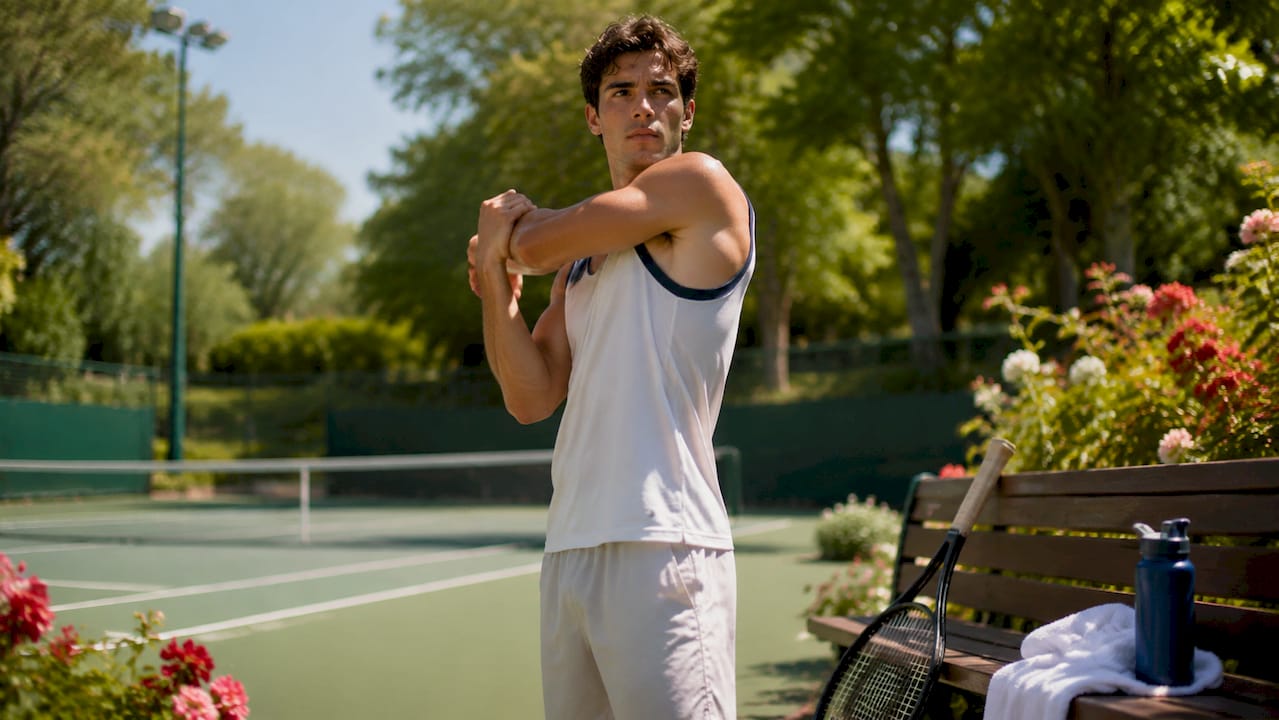
The injuries that show up most frequently in summer sports fall into a predictable set of categories, each tied to the overuse and overload patterns described above.
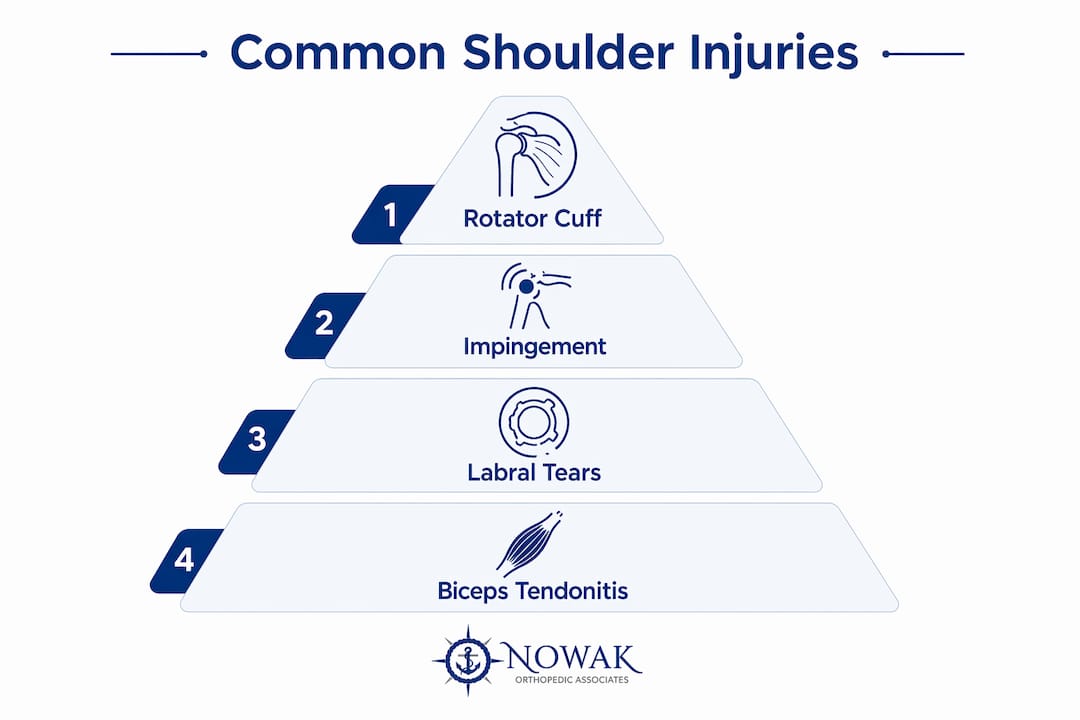
| Injury type | Common cause | Typical recovery |
|---|---|---|
| Rotator cuff strain or tear | Overhead overuse, sudden force | 4 to 12 weeks (partial); surgery for full tears |
| Shoulder impingement | Repetitive elevation, poor posture | 6 to 12 weeks with physical therapy |
| Labral tear (SLAP or Bankart) | Throwing, dislocation, fall | 3 to 6 months; surgery in severe cases |
| Shoulder dislocation | Contact sport, fall, instability | 6 to 12 weeks; recurrence risk is high |
| Biceps tendonitis | Overhead loading, swimming | 4 to 8 weeks with rest and therapy |
Rotator cuff strains are the most common entry point. They often begin as mild soreness after a long day on the tennis court or at the pool, and athletes frequently dismiss them. That dismissal is costly. Ignoring minor shoulder pain and clicking leads to worsening labral fraying and impingement that requires prolonged rehabilitation. A strain that could have resolved in four weeks with early care can evolve into a partial tear requiring months of treatment.
Labral tears, including SLAP tears (superior labrum anterior to posterior) and Bankart lesions, are particularly common in throwing athletes and swimmers. These injuries affect the cartilage ring that deepens the shoulder socket and provides stability. Dr. Roger B. Nowak at Nowak Orthopedic Associates performs both SLAP repair and Bankart repair arthroscopically, which shortens recovery compared to open surgical approaches.
How can athletes prevent shoulder injuries during summer sports?
Prevention is not complicated, but it does require consistency. The athletes who stay healthy through a full summer season are almost always the ones who treat shoulder conditioning as a year-round habit rather than a pre-season checklist item.
Follow these steps to build a shoulder that holds up through the season:
- Start a prehab routine before the season begins. An effective prehab routine involves 3 to 5 sessions per week, each 8 to 12 minutes long, using light resistance and 15 to 25 repetitions per set. This volume builds tendon resilience without creating fatigue.
- Balance your pulling and pressing. Match every pressing or throwing movement with an equal or greater volume of pulling work. Exercises like face pulls, band pull-aparts, and seated rows directly target the posterior cuff and scapular retractors.
- Train scapular stability specifically. Wall slides and scapular retractions are not glamorous, but improving scapular control prevents rotator cuff overload and reduces the risk of impingement. Add two sets of each to every upper-body session.
- Ramp up activity gradually. Increase throwing volume, swim yardage, or serving sessions by no more than 10% per week. Sudden spikes in workload are the single most predictable cause of overuse injuries.
- Correct your technique. Have a coach or physical therapist evaluate your throwing mechanics, swim stroke, or serve. A single technical flaw repeated thousands of times will eventually produce an injury regardless of how strong your shoulder is.
- Prioritize warm-up and recovery. Dynamic shoulder circles, band exercises, and thoracic spine mobility work before activity prepare the joint for load. Cold water immersion, foam rolling, and adequate sleep accelerate tissue recovery between sessions.
Pro Tip: Maintaining baseline strength and mobility during the off-season is the single most effective way to reduce injury risk when summer sports resume. Even two short sessions per week through the winter makes a measurable difference.
What are the best treatment options for a summer sports shoulder injury?
Early action is the defining factor in how quickly and completely a shoulder injury resolves. Physical therapy reduces recovery from months to weeks when started early, primarily by correcting the movement imbalances that caused the injury in the first place.
If you experience shoulder pain during summer sports, here is how to respond:
- Do not push through it. Pain during overhead activity is a signal, not a weakness. Continuing to load an irritated rotator cuff or labrum accelerates tissue damage.
- Seek evaluation promptly. Approximately 34.5% of sports injuries require X-ray evaluation due to fractures accompanying strains and sprains. A clinical exam and imaging can rule out serious structural damage and guide treatment decisions. You can learn more about what that process involves in this shoulder injury diagnosis guide.
- Start physical therapy early. Movement correction, rotator cuff strengthening, and scapular stabilization work address the root cause rather than just the symptoms.
- Consider non-surgical options first. Platelet-rich plasma (PRP) injections, SoftWave therapy, and guided stretch therapy, all available through Nowak Orthopedic Associates’ Regenerative Medicine Clinic, can accelerate healing in partial tears and tendonitis without surgery.
- Understand when surgery is appropriate. Full-thickness rotator cuff tears, complete labral detachments, and recurrent dislocations often require surgical repair. Procedures like rotator cuff repair, SLAP repair, and Bankart repair restore structural integrity and allow a safe return to sport.
For a detailed breakdown of non-surgical and surgical pathways, the shoulder treatment options guide at Nowak Orthopedic Associates covers recovery timelines and what to expect at each stage.
Key takeaways
Shoulder injuries spike in summer sports because the shoulder is asked to perform at high intensity before it has been adequately prepared, and early intervention is the most reliable way to shorten recovery.
| Point | Details |
|---|---|
| Seasonal mismatch drives injuries | Sudden activity after inactivity overloads tendons and muscles that lost resilience during the off-season. |
| Overhead sports carry the highest risk | Tennis, baseball, swimming, and volleyball repeatedly stress the rotator cuff and labrum at extreme ranges. |
| Scapular stability is often the missing link | Weak scapular stabilizers force the rotator cuff to compensate, creating chronic irritation even in strong athletes. |
| Prehab prevents most overuse injuries | Three to five short sessions per week of targeted shoulder work builds the resilience needed for a full season. |
| Early treatment cuts recovery time significantly | Physical therapy started at first symptoms can reduce recovery from months to weeks by correcting root-cause movement faults. |
What I see every summer at Nowak Orthopedic Associates
The pattern I observe every June and July is remarkably consistent. A patient comes in with shoulder pain that started two or three weeks into the season. They played through it for another week, hoping it would settle down. By the time they sit across from me, what began as a mild rotator cuff strain has progressed into impingement or a partial tear.
The misconception I hear most often is that shoulder pain is just part of playing hard. It is not. Pain is the shoulder’s way of telling you that demand has outpaced capacity. The athletes who respond to that signal early, with a physical therapy evaluation and a temporary reduction in load, almost always return to full activity within weeks. The ones who ignore it often end up in my surgical suite months later.
What I tell every patient is this: consistent conditioning through the winter is worth more than any single treatment I can offer. Two short sessions per week maintaining rotator cuff strength and scapular stability through the off-season will do more to protect your summer than any brace, injection, or surgical technique. The shoulder is a resilient joint when it is prepared. It is a fragile one when it is not.
— Dr. Roger Nowak
Shoulder care at Nowak Orthopedic Associates
At Nowak Orthopedic Associates in Hampton, NH, we work with athletes and active individuals at every stage of shoulder care, from prevention and early intervention to complex surgical repair. Board-certified orthopedic surgeon Dr. Roger B. Nowak specializes in minimally invasive arthroscopic procedures including rotator cuff repair, SLAP repair, and Bankart repair, as well as non-surgical options through our Regenerative Medicine Clinic. Whether you are managing early-season soreness or dealing with a more serious injury, our sports medicine services are designed to get you back to the activities you love as quickly and safely as possible. Contact us to schedule an evaluation and build a plan that fits your season.
FAQ
Why do shoulder injuries increase in summer specifically?
Shoulder injuries increase in summer because athletes return to high-intensity overhead sports after months of reduced activity. The mismatch between current shoulder capacity and sudden activity demands is the primary driver of this seasonal spike.
What are the most common summer sports shoulder injuries?
Rotator cuff strains, shoulder impingement, labral tears, and biceps tendonitis are the most common injuries seen in summer sports. Overhead activities in tennis, baseball, swimming, and volleyball are the leading causes.
How do I know if my shoulder pain needs imaging?
Persistent pain that does not improve within a few days, pain accompanied by weakness or instability, or any history of a fall or direct impact warrants evaluation. Approximately one in three sports injuries requires X-ray or MRI to rule out fractures or structural damage.
Can shoulder injuries be treated without surgery?
Most shoulder injuries, including rotator cuff strains, impingement, and mild labral irritation, respond well to physical therapy, activity modification, and regenerative treatments like PRP injections or SoftWave therapy. Surgery is reserved for full-thickness tears, complete labral detachments, and recurrent instability.
How long does it take to recover from a summer sports shoulder injury?
Recovery ranges from four weeks for a mild rotator cuff strain treated early to six months or more for a surgically repaired labral tear. Starting physical therapy at the first sign of symptoms is the most reliable way to shorten that timeline.