

TL;DR:
- Early recognition of elbow and knee injuries in children is crucial to prevent long-term damage and ensure proper recovery.
- Parents should watch for signs such as swelling, persistent pain, and changes in movement or behavior that indicate serious injury.
Elbow and knee injuries in active children are among the most common reasons young athletes visit orthopedic specialists, and recognizing the warning signs early is the difference between a two-week recovery and a six-month setback. What elbow and knee injuries parents should watch out for spans a range of conditions, from growth plate irritations like Little League Elbow and Osgood-Schlatter disease to acute ligament tears that require surgical evaluation. Children’s biological growth plates make them susceptible to unique injury types that differ entirely from adult injuries, which means standard adult injury advice does not apply. The earlier you identify a problem, the better the outcome.
What elbow injuries in child athletes look like
Child elbow injuries fall into two broad categories: acute injuries from a single traumatic event, and overuse injuries that develop gradually from repetitive motion. Little League Elbow, the clinical term for medial apophysitis, is a growth plate overuse injury primarily affecting pitchers and throwers between ages 8 and 15. Mild cases recover in 4 to 8 weeks with rest and rehabilitation, but severe cases require extended breaks from throwing sports.
Common elbow injury warning signs parents should recognize include:
- Pain on the inner or outer elbow during or after throwing, swinging, or gymnastics
- Stiffness or reduced range of motion, particularly in the morning or after activity
- Weakness when gripping objects or carrying a backpack
- Swelling or tenderness directly over the elbow joint
- Locking or catching sensations in the joint during movement
Beyond overuse, conditions like tendonitis and bursitis also appear in young athletes. Tendonitis is inflammation of the tendon tissue connecting muscle to bone, while bursitis is irritation of the fluid-filled sacs that cushion the joint. Both respond well to rest and activity modification, with mild overuse injuries often resolving within six weeks. Knowing what to know about elbow injuries means understanding that not every ache signals a crisis, but certain symptoms demand immediate attention.
Urgent evaluation is necessary when elbow injuries involve deformity, loss of movement, fever, or redness suggesting infection. These signs often indicate fractures, dislocations, or septic bursitis, all of which require same-day medical care. An elbow orthopedic surgeon can assess whether imaging is needed and determine the right course of treatment.
Pro Tip: Children routinely downplay elbow pain to stay in the game. Watch for subtle changes like altered throwing mechanics, reluctance to extend the arm fully, or complaints that only surface at night. Behavioral shifts often reveal injury before your child says a word.
What knee injuries in young athletes signal
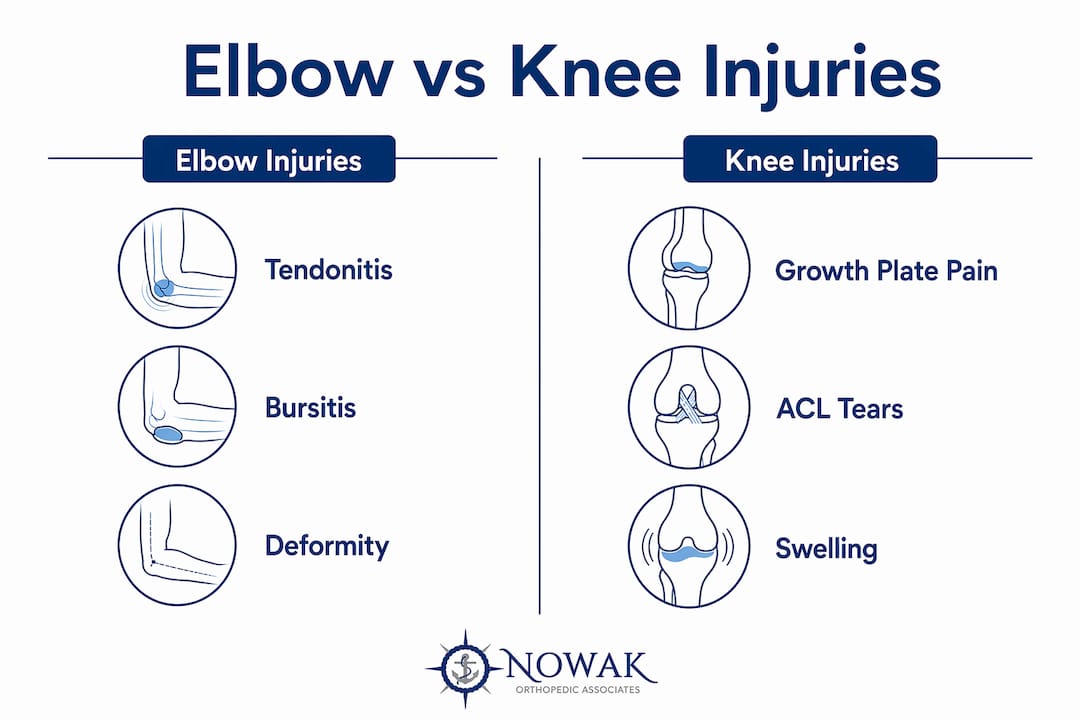
Knee pain in children is not simply “growing pains.” ACL tears account for 50 to 60% of acute knee injuries in children, and roughly 80% of acute knee injuries with swelling involve internal joint damage that requires specialist diagnosis. That statistic matters because swelling after a knee injury is a reliable indicator of serious internal damage, not a symptom to wait out at home.
Key knee injury symptoms in kids that warrant attention include:
- A popping sound or sensation at the moment of injury
- Rapid swelling within the first few hours after activity
- Inability to bear weight or significant limping after play
- Instability or a “giving way” feeling when walking or pivoting
- Persistent pain below the kneecap, which is the hallmark of Osgood-Schlatter disease
Osgood-Schlatter disease and Sever’s disease are growth plate irritations common in youth sports, particularly during growth spurts. Pain causing a limp, changes in running technique, or nighttime pain are key signs of these growth plate syndromes that need prompt attention. Left unaddressed, they can worsen significantly over a single sports season.
About 70% of ACL injuries are non-contact events triggered by sudden stops, pivots, or awkward landings rather than collisions. This means your child does not need to take a hit to sustain a serious knee injury. Muscle guarding during physical exams can also mask injury severity, making MRI the most reliable diagnostic tool for pediatric knee injuries when serious damage is suspected.
How to tell the difference between minor discomfort and serious injury
Parents frequently underestimate injuries when swelling is absent or when a child continues to move the joint. Pain without swelling can still indicate a fracture or ligament tear, particularly in the elbow where growth plate injuries may not produce visible swelling.
| Symptom | Mild or Minor | Serious: Seek Care Now |
|---|---|---|
| Elbow pain | Soreness after activity, resolves with rest | Deformity, numbness, fever, inability to straighten arm |
| Knee swelling | Minor puffiness, improves overnight | Rapid swelling within hours, warm to the touch |
| Weight bearing | Slight limp that resolves quickly | Cannot bear weight at all |
| Range of motion | Mild stiffness, full motion returns | Locked joint, significant loss of movement |
| Duration | Improves within 48 to 72 hours | Persists or worsens after 3 days of rest |
For minor injuries, the RICE protocol (Rest, Ice, Compression, Elevation) is the recommended first response for mild knee injuries, and the same approach applies to mild elbow complaints. Growth plate fractures and severe injuries require orthopedic assessment for proper management, so do not rely on RICE alone if symptoms persist beyond three days or worsen.
Pro Tip: Take a short video of your child moving the injured joint before the appointment. Orthopedic specialists find this footage useful because children often guard the joint differently in a clinical setting, which can make the injury appear less severe than it is.
Preventing knee and elbow injuries in active kids
Preventing knee injuries in kids and reducing elbow injury risk starts well before the first practice of the season. Follow these steps to build a protective foundation:
- Prioritize proper warm-up and cool-down. Dynamic stretching before activity and static stretching after reduces muscle tightness that places excess load on joints.
- Limit single-sport specialization. Early specialization before age 12 increases overuse injury rates. Cross-training with different sports builds balanced muscle strength and reduces repetitive stress on any single joint.
- Monitor pitch counts and throwing volume. For baseball and softball players, following established pitch count guidelines from organizations like USA Baseball directly reduces Little League Elbow risk.
- Watch behavior, not just pain reports. Children often downplay pain to stay active, so observe limping, technique changes, and reluctance to participate as early warning signals.
- Schedule rest weeks. Overuse injuries have variable recovery timelines, with moderate injuries requiring 6 to 12 weeks of rehabilitation. Building planned rest into a training calendar prevents injuries from reaching that severity.
- Consult a pediatric orthopedic specialist early. When symptoms persist beyond a week or recur across multiple seasons, a specialist evaluation identifies underlying structural issues before they become chronic problems.
Physical therapy plays a central role in both prevention and recovery. A licensed physical therapist can correct biomechanical issues in throwing mechanics or landing patterns that silently load joints beyond their tolerance. Mental health support also matters. Young athletes who fear re-injury often alter their movement patterns in ways that create new injury risks, and addressing that fear directly supports a safer return to sport.
Key takeaways
Early recognition of elbow and knee injury warning signs in active children prevents minor overuse conditions from becoming structural damage that requires surgery or extended time off.
| Point | Details |
|---|---|
| Growth plates change everything | Children’s growth plates create injury types unique to pediatric patients, requiring specialized orthopedic evaluation. |
| Swelling after knee injury is serious | About 80% of acute knee injuries with swelling involve internal damage needing specialist diagnosis. |
| Behavior reveals injury early | Watch for limping, technique changes, and nighttime pain, not just verbal complaints from your child. |
| RICE is a starting point, not a solution | Use rest, ice, compression, and elevation for mild injuries, but seek care if symptoms persist beyond 72 hours. |
| Prevention requires planned rest | Cross-training, pitch count limits, and scheduled rest weeks reduce overuse injury risk across both joints. |
What I’ve learned from treating young athletes
By Dr. Roger Nowak
The most common mistake I see parents make is waiting too long because their child “seems fine.” Children are remarkably good at adapting to pain, and that adaptation often masks the severity of what is happening in the joint. By the time a parent brings a child in because the pain became undeniable, what started as a manageable growth plate irritation has sometimes progressed to a stress fracture or a partial ligament tear.
The second thing I want parents to understand is that imaging does not always tell the full story at first glance. Muscle guarding during a physical exam can make a serious knee injury look minor, which is exactly why MRI is so valuable in pediatric cases. I have seen X-rays that looked unremarkable on a child who had a significant ACL injury. Trusting the clinical picture and the child’s history matters as much as the scan.
My honest advice: treat behavioral changes as injury signals. If your child is throwing differently, landing awkwardly, or quietly sitting out drills they used to enjoy, that is your cue to act. Early intervention consistently produces better outcomes than waiting for the pain to become impossible to ignore.
— Dr. Roger Nowak
How Nowak Orthopedic Associates can help your child recover
At Nowak Orthopedic Associates in Hampton, NH, we see young athletes with elbow and knee injuries at every stage, from early overuse complaints to complex ligament tears requiring surgical reconstruction. Our sports medicine services cover the full spectrum of pediatric orthopedic care, including physical examination, MRI-guided diagnosis, and individualized treatment plans that prioritize non-surgical options whenever appropriate. For families exploring conservative care, our non-surgical treatment options include PRP injections, SoftWave therapy, and guided stretch therapy designed to support healing without surgery. When surgery is necessary, Dr. Roger B. Nowak performs procedures including ACL reconstruction, meniscus repair, and elbow surgeries with a focus on restoring full function and a safe return to sport. Schedule your child’s first visit to get a clear diagnosis and a plan built around your child’s specific needs.
FAQ
What are the most common elbow injuries in young athletes?
Little League Elbow (medial apophysitis), tendonitis, and bursitis are the most frequent elbow injuries in children ages 8 to 15. Mild cases typically resolve with 4 to 8 weeks of rest and rehabilitation.
When should I take my child to a doctor for knee pain?
Seek evaluation immediately if your child has rapid swelling, cannot bear weight, heard a pop at the time of injury, or has a knee that feels unstable. The RICE protocol is appropriate for minor symptoms, but persistent or worsening pain requires professional assessment.
Can a child have an ACL tear without a collision?
Yes. About 70% of ACL injuries occur during non-contact movements like sudden stops, pivots, or awkward landings rather than direct hits. Parents should watch for swelling and instability after any rapid change-of-direction activity.
How do I know if elbow pain is a red flag?
Elbow injury warning signs that require urgent care include visible deformity, numbness or tingling in the hand, fever with swelling, and complete inability to move the joint. These symptoms may indicate a fracture, dislocation, or infection.
Does my child need surgery for a knee injury?
Not always. Many knee injuries in children, including Osgood-Schlatter disease and mild ligament sprains, respond well to rest, physical therapy, and activity modification. ACL tears and certain meniscus injuries may require surgical intervention, which a specialist evaluation can determine accurately.