

TL;DR:
- Golf elbow, caused by tendon degeneration from repetitive strain, is common among amateur golfers and worsened by poor swing mechanics and equipment issues. Key risk factors include age, high practice volume, and weak kinetic chain muscles, which can be mitigated through proper conditioning and technique correction. Early intervention with technique adjustments, eccentric strengthening, and equipment fitting significantly reduces injury recurrence and accelerates recovery.
Medial epicondylitis, commonly called golfer’s elbow, is the leading cause of elbow pain during golf, defined by tendon degeneration at the inner bony prominence of the elbow where forearm flexor muscles attach. Elbow injuries affect about 33% of amateur golfers, making it one of the most common golf injuries affecting recreational players. The causes of elbow injuries when golfing center on three overlapping factors: repetitive strain from high swing volume, flawed mechanics that overload forearm tendons, and inadequate conditioning of the muscles that support the entire arm. Understanding these causes is your first step toward staying on the course without pain.
What mechanical errors in golf swings lead to elbow injuries?
Swing mechanics are the single largest contributor to golf elbow injury causes among amateur players. Two errors stand out above all others: casting and wrist flipping. Casting and wrist flipping during impact create an eccentric overload on the forearm flexor tendons, meaning the tendons are forced to lengthen under tension. Repeated microtears from this pattern accumulate faster than the tendon can repair itself, eventually producing the chronic pain and stiffness that define medial epicondylitis.

Grip pressure compounds the problem significantly. A tight grip causes constant high tendon load, and many golfers instinctively squeeze harder when they feel they are losing control of the shot. That response makes the underlying tendon stress worse, not better. Abrupt deceleration at the end of the swing adds another stress spike, particularly when the lead wrist breaks down through impact instead of staying firm.
Fatigue plays a role that most golfers underestimate. As forearm muscles tire over a long round or a heavy practice session, the body recruits compensatory movement patterns that place even greater demand on the tendons. The result is that the final holes of a round or the last bucket of range balls carry a disproportionately high injury risk.
Key swing errors that drive elbow strain from golfing:
- Casting: releasing the club too early in the downswing, forcing the wrist into rapid extension under load
- Wrist flipping: scooping through impact to add loft, creating a sudden eccentric jerk on flexor tendons
- Excessive grip pressure: sustained tension above a moderate level that fatigues forearm muscles prematurely
- Abrupt deceleration: stopping the swing sharply after impact rather than following through smoothly
- Collapsed lead wrist: losing wrist extension at impact, shifting stress directly to the medial elbow
Pro Tip: Rate your grip pressure on a scale of 1 to 10 before every swing. A 4 to 5 is the target. If you are consistently above 6, your tendons are absorbing load that your technique should be managing instead.
Which golfer risk factors are associated with higher elbow injury rates?
Not every golfer carries the same risk. Golfers aged 40 or older, those performing over 2 hours of repetitive wrist and finger motions daily, and individuals with a high body mass index face a measurably elevated risk of medial epicondylitis. Age reduces tendon resilience because collagen turnover slows, meaning tendons take longer to recover from each loading session. High body mass index increases the compressive and tensile forces transmitted through the elbow on every swing.
Amateur golfers sustain elbow injuries mainly from technical errors, which means beginners and intermediate players face a double disadvantage: their mechanics are less refined and their tendons have not been conditioned to handle high swing volumes. The following risk factors are ranked by clinical frequency:
- Age 40 or older with reduced tendon collagen density and slower tissue repair
- Daily practice volume exceeding two hours of repetitive wrist and forearm motion
- High body mass index amplifying mechanical load through the elbow joint
- Beginner or intermediate skill level where swing faults are more frequent and more forceful
- Inadequate warm-up before play, leaving tendons stiff and less tolerant of sudden loading
Skipping a warm-up is one of the most correctable risk factors on this list. A 10-minute pre-round warm-up targeting the forearm, shoulder, and thoracic spine increases tissue temperature and prepares tendons for the demands of a full swing before the first tee shot.
How does conditioning and the kinetic chain affect elbow injury risk?
The kinetic chain in golf runs from the ground through the hips, torso, shoulder, and finally the forearm and wrist. When any link in that chain is weak, the links below it absorb extra load. Shoulder and scapular muscle weakness causes forearm muscles to compensate, shifting stress onto the inner elbow tendons with every swing. This is why many golfers develop medial epicondylitis despite having what appears to be a reasonable swing. The problem originates higher up the chain.
Strengthening the kinetic chain starting with shoulder stabilizers reduces forearm overload and accelerates recovery from existing tendon irritation. Forearm and grip strength also matter directly. Tendons adapt to load over time, but only when that load is applied progressively. Golfers who jump back into full practice after a rest period without rebuilding tendon capacity are the most likely to experience a flare.
Effective conditioning targets for golfers:
- Scapular stabilization exercises: rows, face pulls, and band pull-aparts to support the shoulder during the swing
- Rotator cuff strengthening: external rotation work to control the lead arm through impact
- Forearm eccentric loading: wrist flexion and extension with slow lowering phases to build tendon capacity
- Hip and core stability: deadlifts and Pallof presses to generate power from the ground up, reducing arm-dominant swings
- Grip endurance training: farmer carries and towel hangs to build sustained forearm tolerance
Pro Tip: If your forearm feels fatigued before the back nine, your shoulder and core are not doing their share of the work. Address proximal weakness first, and forearm endurance will follow.
What equipment factors contribute to elbow injuries when golfing?
Equipment is an underappreciated cause of elbow strain from golfing. Improper equipment, including old clubs with worn grips or incorrect grip size, forces golfers to grip harder to maintain club control, which directly increases tendon load. A grip that is too thin causes the fingers to wrap tightly around the handle, activating the forearm flexors at a high level throughout the swing. A grip that is too thick limits wrist hinge and alters swing mechanics.
| Equipment factor | Effect on elbow | Recommended fix |
|---|---|---|
| Worn or slick grips | Forces higher grip pressure to prevent slipping | Replace grips annually or every 40 rounds |
| Grip diameter too small | Increases finger flexor activation and tendon load | Fit grip size to hand measurement with a club fitter |
| Stiff shaft flex | Transmits more shock through the hands at impact | Match shaft flex to swing speed with a fitting session |
| Heavy club head | Amplifies eccentric load at the wrist and elbow | Use appropriate club weight for your strength level |
Shaft stiffness deserves particular attention. A shaft that is too stiff for your swing speed transfers vibration directly into the hands and forearm at impact rather than absorbing it through flex. A professional club fitting session at a facility like a PGA Tour Superstore or a certified club fitter addresses grip size, shaft flex, and club weight simultaneously, often resolving equipment-related elbow pain without any other intervention.
What prevention strategies reduce the risk of elbow injuries for golfers?
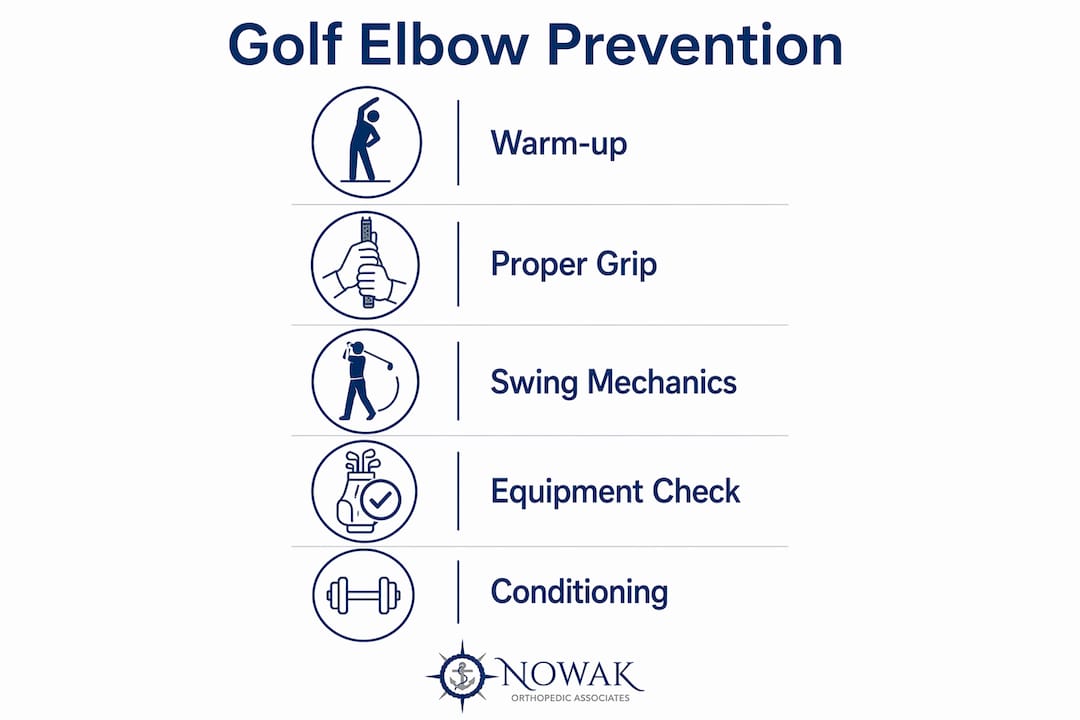
Preventing elbow injuries in golf requires consistent attention to four areas: technique, conditioning, equipment, and load management. Progressive forearm strengthening combined with proper swing adjustments reduces recurrence and promotes tendon healing more effectively than rest alone. The following steps form a practical prevention framework:
- Warm up for at least 10 minutes before every round, including golf stretching for the forearm, shoulder, and thoracic spine
- Maintain grip pressure at 4 to 5 out of 10 throughout the swing
- Perform eccentric forearm strengthening three times per week, keeping load under 30% of maximum capacity during early conditioning phases
- Limit practice sessions to manageable volumes and avoid rapid increases after rest periods
- Have clubs fitted professionally to confirm grip size and shaft flex match your hand size and swing speed
- Address swing faults, particularly casting and wrist flipping, with a qualified PGA instructor
- Follow a pain-free transition protocol before returning to full play after any elbow flare
Excessive practice volume after rest periods is a top trigger for acute flare-ups, so gradual return is not optional. Medical experts caution that returning to golf too quickly without a pain-free transition period perpetuates the rest-flare-repeat cycle that keeps many golfers sidelined for months.
Key takeaways
The most effective way to prevent elbow injuries when golfing is to address swing mechanics, build kinetic chain strength, and manage practice volume before pain begins.
| Point | Details |
|---|---|
| Swing mechanics are the primary cause | Casting, wrist flipping, and high grip pressure overload forearm tendons on every swing. |
| Risk increases with age and volume | Golfers over 40 practicing more than two hours daily face the highest injury rates. |
| Kinetic chain weakness amplifies forearm load | Shoulder and scapular weakness forces the forearm to compensate, accelerating tendon breakdown. |
| Equipment fit matters | Worn grips and mismatched shaft flex increase grip pressure and shock transmission to the elbow. |
| Progressive loading beats rest alone | Eccentric strengthening combined with technique correction reduces recurrence more effectively than stopping play. |
What I have learned treating golfers with elbow pain
I have treated hundreds of golfers with medial epicondylitis over the years, and the pattern is remarkably consistent. Most of them rested, felt better, went back to the range at full volume, and were back in my office within six weeks. Rest reduces pain, but it does not rebuild tendon capacity. That distinction is the most important thing I can share with any golfer reading this.
The second thing I have noticed is that the golfers who recover fastest are not necessarily the ones with the mildest injuries. They are the ones who commit to elbow injury rehab that includes progressive loading and who fix the swing fault that caused the problem in the first place. A stronger kinetic chain genuinely changes outcomes. I have seen patients who had struggled with recurring flares for two years become pain-free within three months once they addressed shoulder stability and reduced grip pressure.
My honest advice: do not wait until the pain is severe. Mild medial elbow tenderness after a round is a signal worth acting on. Adjust your grip, reduce your volume, and start a forearm conditioning program. If the pain persists beyond two to three weeks despite those changes, come in for an evaluation. Early intervention almost always means a shorter, simpler treatment path.
— Dr. Roger Nowak
Elbow care at Nowak Orthopedic Associates
If elbow pain is affecting your game or your daily life, Nowak Orthopedic Associates in Hampton, NH offers individualized care from diagnosis through recovery. Dr. Roger B. Nowak provides a full range of elbow treatments and surgical options, from conservative physical therapy and PRP injections to medial epicondylectomy for cases that do not respond to non-surgical care. The practice’s Regenerative Medicine Clinic also offers SoftWave therapy and orthobiologic treatments designed to stimulate tendon healing without surgery. For golfers who want to understand all available options, our guide to advanced joint care explains what to expect from your first consultation through your return to play.
FAQ
What is golfer’s elbow and how is it different from tennis elbow?
Golfer’s elbow, or medial epicondylitis, affects the tendons on the inner side of the elbow, while tennis elbow (lateral epicondylitis) affects the outer side. Both involve tendon degeneration from repetitive overload, but golfer’s elbow is driven by wrist flexion and grip forces common in the golf swing.
Why does my elbow hurt only after golfing, not during?
Tendon pain often appears hours after activity because inflammation and micro-damage accumulate during loading and peak during the recovery phase. This delayed onset is a sign that your tendon capacity is being exceeded during play, even if the swing feels comfortable in the moment.
Can I keep playing golf with golfer’s elbow?
Continuing to play through significant pain accelerates tendon degeneration and extends recovery time. A short period of modified activity combined with progressive strengthening and technique correction is more effective than playing through pain and hoping it resolves on its own.
How long does golfer’s elbow take to heal?
With consistent eccentric strengthening, technique adjustment, and appropriate load management, most golfers see meaningful improvement within 6 to 12 weeks. Cases involving significant tendon degeneration or repeated flare cycles may require 3 to 6 months of structured rehabilitation.
When should I see a doctor for elbow pain from golf?
Seek evaluation if elbow pain persists beyond two to three weeks despite rest and self-care, if pain is present at rest or at night, or if grip strength has noticeably decreased. These signs suggest tendon damage that benefits from professional diagnosis and a structured treatment plan rather than continued self-management.