

TL;DR:
- Orthopedic treatment helps golfers improve swing mechanics by addressing physical limitations and preventing injury. A golf-specific evaluation identifies mobility deficits that cause swing faults and risk of overuse injuries. Structured rehabilitation focusing on mobility, stability, and strength enhances performance and reduces pain, enabling safer and more effective play.
Orthopedic treatment for golfers is the clinical practice of identifying and correcting the physical limitations that degrade swing mechanics and cause pain. To improve your golf swing through orthopedic treatments, you need more than swing lessons. You need a body that can actually execute the movement. Over 50% of golfers will sustain a musculoskeletal injury during their playing years, most from overuse rather than a single traumatic event. That statistic means the average recreational golfer is one bad season away from a chronic problem. Orthopedic care for athletes addresses this directly by treating the root physical cause, not just the symptom.
How orthopedic evaluations improve your golf swing
A golf-specific orthopedic evaluation does something a standard sports physical cannot. It maps your body’s movement deficits directly to your swing faults. The Titleist Performance Institute (TPI) screening protocol is the most widely used framework for this. TPI assessments identify restrictions in hip rotation, thoracic spine mobility, and core stability that show up as swing compensations, not just technique problems.

The distinction matters. What looks like a casting fault or early extension on video is often a physical restriction, not a mental error. A golfer who cannot rotate through the hips will compensate with the lower back, loading the lumbar spine with every swing. That compensation is the injury waiting to happen.
Common physical deficits found in golf evaluations include:
- Limited hip rotation: Reduces power transfer and forces the lower back to overwork
- Thoracic stiffness: Restricts shoulder turn, flattening the swing plane
- Weak core stability: Causes loss of posture and inconsistent ball striking
- Shoulder mobility deficits: Limit backswing depth and increase rotator cuff stress
- Poor ankle dorsiflexion: Disrupts weight shift and balance through impact
Generic physical therapy clinics treat pain. A golf-specific physical assessment treats the movement pattern causing the pain. That difference in approach is why golfers who see TPI-certified specialists recover faster and return to play with measurably better mechanics.
Pro Tip: Ask your orthopedic provider specifically whether they use TPI screening or a golf biomechanics protocol. If they do not, your treatment plan may address your pain but miss the swing fault driving it.
What does a personalized golf rehab plan actually look like?
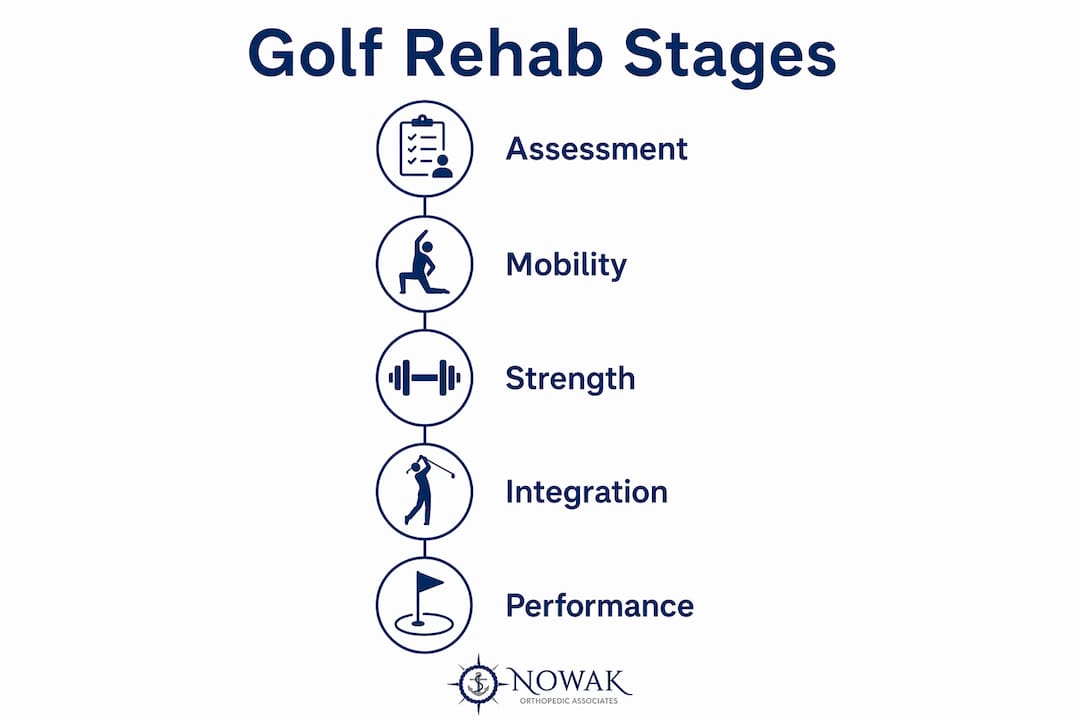
Structured rehabilitation for golf injuries follows a clear progression. Specialized golf health programs typically run 12 weeks, combining movement screening, corrective exercise, and performance coaching to increase swing speed and consistency. That timeline is not arbitrary. It reflects how long the body needs to build new movement patterns and strengthen the muscles that support them.
A well-designed plan targets the kinetic chain in sequence:
- Restore mobility first. Hip flexor stretching, thoracic rotation drills, and shoulder capsule work come before any strength training. You cannot strengthen a joint that cannot move correctly.
- Build stability. Core anti-rotation exercises like Pallof presses and single-leg balance work teach the body to transfer force without leaking energy through the spine.
- Add strength. Glute activation, rotator cuff strengthening, and forearm conditioning protect the joints most stressed by the golf swing.
- Integrate movement patterns. Medicine ball rotational throws and cable woodchops train the body to sequence power from the ground up, the same way a proper swing does.
- Transfer to the course. A dynamic warm-up of 5–15 minutes before each round reduces joint stress and primes the movement patterns built in rehab.
The result is a smoother swing with less fatigue over 18 holes, and more clubhead speed without swinging harder. Physical therapy for golfers works because it addresses the body’s capacity to perform, not just its ability to tolerate pain.
Pro Tip: Do not skip the mobility phase to get to strength work faster. Golfers who rush this step often plateau or re-injure because the underlying restriction was never fully resolved.
How to integrate orthopedic care into your golf routine
Rehabilitation for golf injuries works best when it follows a structured sequence. Here is how to build that process from the first appointment through long-term maintenance:
- Schedule a comprehensive evaluation. Start with a board-certified orthopedic specialist who understands golf biomechanics. Bring video of your swing if possible. The more context your provider has, the more precise your plan will be.
- Complete your movement screening. A TPI screen or equivalent golf-specific assessment identifies your physical deficits. This is the foundation of your entire treatment plan.
- Follow your tailored rehab program. Commit to the full 12-week framework. Partial compliance produces partial results.
- Add a pre-round warm-up protocol. The Mayo Clinic recommends dynamic movements over static stretching before play. Leg swings, torso rotations, and hip circles prepare the joints for rotational load.
- Track your progress. Reassess your movement screen at weeks 4, 8, and 12. Adjustments to your program should be based on objective data, not how you feel on a given day.
- Maintain with off-season training. Golf injuries often stem from overdoing activity too soon after a layoff. Consistent off-season strength work prevents the early-season injury spike most recreational golfers experience.
| Phase | Focus | Timeline |
|---|---|---|
| Assessment | Movement screening, deficit identification | Week 1 |
| Mobility restoration | Hip, thoracic, shoulder flexibility work | Weeks 2–4 |
| Stability and strength | Core, glute, rotator cuff conditioning | Weeks 5–9 |
| Performance integration | Rotational power, swing pattern transfer | Weeks 10–12 |
| Maintenance | Off-season training, pre-round warm-up | Ongoing |
Common mistakes golfers make when seeking orthopedic help
Most golfers who seek orthopedic care do so too late and too narrowly. These are the patterns that slow recovery and limit results.
- Treating only the painful area. Back pain in golfers almost always requires hip and thoracic mobility treatment, not just lumbar spine therapy. Isolating the symptom while ignoring the kinetic chain produces temporary relief at best.
- Choosing a general clinic over a golf-knowledgeable provider. A therapist unfamiliar with golf biomechanics will treat your shoulder like a swimmer’s shoulder. The loading patterns, ranges of motion, and performance goals are completely different.
- Waiting for severe pain before seeking care. Minor aches are early warning signs of worsening injury. Golfers who address discomfort early make smaller corrections and recover faster than those who wait for a breakdown.
- Skipping prehab entirely. Reactive care after injury costs more time and more rounds than proactive conditioning. Prehab, meaning targeted strengthening before problems develop, is the most efficient form of golf swing injury prevention available.
“The golfers who stay on the course longest are not the ones with the best technique. They are the ones who treat their bodies as part of their equipment.”
Choosing a provider with golf-specific orthopedic experience consistently produces better outcomes than general therapy. That is not an opinion. It reflects the difference between treating a movement-based sport and treating a static injury.
Key takeaways
Orthopedic treatment improves your golf swing by correcting the physical deficits that cause both swing faults and injury, making body preparation as important as technique.
| Point | Details |
|---|---|
| Start with a golf-specific evaluation | TPI screening maps physical deficits directly to swing faults for precise treatment. |
| Follow the 12-week framework | Structured rehab programs build mobility, stability, and strength in the correct sequence. |
| Warm up dynamically before every round | Five to fifteen minutes of movement prep reduces joint stress and primes swing mechanics. |
| Treat the kinetic chain, not just the pain | Back, hip, and shoulder issues are interconnected; isolating one area produces incomplete results. |
| Act early, not reactively | Addressing minor discomfort before it worsens keeps you on the course and shortens recovery time. |
What i’ve learned treating golfers over the years
The golfers who frustrate me most are the ones who spend thousands on new equipment and lessons but ignore a hip that hasn’t rotated properly in three years. I see it constantly. A player comes in with elbow pain or a sore lower back, and within the first assessment it’s clear the real problem is a thoracic spine that stopped moving freely long before the pain showed up.
What I’ve found is that restoring mobility, even modest improvements in hip rotation or shoulder flexibility, produces swing changes that no lesson can replicate. The body finds efficiency on its own when you remove the restriction. Patients often tell me their ball striking improved before they even returned to formal instruction.
My strongest recommendation is this: treat prehab as part of your training, not as something you do after you get hurt. The joint health principles that protect professional athletes apply equally to the weekend golfer. Your body is the most important piece of equipment you own.
— Dr. Roger Nowak
How nowak orthopedic associates helps golfers play better and hurt less
Nowak Orthopedic Associates in Hampton, NH offers sports medicine services designed for athletes who need more than generic care. Dr. Roger B. Nowak and the team provide golf-specific movement screenings, individualized rehabilitation programs, and a full range of orthopedic treatments covering the shoulder, elbow, knee, and hand. For golfers dealing with persistent pain or swing limitations, the practice also offers non-surgical options through its Regenerative Medicine Clinic, including PRP injections and SoftWave therapy. If you are ready to address what is actually limiting your game, start with a comprehensive orthopedic evaluation and get a treatment plan built around your body and your goals.
FAQ
What orthopedic conditions most commonly affect golfers?
Golfer’s elbow, rotator cuff tendinitis, lumbar strain, and hip impingement are the most frequent diagnoses. Most result from repetitive rotational stress rather than a single injury.
How does physical therapy for golfers differ from standard PT?
Golf-specific physical therapy uses TPI screening to connect your physical deficits to your swing mechanics, then builds corrective programs targeting the hips, thoracic spine, and rotator cuff as a connected system.
When should a golfer see an orthopedic specialist?
See a specialist at the first sign of recurring discomfort, not after pain becomes severe. Early intervention requires smaller corrections and produces faster returns to full play.
Can orthopedic care increase swing speed without more practice?
Yes. Restoring hip rotation and thoracic mobility allows the body to transfer force more efficiently through the kinetic chain, which increases clubhead speed without changing swing technique.
What non-surgical options exist for golf-related joint pain?
PRP injections, SoftWave therapy, guided stretch therapy, and targeted physical therapy are all effective non-surgical orthopedic treatments for golfers managing joint pain without surgery.