

TL;DR:
- Golfer’s elbow and tennis elbow are two distinct overuse injuries characterized by pain on the inner and outer elbows, respectively. Both conditions stem from repetitive stress, affecting specific tendons and often impacting non-athletes from occupational activities. Proper diagnosis, activity modification, and eccentric exercises typically lead to effective conservative treatment within months.
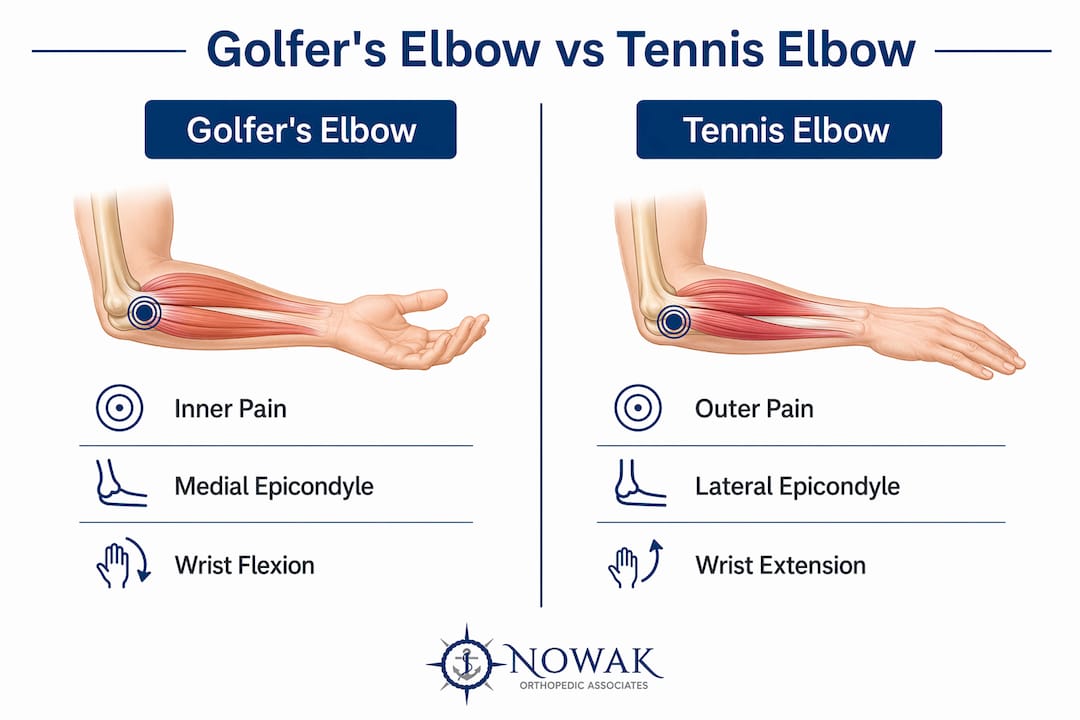
Golfer’s elbow and tennis elbow are distinct overuse injuries defined by where pain occurs and which tendons are affected. Golfer’s elbow causes inner elbow pain by involving the wrist flexors and forearm pronators, while tennis elbow causes outer elbow pain by affecting the wrist extensors. Both conditions are forms of epicondylitis, meaning tendon degeneration at the elbow’s bony attachment points. Understanding what’s the difference between golfer’s elbow and tennis elbow is the first step toward getting the right treatment and recovering faster. Neither condition requires you to play golf or tennis to develop it.
What’s the difference between golfer’s elbow and tennis elbow?
The core distinction comes down to anatomy. Golfer’s elbow, or medial epicondylitis, affects the common flexor-pronator tendon origin on the inner side of the elbow. Tennis elbow, or lateral epicondylitis, targets the extensor carpi radialis brevis (ECRB) tendon on the outer side.

Think of it this way: if you press on the bony bump on the inside of your elbow and feel pain, that points to golfer’s elbow. Pain on the outside bump points to tennis elbow. This simple location test is one of the most reliable first indicators for both patients and clinicians.
Both conditions develop from repetitive stress rather than a single traumatic event. The tendons gradually break down under repeated loading, leading to pain, weakness, and tenderness that can affect everyday tasks like gripping a coffee mug or turning a doorknob.
What are the symptoms and causes of each condition?
Golfer’s elbow symptoms and triggers
Golfer’s elbow symptoms center on the inner elbow and often extend down the forearm toward the wrist. You may also notice tingling or numbness in the ring and little fingers if the nearby ulnar nerve becomes irritated.
Common golfer’s elbow symptoms include:
- Tenderness directly over the medial epicondyle (the inner elbow bump)
- Pain that worsens with wrist flexion or forearm rotation inward
- Weakened grip strength
- Stiffness when bending the elbow
- Occasional numbness or tingling into the fourth and fifth fingers
Golfer’s elbow most frequently affects adults aged 30–50 due to repetitive wrist flexion and forearm pronation in sports and manual labor. Carpenters, plumbers, and assembly line workers are just as likely to develop it as golfers.
Tennis elbow symptoms and triggers
Tennis elbow produces pain on the outer elbow that worsens with gripping, lifting, or any activity requiring wrist extension. Shaking hands, lifting a briefcase, or even typing can aggravate it.
Common tennis elbow causes include:
- Repetitive wrist extension in racket sports, painting, or plumbing
- Prolonged computer mouse use
- Repeated gripping with the forearm in a palm-down position
- Poor technique in overhead or throwing activities
Most cases arise from everyday repetitive tasks like typing, computer mouse use, and household chores rather than from playing tennis. This is one of the most overlooked facts about both conditions.
Pro Tip: If your elbow pain gets worse when you lift a full coffee cup with your palm facing down, tennis elbow is the more likely culprit. If it hurts more when you squeeze or flex your wrist, suspect golfer’s elbow.
How do doctors diagnose and differentiate elbow pain?
Knowing how to diagnose elbow pain accurately matters because the wrong diagnosis leads to the wrong treatment. A clinical exam is usually all that’s needed to tell these two conditions apart.
Here is what a typical evaluation looks like at Nowak Orthopedic Associates:
- Patient history review. Your provider asks about your occupation, sports habits, and when the pain started. Gradual onset tied to repetitive activity is a strong indicator of epicondylitis.
- Palpation. The examiner presses directly on the medial epicondyle (inner elbow) and lateral epicondyle (outer elbow) to pinpoint tenderness.
- Resisted movement testing. Pain with resisted wrist extension indicates tennis elbow; pain with resisted wrist flexion or pronation indicates golfer’s elbow. These tests are highly specific and take only seconds.
- Grip strength assessment. Reduced grip strength on the affected side supports the diagnosis and helps gauge severity.
- Imaging when needed. X-rays rule out bone spurs or arthritis. Ultrasound or MRI may be ordered if symptoms are severe, atypical, or fail to respond to initial treatment.
Most patients leave their first visit with a clear diagnosis and a treatment plan in hand. Specialist referral to an elbow orthopedic surgeon is appropriate when conservative care has not produced improvement after several weeks.
What are the treatment options for both conditions?
First-line conservative care
The good news is that most cases resolve within 12 months with physical therapy and conservative management. Treatment for golfer’s elbow and tennis elbow follows a similar framework, adjusted for which tendon is involved.
Effective first-line steps include:
- Activity modification. Reduce or temporarily avoid the movements that provoke pain. This does not mean complete rest.
- Ice application. Apply ice for 15–20 minutes after activity to reduce local inflammation.
- Anti-inflammatory medication. Over-the-counter NSAIDs like ibuprofen or naproxen can reduce pain in the short term.
- Counterforce bracing. A forearm strap worn just below the elbow reduces stress on the tendon attachment during activity.
- Physical therapy. A structured program of stretching and progressive strengthening is the most effective long-term treatment.
The role of eccentric exercise
Complete rest may worsen symptoms by causing stiffness and weakening the tendon further. Progressive loading with eccentric exercises is the preferred approach for tendon healing. Eccentric exercises involve lengthening the muscle under load, which stimulates collagen remodeling in the damaged tendon.
Research supports low-load eccentric strengthening at roughly 30% of maximum capacity as the starting point. You gradually increase load over weeks as the tendon adapts. A physical therapist guides this progression to avoid flare-ups.
Pro Tip: Eccentric wrist curls and reverse wrist curls are the two most commonly prescribed exercises for these conditions. Ask your physical therapist to demonstrate proper form before adding resistance.
When advanced treatment is needed
Surgery is reserved for cases that fail 6–12 months of proper rehabilitation. At Nowak Orthopedic Associates, Dr. Roger B. Nowak performs lateral epicondylectomy for tennis elbow and medial epicondylectomy for golfer’s elbow when conservative care is exhausted. Non-surgical options like platelet-rich plasma (PRP) injections and SoftWave therapy are also available through the practice’s Regenerative Medicine Clinic for patients who want to explore non-surgical treatment options before considering surgery.
How can you prevent golfer’s elbow and tennis elbow?
Prevention focuses on reducing repetitive strain and building the strength that protects your tendons over time. Small changes in technique and workload make a significant difference.
Key prevention strategies include:
- Strengthen the full kinetic chain. Elbow pain often originates from weakness in the shoulder and scapular muscles, which forces the elbow to compensate. Include shoulder stabilization exercises in your routine.
- Improve technique. In racket sports, a two-handed backhand reduces lateral elbow stress. In the workplace, keep your wrist in a neutral position during repetitive tasks.
- Increase workload gradually. Sudden spikes in training volume or new repetitive tasks at work are common triggers. Follow the 10% rule: increase activity by no more than 10% per week.
- Stretch regularly. Wrist flexor and extensor stretches held for 30 seconds, performed before and after activity, maintain tendon flexibility.
- Act on early warning signs. Mild aching after activity that resolves with rest is your body’s signal to back off. Ignoring it leads to chronic tendinopathy that takes months to resolve.
You can find a detailed elbow injury rehab guide at Nowak Orthopedic Associates that walks through each phase of recovery and return to activity.
Key takeaways
The single most reliable way to distinguish golfer’s elbow from tennis elbow is pain location: inner elbow pain points to golfer’s elbow, outer elbow pain points to tennis elbow.
| Point | Details |
|---|---|
| Pain location is the key differentiator | Inner elbow pain indicates golfer’s elbow; outer elbow pain indicates tennis elbow. |
| Both conditions affect non-athletes | Most cases stem from repetitive occupational tasks, not golf or tennis specifically. |
| Eccentric exercise beats complete rest | Low-load progressive strengthening promotes tendon healing better than stopping all activity. |
| Most cases resolve conservatively | The majority of patients improve within 12 months with physical therapy and activity modification. |
| Shoulder strength matters | Weakness in the shoulder and scapular muscles frequently contributes to elbow overload and must be addressed in rehab. |
What i’ve learned treating these conditions over the years
By Dr. Roger Nowak
The biggest mistake I see patients make is waiting too long to seek care because they assume the pain will go away on its own. It sometimes does. But when it doesn’t, months of untreated tendon degeneration make recovery significantly harder.
The second mistake is assuming these conditions only affect athletes. Naming them after sports misleads patients about the real causes, and I regularly see office workers, contractors, and musicians who dismissed their symptoms for months because they “don’t play golf or tennis.”
What I have found works consistently is treating the whole arm, not just the elbow. When I evaluate a patient with medial or lateral epicondylitis, I always assess shoulder mechanics and scapular stability. Weak proximal muscles force the elbow tendons to absorb stress they were never designed to handle. Fixing the elbow without addressing the shoulder is like patching a leak without fixing the pipe.
Finally, I want to be honest about recovery timelines. These conditions take time. A stepwise return to activity with controlled tendon loading yields far better outcomes than either pushing through pain or stopping all movement. Patience, guided by a good rehab program, is the most effective tool you have.
— Dr. Roger Nowak
Get expert elbow care at nowak orthopedic associates
If elbow pain has been limiting your daily activities or keeping you off the field, Nowak Orthopedic Associates in Hampton, NH is ready to help. Dr. Roger B. Nowak and his team provide thorough clinical evaluation to accurately diagnose your condition and build a treatment plan tailored to your specific needs. Whether you need physical therapy, PRP injections through the Regenerative Medicine Clinic, or surgical intervention like a lateral or medial epicondylectomy, you receive individualized care from start to finish. Explore your sports medicine treatment options or schedule your first visit to take the first step toward lasting relief.
FAQ
What is the fastest way to tell the two conditions apart?
Press on the bony bump on the inside of your elbow for inner pain (golfer’s elbow) or the outside bump for outer pain (tennis elbow). Pain location is the primary differentiator between the two conditions.
Can you have both golfer’s elbow and tennis elbow at the same time?
Yes, though it is uncommon. Simultaneous medial and lateral epicondylitis can occur in athletes or workers who perform both wrist flexion and extension under heavy repetitive load.
How long does recovery from these conditions typically take?
Most cases of golfer’s elbow and tennis elbow resolve within 12 months with consistent physical therapy and activity modification. Surgery is considered only after 6–12 months of conservative care without adequate improvement.
Do i need imaging to confirm the diagnosis?
Not usually. A physical exam with resisted wrist movement testing is sufficient to diagnose most cases. Imaging like ultrasound or MRI is reserved for atypical presentations or cases that do not respond to initial treatment.
Is it safe to keep exercising with golfer’s or tennis elbow?
Yes, with modification. Gradual reintroduction of activity within pain tolerance is recommended over strict rest, which can cause stiffness and weaken the tendon further.