

TL;DR:
- Carpal tunnel syndrome results from median nerve compression in the wrist, causing numbness and weakness. Early symptoms include nighttime wakefulness, finger tingling, and grip weakness, often detectable with self-assessment tests. Most mild cases recover with non-surgical treatments, but persistent symptoms require professional evaluation to prevent permanent nerve damage.
Carpal tunnel syndrome is defined as compression of the median nerve as it passes through the carpal tunnel in your wrist, causing numbness, tingling, and hand weakness. It is the most common entrapment neuropathy, affecting approximately 270 per 100,000 people. That prevalence means millions of Americans experience these symptoms without knowing what is causing them. Recognizing the signs of carpal tunnel syndrome early is the difference between simple treatment and permanent nerve damage. This guide walks you through the key symptoms, self-assessment techniques, and warning signs that tell you it is time to see a specialist.
What are the common signs and symptoms of carpal tunnel syndrome?
The hallmark carpal tunnel symptoms are numbness, tingling, and burning in the thumb, index, middle, and half of the ring finger. Symptoms affect the median nerve distribution, which is why the little finger is almost never involved. If your little finger is numb, that points to a different nerve problem entirely.

Nighttime symptoms are one of the clearest early warning signs. Many patients wake up with a hand that feels asleep and shake it to get relief. Fluid shifts during sleep increase hand swelling by roughly 10%, which raises pressure inside the carpal tunnel and triggers numbness. Most patients initially blame their sleeping position, but frequent waking due to hand numbness is a major red flag for carpal tunnel syndrome.
Daytime symptoms also follow a recognizable pattern. Holding a phone, gripping a steering wheel, or typing for extended periods often triggers or worsens the tingling. As the condition progresses, grip strength weakens and patients begin dropping objects without warning.
- Numbness or tingling in the thumb, index, middle, and half of the ring finger
- Electric shock sensations that shoot into the fingers
- Nighttime hand numbness that wakes you from sleep
- Symptoms triggered by holding a phone, steering wheel, or keyboard
- Weakened grip and difficulty holding small objects
- Burning or aching that travels up the forearm
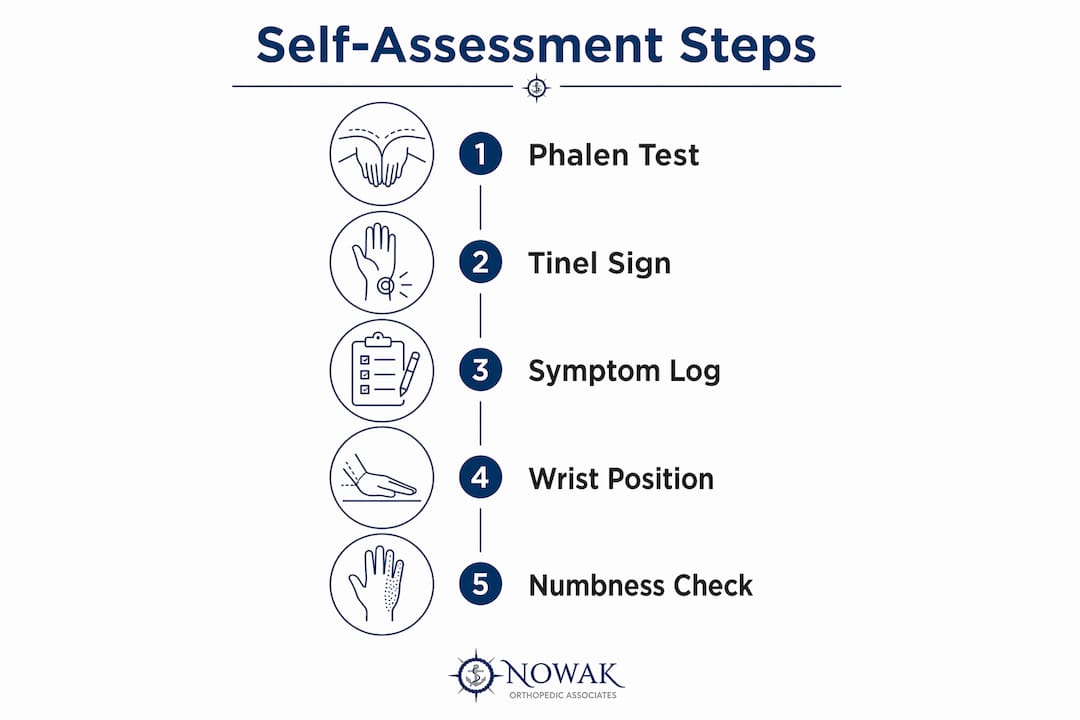
Pro Tip: Keep a simple symptom log for one week. Note which fingers go numb, what activity triggered it, and whether it happened at night. That information gives your doctor a much clearer picture than memory alone.
How can you perform simple self-assessments to detect carpal tunnel syndrome?
Two clinical tests help identify carpal tunnel syndrome before you see a doctor. The Phalen and Tinel tests are the most widely used self-assessments, and both are easy to perform at home.
- Phalen test: Press the backs of both hands together with your wrists fully bent downward. Hold that position for 60 seconds. Numbness or tingling in the median nerve fingers during this time is a positive result.
- Tinel’s sign: Tap lightly over the inside of your wrist at the base of your palm. A tingling or electric sensation that shoots into your fingers suggests median nerve irritation.
- Grip strength check: Try squeezing a rolled towel firmly. Noticeable weakness or an inability to sustain the grip points to progressing nerve involvement.
- Symptom trigger review: Note whether holding your phone for five minutes or driving with your wrists bent produces numbness. Wrist flexion is a consistent trigger in carpal tunnel syndrome.
These self-tests are useful starting points, but they are not a substitute for a clinical evaluation. The CTS-6 clinical prediction tool, recommended by the American Academy of Orthopaedic Surgeons (AAOS), scores six clinical factors to confirm a diagnosis without expensive imaging. The AAOS prefers this tool over MRI because it delivers comparable accuracy at far lower cost and discomfort to the patient.
| Self-assessment | What to do | Positive sign |
|---|---|---|
| Phalen test | Bend wrists downward, hold 60 seconds | Numbness or tingling in median nerve fingers |
| Tinel’s sign | Tap lightly over the wrist crease | Electric sensation shooting into fingers |
| Grip strength check | Squeeze a rolled towel firmly | Noticeable weakness or inability to sustain grip |
| Symptom trigger review | Hold phone or grip steering wheel for 5 minutes | Numbness or tingling in thumb, index, or middle finger |
Pro Tip: Perform the Phalen test first thing in the morning when your hands are most likely to be symptomatic. A positive result at that time carries more diagnostic weight.
What conditions can mimic carpal tunnel syndrome?
Several conditions produce hand and wrist symptoms that look like carpal tunnel syndrome but require different treatment. Knowing the differences helps you describe your symptoms accurately to your doctor.
Arthritis pain differs from carpal tunnel symptoms in a key way. Arthritis pain is activity related and centers on the joints themselves. Carpal tunnel syndrome produces numbness and tingling in specific fingers, not joint tenderness or swelling at the knuckles.
Cervical radiculopathy, which is a pinched nerve in the neck, can also send pain and tingling down the arm into the hand. The critical difference is that cervical radiculopathy involves neck pain and symptoms that radiate from the shoulder downward. Carpal tunnel syndrome does not cause neck or head pain.
- Arthritis: Joint pain and stiffness worsened by activity; no finger-specific numbness pattern
- Cervical radiculopathy: Neck pain with arm radiation; symptoms often involve the entire hand or follow a different finger pattern
- Cubital tunnel syndrome: Numbness in the ring and little finger caused by ulnar nerve compression at the elbow, not the wrist
- Peripheral neuropathy: Numbness in both hands and feet simultaneously, often linked to diabetes or vitamin deficiency
The single most reliable distinguishing feature of carpal tunnel syndrome is that the little finger is spared. If your little finger is involved, the median nerve is not the source of your problem.
When should you seek professional evaluation?
Persistent or worsening symptoms are the clearest signal that self-care is not enough. Carpal tunnel syndrome does not resolve on its own in moderate or severe cases, and untreated nerve compression can cause permanent muscle and sensory loss in the hand.
Seek a professional evaluation if you experience any of the following:
- Nighttime numbness that wakes you more than twice per week
- Hand weakness that causes you to drop objects regularly
- Symptoms that have lasted more than two months without improvement
- Numbness that is now constant rather than intermittent
- Visible muscle wasting at the base of the thumb
“Nerve damage from untreated carpal tunnel syndrome can become permanent. Early evaluation gives you the most treatment options and the best chance of full recovery.”
When you do see a specialist, the diagnostic process typically starts with a clinical interview and physical exam. Hand surgeons rely heavily on symptom triggers, such as numbness while holding a phone, to make a diagnosis without electrodiagnostic tests in many cases. When confirmation is needed, nerve conduction studies demonstrate about 88% accuracy in diagnosing carpal tunnel syndrome, with specialized inching techniques improving sensitivity to 92.5%.
What are the initial nonsurgical options for carpal tunnel syndrome?
Most patients with mild to moderate symptoms do not need surgery right away. Up to two-thirds of patients with mild, classic carpal tunnel symptoms improve with nonsurgical treatment, making conservative care the recommended first step.
Practical first steps include:
- Wrist splints: Wearing a neutral-position wrist splint at night prevents the wrist from bending during sleep, which reduces pressure on the median nerve and relieves nighttime symptoms.
- Activity modification: Reducing repetitive wrist flexion and taking regular breaks from keyboard or grip-heavy tasks lowers daily nerve irritation.
- Ergonomic adjustments: Raising your keyboard, using a padded wrist rest, or switching to a vertical mouse keeps your wrist in a neutral position during work.
- Anti-inflammatory measures: Reducing swelling through ice application or oral anti-inflammatory medications can ease pressure inside the carpal tunnel.
- Physical therapy: Targeted nerve gliding exercises help the median nerve move freely through the tunnel and reduce adhesion-related symptoms.
Patients should avoid skipping clinical follow-up in favor of self-managing indefinitely. If symptoms do not improve within 6–8 weeks of conservative care, a specialist evaluation for non-surgical orthopedic treatments or surgical options is the appropriate next step. Carpal tunnel release surgery is one of the most effective and commonly performed hand procedures, with high success rates when performed at the right stage.
Key takeaways
Carpal tunnel syndrome is identified by numbness and tingling in the thumb, index, middle, and ring fingers, nighttime waking, and grip weakness, all caused by median nerve compression in the wrist.
| Point | Details |
|---|---|
| Finger pattern is diagnostic | Numbness in the thumb, index, middle, and half the ring finger confirms median nerve involvement. |
| Nighttime waking is a red flag | Frequent hand numbness during sleep is an early and reliable warning sign of carpal tunnel syndrome. |
| Self-tests provide early clues | The Phalen and Tinel tests can be performed at home to detect median nerve irritation before a clinical visit. |
| Little finger involvement rules out CTS | If the little finger is numb, the cause is a different nerve, not carpal tunnel syndrome. |
| Most mild cases improve without surgery | Up to two-thirds of mild carpal tunnel cases respond to splinting, activity modification, and conservative care. |
What I have learned from years of treating carpal tunnel syndrome
The most common mistake I see is patients waiting too long. By the time they come in, the numbness is constant, the grip is noticeably weak, and the window for the simplest treatments has narrowed. That is frustrating for everyone, because carpal tunnel syndrome caught early responds very well to conservative care.
The second most common mistake is misattributing symptoms to sleeping position. I hear this almost every week. A patient wakes up with a numb hand, adjusts how they sleep, and assumes the problem is solved. But when it keeps happening, that is the median nerve telling you something is wrong inside the carpal tunnel. Listening to that signal early is what separates a quick recovery from a longer one.
My advice is straightforward. If your fingers are going numb at night more than once or twice a week, or if you are dropping things you used to hold easily, get evaluated. A clinical exam and the CTS-6 prediction tool give us most of what we need to make a confident diagnosis without expensive tests. From there, we build a plan that fits your life, whether that is a splint and some activity changes or a hand surgery procedure when conservative care has run its course. Do not wait until the damage is harder to reverse.
— Dr. Roger Nowak
Carpal tunnel care at Nowak Orthopedic Associates
Nowak Orthopedic Associates in Hampton, NH evaluates and treats carpal tunnel syndrome using a clinical-first approach that avoids unnecessary and costly testing. Dr. Roger B. Nowak uses the CTS-6 prediction tool and a thorough physical exam to reach an accurate diagnosis efficiently. Treatment options range from wrist splinting and activity modification to carpal tunnel release surgery for patients who need it. Every patient receives a plan matched to the severity of their symptoms and their personal goals. To get a clear answer about what is causing your hand and wrist symptoms, schedule your first visit with Nowak Orthopedic Associates and take the first step toward relief.
FAQ
What are the first signs of carpal tunnel syndrome?
The first signs are numbness and tingling in the thumb, index, and middle fingers, often occurring at night. Frequent waking due to hand numbness is one of the earliest and most reliable indicators.
Does carpal tunnel syndrome affect the little finger?
No. Carpal tunnel syndrome affects the median nerve, which does not supply the little finger. Numbness in the little finger points to ulnar nerve compression or another condition.
Can I diagnose carpal tunnel syndrome at home?
You can perform the Phalen and Tinel tests at home to identify possible median nerve irritation, but a professional evaluation is needed for a confirmed diagnosis and treatment plan.
How is carpal tunnel syndrome diagnosed by a doctor?
Doctors use clinical history, the CTS-6 prediction tool, and physical exam findings to diagnose most cases. Nerve conduction studies are added when the diagnosis is uncertain or symptoms are severe.
Will carpal tunnel syndrome go away without treatment?
Mild cases can improve with splinting and activity changes, and up to two-thirds of mild cases respond to nonsurgical care. Moderate to severe cases typically require professional treatment to prevent permanent nerve damage.