

TL;DR:
- Recovery time for sprains and strains varies with injury severity, from one week for mild cases to several months for full ligament ruptures. Personal factors such as age, smoking, nutrition, sleep, and rehabilitation adherence significantly influence healing duration and outcome. Following a structured rehab program and avoiding common mistakes can speed recovery and prevent chronic issues.
Sprain and strain recovery time is defined by injury severity, ranging from one week for mild cases to several months for complete ligament ruptures. A sprain affects ligaments connecting bones at a joint, while a strain involves muscles or tendons. Both injuries follow a graded classification system that directly predicts how long healing takes. Understanding where your injury falls on that scale is the most reliable way to set realistic expectations and build a rehabilitation plan that actually works.
How long does recovery really take after a sprain or strain?
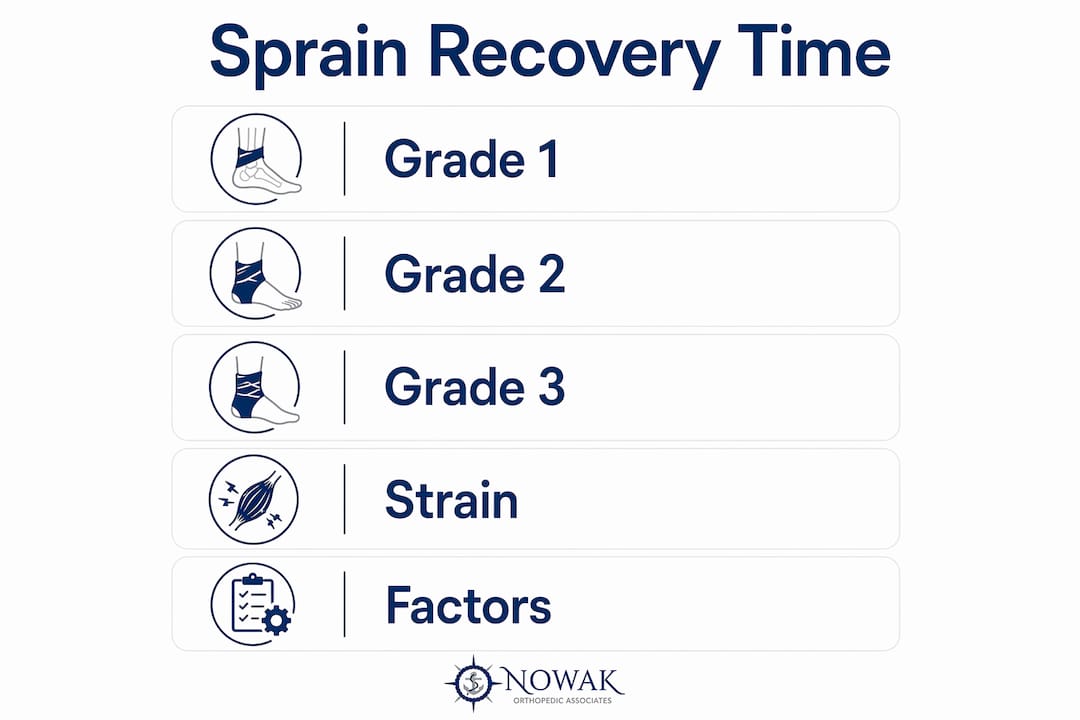
Recovery duration depends first on the grade of injury. Ankle sprain recovery follows a clear pattern: Grade 1 injuries, which involve mild ligament stretching, heal in 1–3 weeks. Grade 2 injuries, involving a partial tear, take 3–6 weeks. Grade 3 injuries, meaning a complete rupture, require 3 or more months and sometimes surgical repair. These timelines apply broadly across ankle, knee, and wrist sprains, not just the ankle.
Strains often resolve in 1–6 weeks because muscle and tendon tissue receives a richer blood supply than ligaments. Better circulation means faster nutrient delivery and quicker cellular repair. Sprains, by contrast, involve ligaments with limited blood flow, which is why they tend to heal more slowly and require more deliberate rehabilitation.
The table below shows typical recovery windows by injury grade:
| Injury grade | Tissue involved | Typical recovery time |
|---|---|---|
| Grade 1 (mild) | Minor ligament stretch | 1–3 weeks |
| Grade 2 (moderate) | Partial ligament or muscle tear | 3–6 weeks |
| Grade 3 (severe) | Complete rupture | 3+ months, possible surgery |
| Mild strain | Muscle or tendon overstretching | 1–3 weeks |
| Moderate strain | Partial muscle or tendon tear | 3–6 weeks |
Pro Tip: Do not use pain level alone to judge your grade. A Grade 3 rupture sometimes causes less immediate pain than a Grade 2 partial tear because the nerve fibers are fully disrupted. Get a clinical evaluation if swelling and instability are present.
What personal factors affect how long healing takes?
Injury grade sets the baseline, but your individual health profile determines whether you hit the short or long end of that range. Several factors consistently accelerate or delay the sprain healing process:
- Age. Tissue regeneration slows with age. Older patients typically need more time at each grade compared to younger patients with the same injury.
- Smoking. Smoking can double or triple healing time for soft tissue injuries by reducing circulation and oxygen delivery to damaged tissue. This is one of the most underappreciated delays in recovery.
- Nutrition. Protein supports tissue rebuilding. Vitamins C and D play direct roles in collagen synthesis and immune regulation. Poor dietary intake extends the inflammatory phase of healing.
- Sleep. Poor sleep reduces growth hormone output, and growth hormone is the primary driver of ligament and tendon repair during the night. Patients who sleep fewer than seven hours consistently show slower tissue recovery.
- Rehabilitation adherence. Patients who skip prescribed exercises or return to activity too soon routinely extend their recovery by weeks. Consistency with a structured rehab plan is the single most controllable factor in your timeline.
Addressing these factors is not optional if you want to reach the short end of your recovery window. Each one compounds the others.
What rehabilitation strategies speed up safe recovery?
Modern orthopedic rehabilitation has moved away from the traditional RICE protocol (Rest, Ice, Compression, Elevation) toward the PEACE & LOVE protocol, which prioritizes early controlled loading and a positive recovery mindset. The shift reflects strong evidence that passive rest alone slows healing and increases the risk of chronic stiffness.
A structured rehabilitation progression for sprains and strains typically follows these steps:
- Protect and offload (days 1–3). Limit movement that causes sharp pain. Use compression and elevation to manage swelling. Avoid complete immobilization.
- Gentle range of motion (days 3–7). Begin pain-free ankle circles, wrist rotations, or knee bends depending on the injury site. Movement stimulates circulation and prevents joint stiffness.
- Progressive loading (weeks 1–4). Introduce body weight exercises such as single-leg stands, resistance band work, and light walking. Controlled stress on healing tissue promotes collagen alignment.
- Neuromuscular training (weeks 3–8). Restoring neuromuscular control prevents recurrent sprains even after pain resolves. Balance board exercises, single-leg squats, and proprioception drills rebuild the joint’s ability to respond to sudden movement.
- Sport-specific or activity-specific loading (weeks 6+). Gradually reintroduce the movements required for your sport or daily activities. Clearance should be based on functional tests, not just pain status.
For patients interested in complementary approaches, light therapy for joint injuries has shown promise in reducing inflammation and supporting tissue repair alongside standard rehabilitation.
Pro Tip: Proprioception, your joint’s ability to sense its own position, is the last thing to return after a sprain. Skipping balance training is the most common reason patients re-injure the same joint within a year.
What mistakes delay recovery from sprains and strains?
Several common errors consistently extend strain recovery duration and turn manageable injuries into chronic problems:
- Mistaking reduced pain for full healing. Pain often decreases before tissue strength fully returns. Returning to high-impact activity at this stage is the leading cause of reinjury and chronic joint instability.
- Relying on rest alone. Rest controls initial swelling, but excessive immobilization causes muscle atrophy, joint stiffness, and can turn a reversible injury into a long-term problem.
- Overusing ice. Ice is appropriate in the first 24–48 hours to limit swelling. Using it beyond that window can suppress the inflammatory response your body needs to begin tissue repair.
- Skipping gradual movement. Avoiding all movement leads to scar tissue forming in disorganized patterns, reducing long-term joint flexibility and strength.
- Ignoring persistent symptoms. If pain, swelling, or instability continues beyond the expected timeline for your grade, a clinical evaluation is necessary. Some Grade 3 injuries and complex cases require imaging or surgical consultation to avoid permanent joint damage.
Recognizing these errors early gives you the best chance of a full recovery within the expected window.
Key Takeaways
Full recovery from a sprain or strain requires matching your rehabilitation intensity to your injury grade, addressing personal health factors, and restoring functional stability before returning to activity.
| Point | Details |
|---|---|
| Grade determines timeline | Grade 1 heals in 1–3 weeks; Grade 2 takes 3–6 weeks; Grade 3 needs 3+ months. |
| Strains heal faster | Better blood supply in muscle tissue means strains typically resolve in 1–6 weeks. |
| Lifestyle factors matter | Smoking, poor sleep, and poor nutrition can significantly extend your recovery window. |
| PEACE & LOVE over RICE | Early controlled loading outperforms passive rest for faster, more complete healing. |
| Pain is not the finish line | Functional stability and neuromuscular control must be restored before returning to full activity. |
What I have learned about sprain recovery after years in orthopedic practice
The pattern I see most often is patients who feel better at week two and assume they are done. They stop their exercises, return to the gym or the field, and come back to my office six weeks later with the same joint, now chronically unstable. The tissue was not healed. The pain was simply gone.
What I tell every patient is this: pain is a lagging indicator. Ligament and tendon strength return on a biological timeline that does not care how good you feel on a Tuesday morning. Functional stability, measured through proprioception tests and single-leg loading, is the only reliable marker for return to activity.
The other thing I have observed is that patients who come in early, get an accurate grade, and follow a structured plan consistently recover faster than those who wait and self-manage. A personalized rehabilitation plan is not a luxury. It is the difference between a six-week recovery and a six-month one. If your symptoms are not improving on schedule, do not wait it out. Get evaluated.
— Dr. Roger Nowak
Orthopedic care for sprains and strains at Nowak Orthopedic Associates
When recovery stalls or symptoms persist beyond expected timelines, professional evaluation makes a real difference. Nowak Orthopedic Associates in Hampton, NH provides accurate injury grading, individualized rehabilitation plans, and access to advanced joint care for patients with sprains, strains, and related soft tissue injuries. Treatment options range from physical therapy and targeted injections to platelet-rich plasma (PRP) and SoftWave therapy through the practice’s Regenerative Medicine Clinic. For patients whose injuries require surgical intervention, Dr. Roger B. Nowak offers minimally invasive arthroscopic procedures for the shoulder, knee, elbow, and hand. You can also review non-surgical treatment options to understand what conservative care looks like before committing to any path.
FAQ
How long does a Grade 1 sprain take to heal?
A Grade 1 sprain, involving mild ligament stretching without tearing, typically heals in 1–3 weeks with proper rest, compression, and early gentle movement.
Is a strain faster to recover from than a sprain?
Yes. Strains generally resolve in 1–6 weeks because muscle and tendon tissue has a richer blood supply than ligaments, which speeds nutrient delivery and cellular repair.
When can I return to sports after a sprain?
Return to sport is appropriate when functional stability is restored, not just when pain subsides. Proprioception tests and single-leg loading assessments are more reliable markers than pain level alone.
Does smoking really slow down sprain recovery?
Smoking can double or triple soft tissue healing time by impairing circulation and reducing oxygen delivery to the injured area. Quitting or reducing smoking during recovery has a measurable positive effect on healing speed.
When should I see a doctor for a sprain or strain?
Seek evaluation if swelling, instability, or pain persists beyond the expected timeline for your injury grade, or if you cannot bear weight on the affected joint. Grade 3 injuries often require imaging and may need surgical repair.